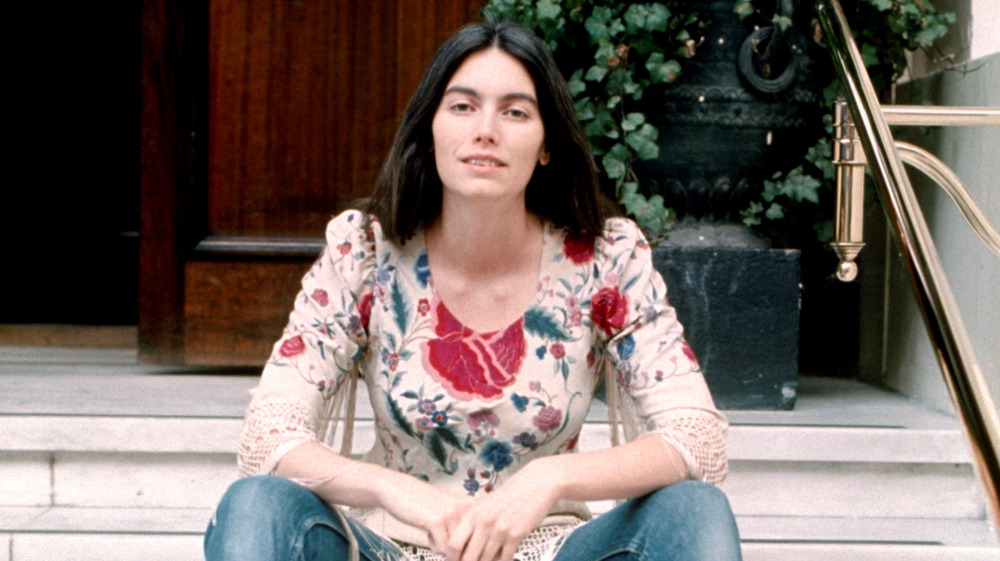
On Love Hurts from Gram Parsons’ 1974 album Grievous Angel, Emmylou Harris was not just singing beside him. She was quietly stepping into the country-rock future that would soon become her own.
When Grievous Angel arrived in January 1974, it came wrapped in an ache that listeners could feel immediately. Gram Parsons had already been gone for several months, so the record landed not simply as a release, but as a kind of unfinished goodbye. In commercial terms, its first impact was modest. The album reached No. 195 on the Billboard 200, and Love Hurts was never a major chart single for Parsons and Harris. But some records outgrow their chart positions, and this one certainly did. Today, that duet stands as one of the defining moments in country-rock history, not only because of Parsons’ fragile brilliance, but because it revealed Emmylou Harris at the exact point where promise became direction.
Love Hurts was already an established song before Parsons and Harris touched it. Written by Boudleaux Bryant, it had been heard through the Everly Brothers in 1960 and then through Roy Orbison, whose version gave it a dramatic, lonely grandeur. By the time it reached Grievous Angel, the song had traveled through pop, rock, and country memory. Yet Parsons and Harris somehow made it feel newly wounded. Their reading is restrained, almost conversational, but that calm surface is exactly what makes it cut so deeply. There is no theatrical excess here, no need to oversell the pain. Instead, the performance leans on stillness, on trust, on the sad knowledge that some truths do not need decoration.
That is where Emmylou Harris enters the story in a way that changed everything. Parsons first heard her in Washington, D.C., in 1971, and he immediately recognized something unusual in her voice: purity without softness, emotional intelligence without strain, a natural understanding of country phrasing that never felt imitated. He brought her into his musical orbit for his solo work, including sessions for GP and later Grievous Angel, and she joined him on the road with the Fallen Angels in 1973. Those collaborations mattered enormously for both artists, but on Love Hurts, the chemistry becomes impossible to ignore. She is not simply supplying harmony. She is answering him, balancing him, and, in a quiet way, matching him line for line.
That is why this recording feels like such a turning point. Before these sessions, Harris had roots in folk and singer-songwriter circles, and her own major breakthrough had not yet come. After them, the path became clearer. The sound she would soon refine on her own records was already there in outline: traditional country feeling, close-harmony intimacy, a reverence for older forms, and a modern emotional sharpness that made those forms feel alive again. Within a year, she would release Pieces of the Sky in 1975, and listeners would hear the full flowering of what Love Hurts had quietly predicted. Even her later band, the Hot Band, grew in part from the musical world she had entered through Parsons.
What makes the duet so unforgettable is that both voices seem to understand different sides of the same sorrow. Parsons sings with a tired tenderness, as if the lyric has already proved itself true too many times. Harris, by contrast, brings a clarity that feels almost luminous, but never untouched. Her voice does not innocence the song; it deepens it. When she comes in, the emotional frame widens. Suddenly, Love Hurts is no longer only a lament. It becomes a conversation about what love asks, what it takes, and what remains after idealism gives way to experience.
And because Grievous Angel was released after Parsons’ passing, the track carries an additional emotional weight that nobody could have planned. Listening now, it is hard not to hear the whole album through the lens of absence. That does not turn Love Hurts into something morbid; rather, it makes it feel suspended in time, like a door left half open. In that space, Emmylou Harris becomes even more essential. She is the living bridge between what Parsons was reaching for and what country-rock would become after him. She did not imitate his vision. She absorbed it, refined it, and then carried it forward with remarkable grace.
Musically, the performance is also a lesson in economy. Nothing is pushed too hard. The arrangement leaves room for the lyric, room for the ache in the melody, room for the singers to trust understatement. That approach became central to Harris’ finest work. She would go on to build a career on exactly this kind of emotional precision, where heartbreak is not shouted but shaped, and where tradition is not preserved in glass but made to breathe again. If one wants to locate the moment when her artistic identity fully began to crystallize, this duet is one of the most convincing places to start.
So when people return to Love Hurts on Grievous Angel, they are hearing more than a beautiful cover. They are hearing a handoff, a revelation, and a beginning hidden inside an ending. The album’s original chart performance never told that story. Time did. And time has been kind to this recording, because it recognizes what the moment held: Gram Parsons at his most exposed, Emmylou Harris at the edge of her becoming, and a song old enough to be familiar suddenly sounding as if it had been waiting for these two voices all along.
