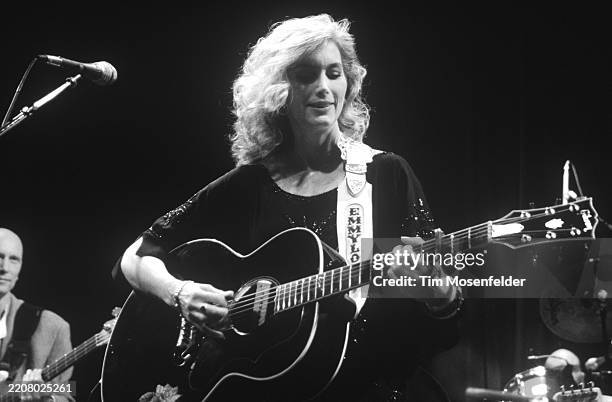
Emmylou Harris did more than record “Pancho and Lefty” on Luxury Liner; she quietly carried Townes Van Zandt from the songwriter’s shadows into the heart of mainstream country listening.
There are recordings that arrive like announcements, and then there are recordings that move more quietly, changing the landscape without demanding applause. Emmylou Harris singing “Pancho and Lefty” on her 1977 album Luxury Liner belongs to that second category. It was not released as the album’s big radio single, and it did not storm the charts in the way later versions would. But its importance has only grown with time. On an album that reached No. 1 on the Billboard Top Country Albums chart and crossed over to No. 21 on the Billboard 200, Harris gave one of Townes Van Zandt’s most haunting songs a place inside a record that a broad country audience was already prepared to hear.
That matters. In 1977, Townes Van Zandt was revered by songwriters, cult listeners, and those who understood that some of the deepest truths in American music rarely arrived with commercial fanfare. His original “Pancho and Lefty” had appeared on The Late Great Townes Van Zandt in 1972, and even then it felt like a song that lived half in legend, half in dust. It was mysterious, spare, and morally unsettled. It did not explain itself. It trusted the listener to sit with absence, betrayal, memory, and the silence left behind by both. That kind of writing was not always where mainstream country commerce naturally looked. Emmylou Harris helped change that.
Her gift was never simply that she sang beautifully, though she certainly did. Her deeper gift was discernment. She had an extraordinary ear for songs that carried history inside them. After the loss of Gram Parsons, Harris became not just one of the finest singers of her era but also one of its great curators of American songwriting. She could take material from writers with cult followings, literary reputations, or rougher edges and place those songs within records that sounded graceful, welcoming, and emotionally immediate. In doing so, she became a bridge between worlds: cosmic country, folk poetry, honky-tonk feeling, and mainstream Nashville craft.
That bridge is exactly what her version of “Pancho and Lefty” represents. She did not smooth away the song’s ambiguity. She did not overplay its drama. Instead, she let its mystery breathe. Harris understood that the power of the song lies in what it withholds as much as in what it reveals. Pancho is not just an outlaw figure, and Lefty is not merely the companion who survived. They feel like emblems of loyalty, regret, distance, and the uneasy price of making it through when someone else does not. The famous closing image, with Lefty growing old in cheap hotels and the world moving on, remains one of the most devastating quiet endings in American songwriting. In Harris’s hands, that sorrow became easier for a wider audience to enter without losing its sting.
Luxury Liner itself was a perfect setting for such a song. The album is one of Harris’s finest statements, balancing elegance with rootsiness, polish with ache. It included material by writers as varied as Richard Dobson, Chuck Berry, Graham Parsons, and Townes Van Zandt, which tells you a great deal about her range and instincts. She was never interested in narrow genre boundaries. She was interested in songs that lasted. On a record that also yielded the country hits “One of These Days” and “Making Believe”, her inclusion of “Pancho and Lefty” served almost like a quiet manifesto: this, too, belongs in country music’s central room.
And history proved her right. Six years later, Willie Nelson and Merle Haggard would take “Pancho and Lefty” to No. 1 on the Billboard Hot Country Singles chart in 1983, making the song widely famous in commercial terms. That version became definitive for many listeners, and deservedly so. But Harris’s earlier recording is part of the story that made such a moment possible. She had already helped prepare mainstream ears for Townes Van Zandt’s voice as a writer. Her audience trusted her taste. When she sang a song, people listened differently. She was one of those rare artists whose choices carried authority without feeling heavy-handed.
There is also something deeply moving about how Harris approached lineage itself. She did not treat songwriting as a hierarchy of stars and minor figures. She treated it as an inheritance, something handed from one keeper of the flame to another. By recording writers such as Townes Van Zandt, she was saying that greatness in country-adjacent music could live outside the most obvious commercial lanes. She helped preserve a literary, lonesome, spiritually restless thread in the music and bring it into broader circulation.
That is why her 1977 recording of “Pancho and Lefty” still feels so meaningful. It was not merely a cover tucked into an album sequence. It was an act of advocacy, taste, and faith. It showed that a song born from the peculiar genius of Townes Van Zandt could sit naturally inside a major country release and still keep its weathered soul intact. For listeners who came to the song through Emmylou Harris, a door opened. Behind that door stood not only one unforgettable ballad, but an entire lineage of songwriting that valued ambiguity over slogans, humanity over pose, and lasting truth over quick impact.
In that sense, Harris did what the greatest interpreters always do: she did not just sing a song well. She changed where the song could live. And by giving “Pancho and Lefty” a home on Luxury Liner, she helped carry Townes Van Zandt further into the mainstream than the industry might ever have managed on its own.
