
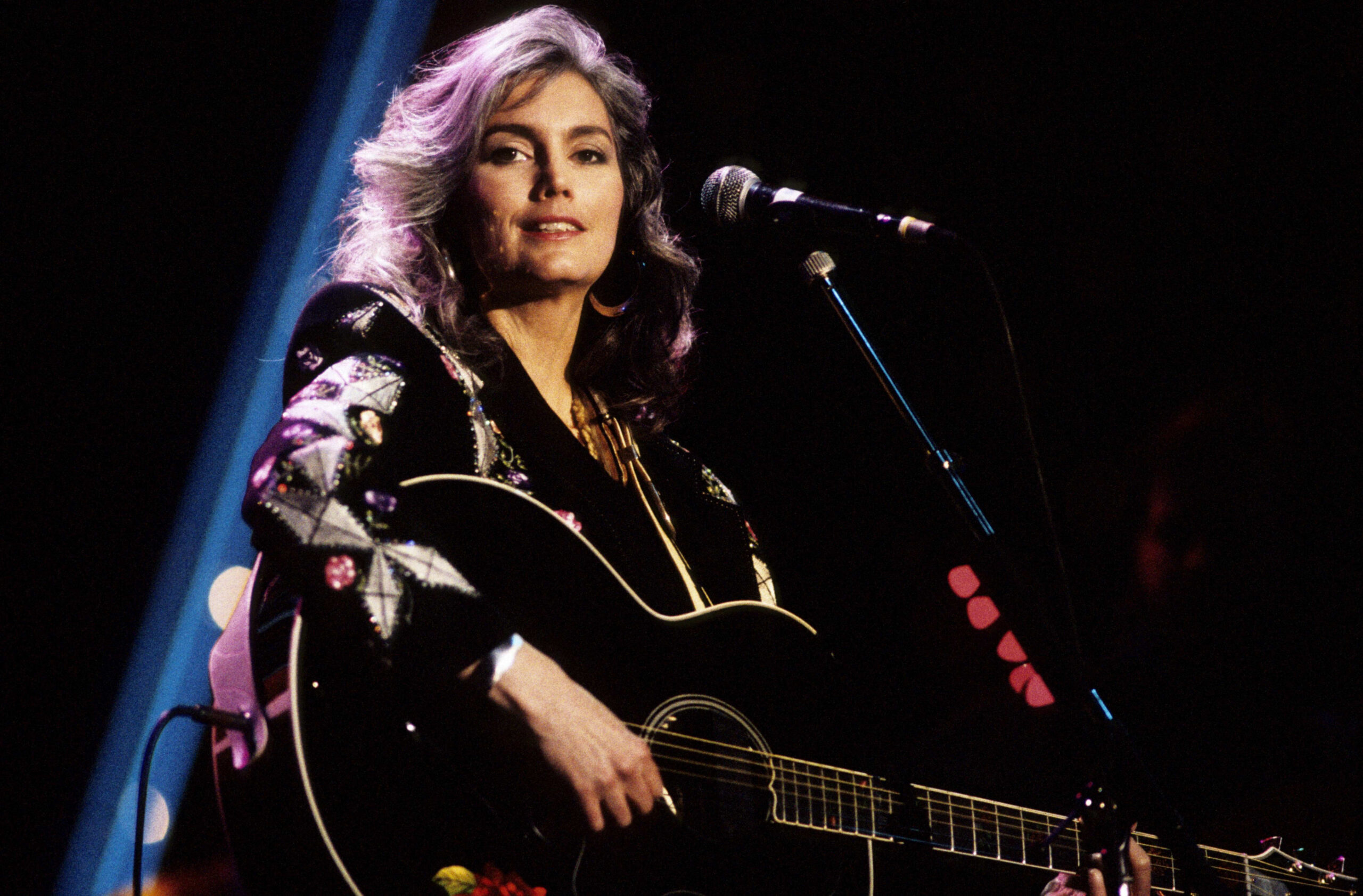
Emmylou Harris turns Spanish Dancer into something far deeper than romance: a drifting portrait of beauty, distance, and the loneliness hidden inside grace.
There are songs in Emmylou Harris‘s catalog that arrived with clear commercial footprints, obvious radio life, and easily remembered chart stories. Spanish Dancer is not one of those songs. It has long felt more intimate than public, more discovered than delivered, the kind of recording that finds its way into a listener’s heart quietly and stays there for years. In terms of chart history, Spanish Dancer is not remembered as a major Billboard country hit, and that matters to the way the song lives. It was never overexposed. It never had the burden of becoming too familiar. Instead, it survives as one of those deeply felt Harris performances that reward patience, memory, and close listening.
That may be the first important thing to understand about Spanish Dancer: it belongs to the shadowed, cherished side of Emmylou Harris‘s work, where the emotional weather often says more than any commercial statistic ever could. Harris has always had a gift for choosing songs that seem to carry whole lives inside them. Even when the lyric leaves space, she fills that space with tone, phrasing, and that unmistakable ache in her voice. In Spanish Dancer, she does exactly that. The title itself suggests movement, elegance, and allure, but Harris hears the sadness beneath the image. What emerges is not just a portrait of someone beautiful or mysterious. It is a portrait of someone unreachable, perhaps even someone using beauty as a form of survival.
The song’s emotional pull comes from contrast. A dancer suggests motion, color, theater, rhythm. Yet Harris rarely sings such figures as mere decoration. In her hands, the woman at the center of Spanish Dancer feels almost symbolic, a figure made of longing and distance. She may be admired, but she is not possessed. She may be seen, but she is not fully known. That tension gives the song its haunting quality. Many singers can deliver sadness directly. Emmylou Harris often does something more powerful: she lets sadness arrive indirectly, through restraint, through atmosphere, through the sense that what hurts most has not been spoken aloud.
This is one reason the song lingers. It does not push too hard. It does not explain itself to death. It trusts mood, and it trusts the listener. Older songs often endure because they leave room for people to bring their own years to them, and Spanish Dancer has that gift. Some hear romantic loss in it. Others hear the loneliness of performance itself, the burden of always being watched, admired, or imagined from a distance. Still others may hear a broader human truth: that grace can sometimes be a mask, and that the most composed person in the room may be carrying the deepest private ache.
That idea connects Spanish Dancer beautifully to the larger artistry of Emmylou Harris. Across decades, she has returned again and again to songs about drifters, dreamers, wounded lovers, solitary women, and people who seem to live just beyond the reach of ordinary comfort. She has never needed to oversing such material. Her greatness has always lived in the space between clarity and mystery. She can sound tender without sounding weak, sorrowful without turning melodramatic, wise without becoming cold. On Spanish Dancer, those qualities gather in especially moving form.
There is also something cinematic about the song. One can almost see it as it unfolds: a figure in motion, a room charged with attention, a memory that will not settle into the past. Yet the real power of the song is not visual at all. It is emotional timing. Harris knows how long to stay on a phrase, how softly to lean into a line, how to make a listener feel that the most important part of the story is the part still hovering just out of reach. That is an old art, and she has always practiced it with uncommon grace.
If Spanish Dancer never became one of the defining chart titles in the Emmylou Harris songbook, that may be part of its lasting beauty. Some songs belong to history. Others belong to memory. This one feels like memory. It slips in gently, carrying dust, perfume, regret, and a kind of hard-earned elegance. It reminds us that Harris was never only a country hitmaker, never only a harmony singer, never only an interpreter of other people’s songs. She was, and remains, one of the great emotional stylists in American music, able to make even a quieter catalog entry feel as though it contains an entire unwritten novel.
And that is why Spanish Dancer still matters. It is not simply a song about beauty, or even about desire. It is about the distance between appearance and feeling, between the life performed and the life endured. Few singers have understood that distance more deeply than Emmylou Harris. When she sings this song, she does not just describe a character. She reveals the sorrow inside the silhouette, and in doing so, she leaves behind one of those rare recordings that grow richer, sadder, and more beautiful with time.
