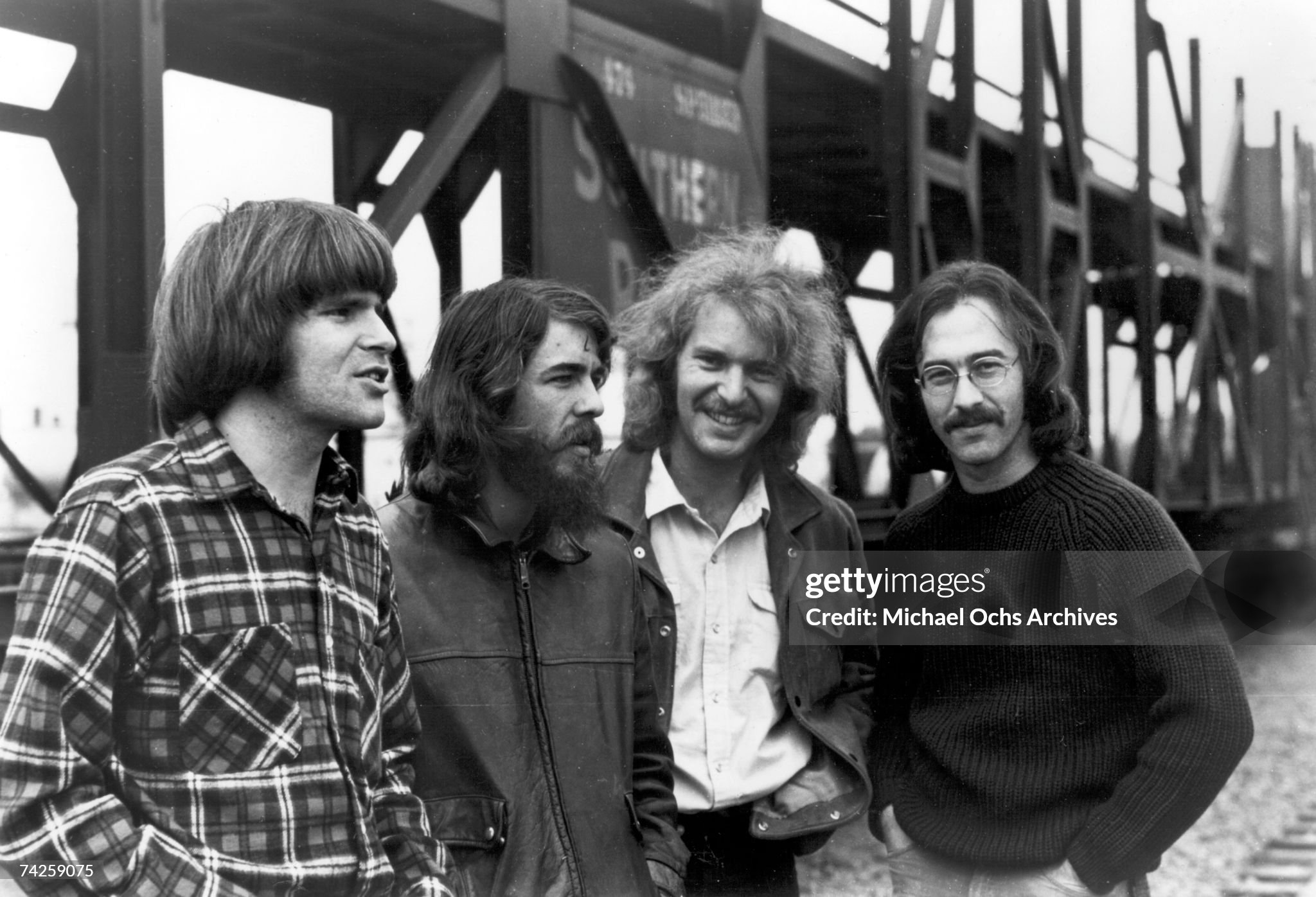
A dark, slow-burning cover of “Susie Q” became Creedence Clearwater Revival’s first true national breakthrough, turning a struggling California band into a serious chart story in 1968.
Before “Proud Mary”, before “Bad Moon Rising”, before the name Creedence Clearwater Revival carried that unmistakable American weight, there was “Susie Q” — the record that made people across the country stop and ask who this band was. Released in 1968 as the group’s debut single from the album Creedence Clearwater Revival, the song rose to No. 11 on the Billboard Hot 100. That Top 20 showing mattered enormously. It was not just their first hit. It was the first real proof that this band, after years of false starts and hard miles, could cut through on a national level.
What made the climb so surprising was that “Susie Q” was not even their song to begin with. The tune had first been a rockabilly hit for Dale Hawkins in 1957, built on a guitar riff that already had a little danger in it, a little swagger, a little nighttime electricity. But CCR did not simply revive it. They transformed it. Their version was darker, heavier, slower, and far more hypnotic. On the album, it ran more than eight minutes, unfolding like a spell rather than a standard pop single. For radio, it had to be split and edited into Part 1 and Part 2, but even in shortened form it still carried that strange, swampy pull that would soon become the band’s signature.
That is one of the great ironies of the record. In the late 1960s, rock was full of color, studio experimentation, and psychedelic ambition. Yet Creedence Clearwater Revival, a band from Northern California, broke through not by sounding fashionable, but by sounding elemental. John Fogerty sang “Susie Q” as if he had found something haunted in the song. His guitar playing was sharp and patient, never in a hurry, and the band behind him locked into a groove that felt earthy and relentless. It was familiar enough to catch listeners immediately, but different enough to feel new all over again.
The backstory makes the breakthrough even sweeter. Before becoming CCR, the group had spent years recording under earlier names, most notably The Golliwogs, with very little to show for it nationally. They were talented, but they were not yet heard in the right way. When they emerged as Creedence Clearwater Revival, there was already history in the room — years of frustration, years of trying to make a record business notice them, years of being close without truly arriving. “Susie Q” changed that. It gave the band a public identity. Suddenly they were not just another regional act with promise. They were a national chart presence.
Part of the song’s momentum came from radio. The longer album cut reportedly received strong attention on underground FM stations, where programmers had more freedom and were willing to let a moody, extended performance breathe. That helped create a bridge between album culture and single-chart success. Then, once the edited version caught fire, “Susie Q” did what every breakthrough record must do: it introduced the band to casual listeners while still sounding completely true to itself. It did not feel calculated. It felt discovered.
And that may be the secret of why the song mattered so much. Lyrically, “Susie Q” is not built on grand poetry or social commentary. Its meaning is simpler, older, and in some ways more powerful. It is about fascination, desire, obsession, and repetition — the kind of emotional loop that early rock and roll understood so well. But in CCR’s hands, the song also became a statement of atmosphere. It was not just about the girl in the lyric. It was about the sound of pursuit, the tension of wanting, the feeling of being pulled by something you cannot quite shake. That gave the record depth beyond its words.
Its chart success also mattered because of what came next. Once “Susie Q” reached the national audience, Creedence Clearwater Revival had an opening. They were no longer introducing themselves from scratch. The single had created room for the extraordinary run that followed — “Proud Mary,” “Born on the Bayou,” “Bad Moon Rising,” “Green River,” and so many others. In that sense, “Susie Q” was the door. It may not always be the first title people name when they think of CCR, but it was the record that made the rest of the story possible.
There is also something deeply satisfying about the way it happened. A band that had labored in near-obscurity did not break through with a novelty, a gimmick, or a polished trend piece. They broke through with a long, brooding, riff-driven remake of an older rock and roll song. That alone says something important about Creedence Clearwater Revival. From the very beginning, they trusted feel over fashion. They trusted groove over spectacle. They trusted the old foundations of American music, then reshaped them with a sound that was unmistakably their own.
So when people look back on 1968 and wonder when CCR first announced themselves to the nation, the answer is right here. “Susie Q” was the shock. It was the first national jolt. It climbed to No. 11 on the Billboard Hot 100 and told the industry that this band was not passing through. Long before the legend was complete, this was the record that lit the fuse.
