
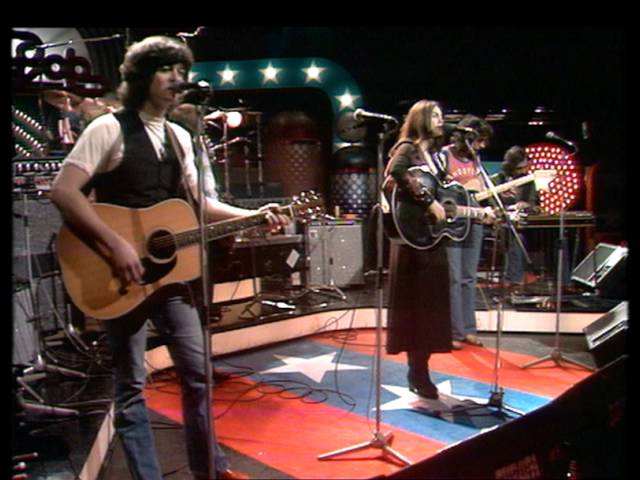
In Tulsa Queen, Emmylou Harris turns the open road into something more than movement: a tender, restless portrait of freedom, longing, and what it costs to keep going.
Tulsa Queen may not be the first title mentioned when people begin naming the most famous songs recorded by Emmylou Harris, but that is precisely why it lingers the way it does. Released on her 1981 album Cimarron, the song belongs to that special class of recordings that never had to dominate the radio in order to earn a permanent place in a listener’s heart. Tulsa Queen was not one of Harris’ major charting singles, yet Cimarron itself reached No. 8 on Billboard’s Top Country Albums chart. That matters, because it places the song inside a period when Harris was already one of the most refined and emotionally reliable voices in country music, even when the material felt quieter, more tucked away, less eager to announce itself.
There is also a little history in the way Tulsa Queen arrived. Cimarron has often been described as a transitional or pieced-together record, assembled from different sessions during a busy chapter in Harris’ career. It lived in the shadow of stronger commercial headlines, and many listeners first remembered the album for If I Needed You, the duet with Don Williams that climbed to No. 3 on the Billboard country chart. But time has a way of changing what feels central. Songs that once seemed like side roads often become the ones we revisit most. Tulsa Queen is one of those songs. It reveals Harris not merely as a singer of elegant hits, but as an artist deeply attuned to mood, geography, and the emotional weather of American music.
Musically, the song carries the easy forward motion that Harris and producer Brian Ahern understood so well. There is country in it, of course, but also that open, windblown country-rock texture that defined so much of Harris’ finest early work. Nothing feels heavy-handed. The arrangement breathes. It moves with a kind of understated confidence, leaving room for her voice to do what it always did better than almost anyone else’s: suggest entire lives in a single line. Harris never had to oversing sorrow or independence. She could lay a phrase down lightly, almost conversationally, and somehow make it feel as though the horizon had widened behind her.
That is one reason Tulsa Queen is so affecting. On the surface, it has the shape of a road song, or perhaps a character sketch built around place and motion. But underneath that movement is a more complicated feeling. The song does not treat freedom as simple triumph. Instead, it hints at the old truth that motion can be exhilarating and lonely at the same time. The very image of a queen tied to a city name suggests both glamour and impermanence, someone larger than life and yet never fully settled. In Harris’ hands, the song becomes a small American drama: a woman in motion, a map folded open, a little dust on the road, and somewhere behind it all the faint ache of what cannot be carried forever.
That emotional duality is what gives the song its staying power. Many country songs about wandering lean hard in one direction or the other. They either celebrate escape or mourn its consequences. Tulsa Queen is more interesting than that. It lives in the space between. It understands the thrill of leaving, the self-invention that comes with distance, and the romance of being untethered. But it also recognizes that every departure leaves an outline somewhere. Harris was always brilliant at singing people who seem strong on the outside but are shadowed by memory, and this song fits beautifully into that gift. She makes the character feel vivid without reducing her to a symbol. The result is tender rather than flashy, knowing rather than dramatic.
It also helps to remember where Emmylou Harris stood in 1981. By then she had already reshaped the possibilities of modern country by bringing together traditional roots, folk intelligence, rock grace, and a voice that could sound both earthly and almost unreachably pure. On paper, a song like Tulsa Queen might seem modest beside the larger landmarks in her catalog. In practice, it tells you nearly everything about why Harris mattered so much. She could elevate material through tone alone. She could make a lesser-known track feel lived in, emotionally exact, and somehow connected to a much older American story of roads, towns, longing, and reinvention.
That is why the song still glows for listeners who return to Cimarron not just for the hits, but for the hidden corners. Tulsa Queen is not simply an overlooked track from an often-overlooked album. It is a reminder that some of the most revealing performances in an artist’s career are not always the ones that chart highest. Sometimes they are the songs that catch a voice in motion, a little looser, a little more mysterious, and therefore a little closer to real life. Harris sings this one with the wisdom of someone who knows that the road can look beautiful and still leave you aching. Decades later, that balance of grace and restlessness is exactly what makes Tulsa Queen worth hearing again.
