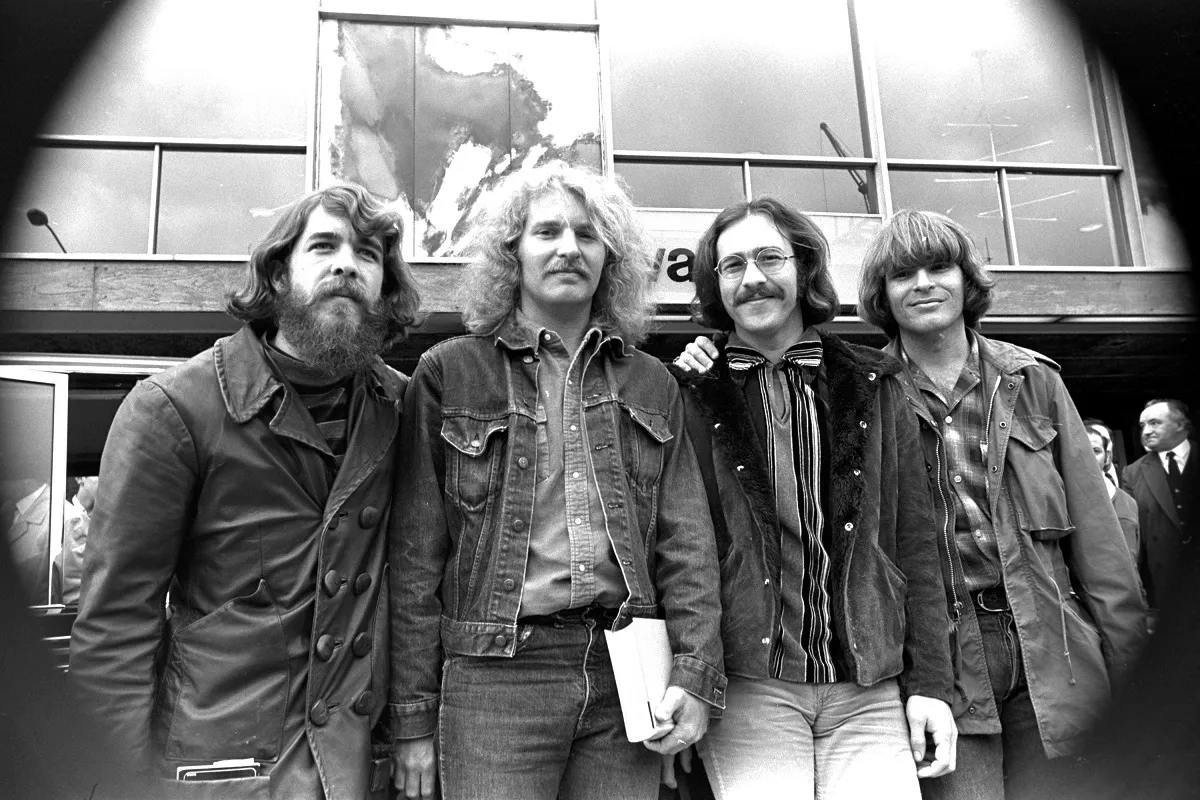
On Live in Europe 1971, Creedence Clearwater Revival turned “Door to Door” into something more revealing than a deep cut: a portrait of a great band still moving forward even as its balance was beginning to slip.
There is something especially compelling about Creedence Clearwater Revival in its late period, and “Door to Door” from Live in Europe 1971 captures that feeling with unusual honesty. This was not the sleek, hit-stacked version of CCR that had stormed radio with “Proud Mary”, “Bad Moon Rising”, or “Have You Ever Seen the Rain”. By the time of the 1971 European tour, Tom Fogerty was gone, and the band was working as a trio. The performance of “Door to Door” belongs to that exact moment. It matters because it shows a famous American band trying, in public, to redefine itself.
That context is essential. “Door to Door” was written by Stu Cook and would later appear on the 1972 album Mardi Gras, the final studio album by Creedence Clearwater Revival. Mardi Gras reached No. 12 on the Billboard 200, but the song itself was not one of the group’s charting signature singles. The live recording from the 1971 European tour was issued later on the 1973 album Live in Europe, which reached No. 52 on the Billboard 200. Those numbers tell only part of the story. The deeper truth is that this version of “Door to Door” has endured not because it was a hit, but because it lets listeners hear a legendary group in a rare and vulnerable state: still professional, still committed, yet unmistakably altered.
The story behind the song is also the story behind the band’s final chapter. After years of astonishing success, tensions inside CCR had grown sharper. John Fogerty had been the creative engine, the lead singer, principal songwriter, and unmistakable voice of the group. But after Tom Fogerty left, the remaining members moved toward a more democratic arrangement, with Stu Cook and Doug Clifford contributing songs and vocals as well. That decision changed the identity of the band almost overnight. For some fans, it was a brave attempt at reinvention. For others, it sounded like a group stepping away from the very chemistry that had made it extraordinary. “Door to Door” sits right in the middle of that debate.
And that is what makes the Live in Europe 1971 performance so fascinating. This is not a polished retrospective. It is a document from the middle of the struggle. The European audiences were hearing a band that still had its drive, its rhythm, and its road-tested power, but was no longer built around a single, unified center. In that setting, “Door to Door” feels almost symbolic. Its very title suggests motion, searching, knocking, pressing onward. It carries a blue-collar sense of persistence, the feeling of somebody trying one more street, one more chance, one more opening. That image fit CCR at the time more than anyone could have known. They were, in a sense, moving from door to door themselves, still carrying the name, still carrying the sound, still looking for a way through a period of strain.
Musically, the song stands apart from the classic John Fogerty-led canon. It does not have the mythic swamp gravity of “Born on the Bayou” or the tight, immediate punch of “Travelin’ Band”. Instead, it leans into a looser, more workmanlike groove. That difference is precisely why some listeners dismissed it, but it is also why others return to it now with fresh ears. Heard today, especially in the live 1971 setting, “Door to Door” sounds less like a failed imitation of vintage CCR and more like a snapshot of internal change. It reveals what happens when a great band stops repeating its own formula and begins exposing its fault lines in real time.
There is also a poignancy to the timing. The 1971 European tour was one of the last major chapters before the group’s breakup became final in 1972. So when modern listeners put on Live in Europe, they are not simply hearing a concert souvenir. They are hearing the closing weather of a remarkable run. That gives “Door to Door” an emotional weight it might not have carried in another context. It becomes more than a late-period album track. It becomes evidence. Evidence of professionalism. Evidence of tension. Evidence that even bands who seem unstoppable can arrive at a moment when every performance carries both strength and uncertainty at once.
That is why this recording deserves more kindness than it often receives. It may never rank with the towering classics of Creedence Clearwater Revival, and it was never meant to replace them. But in “Door to Door”, especially as heard on Live in Europe 1971, there is something honest and human that polished legends rarely offer. It reminds us that the final pages of a band’s story are often the most revealing. The hits tell us how bright the flame was. Recordings like this tell us how it flickered, how it fought to stay lit, and how even in transition, CCR could still command attention simply by stepping onstage and playing the truth of where they were.
