
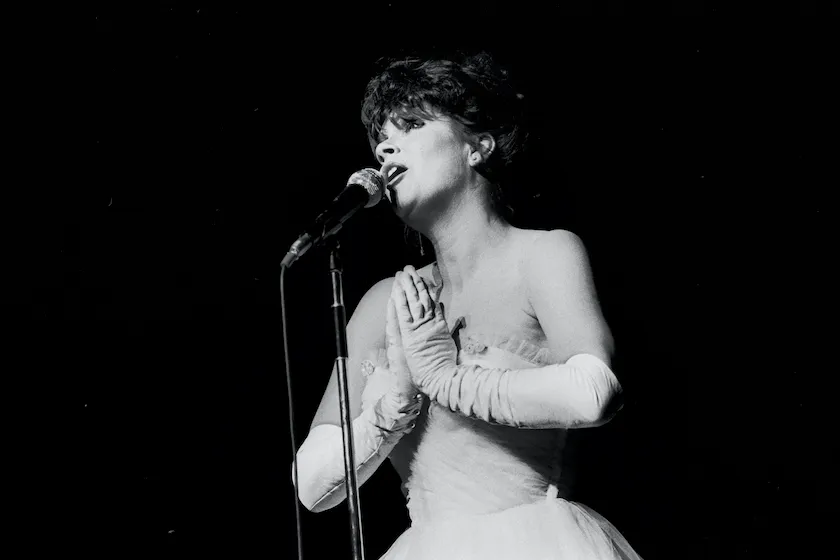
Hey Mister, That’s Me Up on the Jukebox is more than a sad-country song in Linda Ronstadt’s hands. It becomes a deeply human moment, where a voice in a crowded room suddenly sounds like your own private heartbreak.
There are songs that arrive like hits, and then there are songs that stay like memories. Hey Mister, That’s Me Up on the Jukebox belongs to the second kind. When Linda Ronstadt recorded it for her 1975 album Prisoner in Disguise, it was not pushed as one of her biggest standalone chart singles. Yet it lived inside an album that performed brilliantly, reaching No. 4 on the Billboard 200 and No. 1 on Billboard’s country albums chart. That matters, because it tells us where Ronstadt stood in that moment: already one of the defining voices of the decade, but still willing to devote her gifts to songs that whispered instead of shouted.
That is one of the enduring wonders of Linda Ronstadt. She could sing a major radio favorite and make it feel intimate, but she could also take a lesser-known song and give it the emotional weight of a life story. Hey Mister, That’s Me Up on the Jukebox is one of those performances. It sounds, at first, like a classic barroom lament, the kind of song built on dim light, old wounds, and the strange fellowship of strangers listening to the same melody. But listen more carefully and something deeper happens. The title itself carries the entire emotional premise: the person hearing the jukebox is not merely requesting a song. The singer recognizes himself in it. The record spinning in the corner has become a mirror.
That is the quiet brilliance of the song’s meaning. It speaks to a moment almost everyone understands, even if they never had words for it. Sometimes a song comes on, and it does not feel like entertainment anymore. It feels like exposure. It feels as though the room has somehow been let in on what you tried to keep hidden. In Hey Mister, That’s Me Up on the Jukebox, the ache comes from that collision between public sound and private feeling. The jukebox is loud, communal, ordinary. The pain inside the song is personal, solitary, almost embarrassing in its honesty. That tension gives the lyric its power.
Ronstadt was uniquely suited to material like this. By the mid-1970s, she had become one of the essential interpreters of American song, moving through rock, country, folk, and pop with uncommon ease. Yet she never sang as though style mattered more than truth. On Prisoner in Disguise, produced by Peter Asher, she was refining a sound that felt polished without losing its roots. The album could hold commercial appeal and emotional gravity at the same time. In that setting, Hey Mister, That’s Me Up on the Jukebox feels less like filler and more like a statement of what made her artistry so lasting: taste, restraint, and an instinct for emotional precision.
What makes her version so affecting is that she does not overplay the sadness. She does not force the sorrow into melodrama. Instead, she sings with clarity and control, letting the hurt arrive in small waves. That choice is everything. A song like this can easily be pushed too far, turned into pure theatrical heartbreak. Linda Ronstadt understood that the most painful feelings are often delivered almost plainly. Her voice carries strength, but there is also vulnerability in the phrasing, a sense that she is not performing misery so much as recognizing it. The result is a recording that feels lived-in, not manufactured.
It is also a perfect example of how Ronstadt elevated country-rooted material for a broader audience without sanding away its emotional grain. She did not treat these songs as museum pieces, and she did not make them glossy to the point of losing character. She gave them room to breathe. In Hey Mister, That’s Me Up on the Jukebox, the arrangement supports the lyric rather than competing with it. The musical setting has the patience of a late-night conversation. Nothing distracts from the central feeling: that lonely, almost stunned realization of hearing your own story sung back to you.
There is another reason the track lingers. It captures a very particular emotional world that used to live at the center of country and country-rock songwriting: wounded pride, public composure, and private collapse. The song does not beg for sympathy. It simply lays the feeling out on the table. That old kind of dignity, especially in songs about heartache, is one reason recordings like this continue to resonate across decades. They trust the listener. They do not explain too much. They know that memory will do half the work.
In the larger story of Linda Ronstadt’s career, Hey Mister, That’s Me Up on the Jukebox may not be the first title people mention. It does not always arrive in the conversation before the more famous hits. But that is part of its beauty. Some songs are cornerstones; others are secret doorways. This one is a doorway into the side of Ronstadt that valued emotional truth over grand display. It reminds us that her greatness was not only in the songs that dominated the airwaves, but also in the ones she quietly transformed into lasting companions.
And perhaps that is why it still reaches people. Long after the charts have been filed away and the decade itself has turned into history, this recording still feels close. A jukebox, a room, a song, a heart suddenly recognized in public — that image has lost none of its power. In Linda Ronstadt’s voice, it becomes timeless.
