
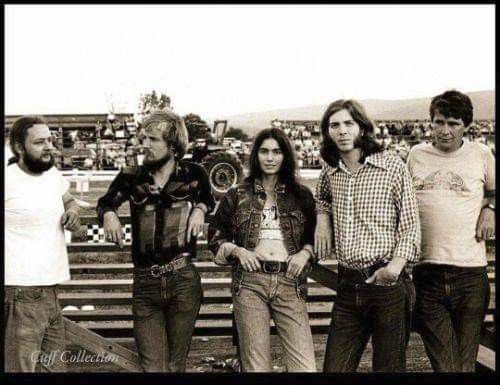
“Born To Run” in Emmylou Harris’s hands still starts arguments because it carries a legendary title, a fearless vocal, and just enough mystery to make listeners ask whether they are hearing a cover, a reinvention, or a completely separate kind of country drama.
One of the first things worth saying clearly is this: Emmylou Harris’s “Born To Run” is not the Bruce Springsteen song. That confusion has followed it for years, and perhaps that confusion is part of the record’s fascination. Released on May 29, 1982 as the second single from Cimarron, Harris’s “Born To Run” was written by Paul Kennerley, produced by Brian Ahern, and climbed to No. 3 on Billboard’s Hot Country Singles. In Canada, it reached No. 10 on RPM Country Tracks. So this was not some obscure album deep cut accidentally living under a famous title. It was a major Top 3 country hit, and one of the songs that kept Harris firmly in the top tier of country music in the early 1980s.
That already gives the song a special kind of charge. A title as mythic as “Born To Run” invites expectations the moment it appears on the sleeve. For some listeners, the title still belongs instinctively to Springsteen’s street-lit escape anthem. But Harris’s song goes somewhere else entirely. It is not urban rock grandeur. It is not Jersey-boardwalk desperation. It is something more old-world, more country, more narrative, and in its own way just as driven. The song was built from Paul Kennerley’s writing, and sources note that its melody comes from “The Death of Me,” a song from his concept project The Legend of Jesse James, previously performed there by Johnny Cash and Levon Helm. That lineage matters. It means Harris’s “Born To Run” already carries a faint outlaw aura before she even opens her mouth.
And that is where the arguments begin. Fans still debate this performance because Emmylou Harris does something she did better than almost anyone: she takes material that might have been merely strong on paper and sings it into a different order of life. Her voice here is not fragile, not decorative, and not overdone. It is fearless in the best Emmylou way — clear, poised, slightly windswept, and emotionally unflinching. She never sounds as though she is trying to make the song “big.” She simply sings it with enough conviction that the scale reveals itself. That is often the mark of her finest work. She could make a song feel larger without ever pushing it into melodrama.
The album context deepens that effect. Cimarron, released in 1981, was made during a period of transition in Harris’s career, after changes in the Hot Band lineup and during an era when country music itself was shifting in tone and texture. Yet the album still produced major country-chart action, spawning U.S. and Canadian top-ten country singles including “Tennessee Rose” and “Born To Run.” Harris was no longer the surprising newcomer by this point. She was an established artist with taste, authority, and a growing command over how traditional country, country-rock, and more literary songwriting could live together in one voice.
What makes “Born To Run” such a compelling point of argument is that it sits right at the intersection of those gifts. It has the movement of a hit single, but not the cheap rush of one. It has story, but not so much story that it becomes heavy-handed. It has country drive, but it also carries that atmospheric, emotionally elevated quality Harris could bring to almost anything. The arrangement, shaped by Brian Ahern, gives her exactly the kind of frame she often wore best: polished but spacious, disciplined but never dry. The result is a performance that feels both radio-ready and strangely expansive.
There is another reason fans still talk about it: the title creates a shadow, and Harris refuses to be intimidated by it. Lesser artists might have avoided a title so heavily associated with another legend. Harris steps straight into it, but with an entirely different emotional language. That takes nerve. And because the song itself was strong enough to back her, the record does not feel overshadowed. It feels defiant in its own quiet way — not arguing with Springsteen, not borrowing from him, simply insisting on its own place. That kind of artistic confidence tends to leave a mark.
So why do listeners still argue about “Born To Run”? Because it is one of those Emmylou Harris performances that resists being filed away neatly. It is a hit, but it feels richer than a chart line. It bears a legendary title, but belongs to a different tradition. It is elegant, but never tame. And above all, it carries that unmistakable Emmylou quality: the sense that a song is being sung not just beautifully, but with deep inner certainty. Some records invite admiration. This one invites loyalty. That is why people still come back to it, still defend it, still debate it. With one legendary title, one fearless voice, and one performance full of nerve and poise, “Born To Run” remains exactly the kind of Emmylou Harris record that serious listeners never stop arguing over.
