
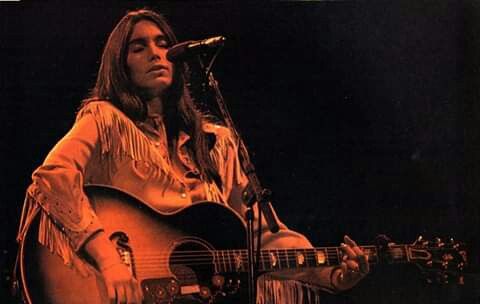
When Emmylou Harris sings “Wildwood Flower”, she does more than revisit an old standard—she brings back the tenderness, loneliness, and plain-spoken grace that made country music endure in the first place.
There are some songs that belong to the charts, and there are some songs that belong to the bloodstream of American music. “Wildwood Flower” is very much the second kind. First popularized by The Carter Family in 1928, the song became one of the foundation stones of country music, carrying traces of the older parlor ballad “I’ll Twine ’Mid the Ringlets” into a new, rural, deeply felt language. In Emmylou Harris’s hands, it was never merely an old song revived for display. It felt lived in. It felt remembered. And that is exactly why her way with it has stayed with listeners for so long.
Strictly speaking, “Wildwood Flower” was not one of Emmylou Harris’s major solo Billboard country singles, so it did not arrive with the kind of chart peak attached to classics like “Together Again”, “If I Could Only Win Your Love”, or “Beneath Still Waters”. It belongs to a different category of music history—songs that are measured less by weekly rankings than by how deeply they settle into the hearts of those who hear them. That, in a way, is fitting. A song this old and this essential was never meant to be reduced to numbers alone.
The story behind “Wildwood Flower” is part of what gives it such power. The Carter Family version, led by the hauntingly direct voice of A.P., Sara, and Maybelle Carter, helped define the sound and soul of early commercial country music. The lyric speaks in the voice of a woman left in sorrow, turning to flowers, memory, and solitude as she tries to live with a love that has faded. There is no grand spectacle in it, only emotional truth. That honesty is what made the song last. Country music, at its best, has always known that heartbreak does not need embellishment. It only needs a voice that believes every word.
And this is where Emmylou Harris enters the story so beautifully. Few singers in modern country or folk have possessed her gift for sounding both celestial and earthly at once. Her voice can float, but it never feels detached. It can ache without becoming theatrical. It can honor tradition without sounding trapped by it. When she approaches a song like “Wildwood Flower”, she does not try to overpower its history. She listens to it. She leans into its age, its simplicity, its weathered emotion. The result is not imitation of the Carter style, but continuity with it. She sings as someone who understands where the song came from and why it still matters.
That may be the deepest answer to the question of how she could sing “Wildwood Flower” the way she did: because Emmylou Harris has always understood that the finest country songs are not performances first—they are inheritances. Throughout her career, whether interpreting old Appalachian material, classic honky-tonk, or contemporary songwriting, she has shown an almost reverent sense of musical lineage. She knows that a song can carry family history, regional memory, and private grief all at once. “Wildwood Flower” demands exactly that kind of singer. Not a singer chasing effect, but one willing to disappear into the emotional grain of the song.
The meaning of “Wildwood Flower” has never rested only in its tale of romantic loss. Beneath the lyric is something even older and more durable: the image of a person trying to remain gentle in the face of disappointment. The flower itself becomes a symbol of beauty that survives sorrow. That is why the song has lasted far beyond its era. It speaks to the quiet endurance of feeling—the way memory lingers, the way love can leave an imprint long after the moment has passed, the way dignity can exist even in loneliness. When Emmylou Harris sings it, that emotional core becomes even clearer. She never rushes it. She allows the sadness to breathe, and because of that restraint, the song feels more human, not less.
There is also something unmistakably moving about the contrast between the purity of Emmylou Harris’s voice and the rough-hewn age of the material. “Wildwood Flower” comes from a time when songs were passed through kitchens, porches, churchyards, and radio static. Her singing carries the polish of a great artist, but never the vanity of one. She seems to know that the beauty of a traditional song lies partly in its humility. Instead of modernizing it into something clever, she lets it remain plain and luminous. That choice is not small. It is artistic wisdom.
For listeners who have spent a lifetime with country music, that is part of the magic. Hearing Emmylou Harris sing “Wildwood Flower” is like hearing one era reach back and gently take the hand of another. It reminds us that the distance between the Carter Family’s 1928 recording and later generations of country music is not as wide as it may seem. The feelings are the same. The ache is the same. The need for a song that tells the truth with grace is the same.
In the end, “Wildwood Flower” does not survive because it is antique. It survives because it is alive. And when Emmylou Harris sings it, she proves that some voices are not merely beautiful—they are beautifully suited to memory itself. She does not just sing the song. She returns it to the place where all enduring country music begins: somewhere between love, loss, and the hush of a human voice telling the truth.
