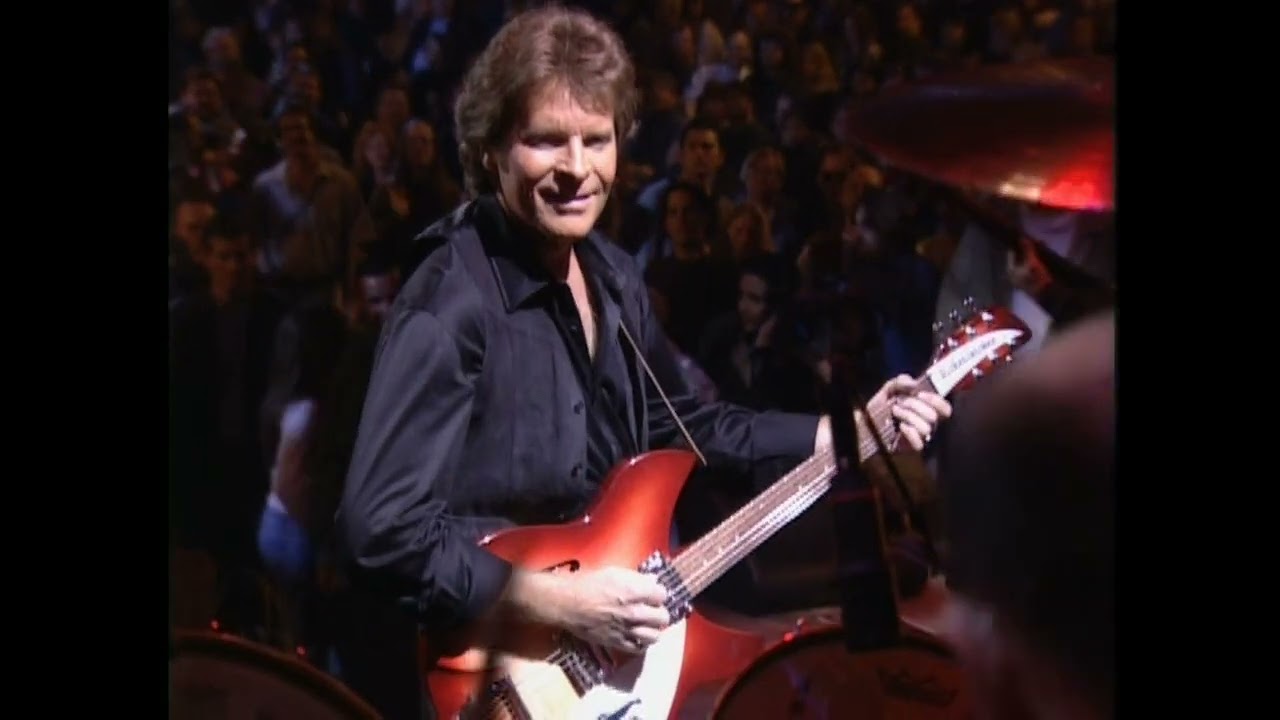
A swamp-rock warning from 1986 found a different sky when John Fogerty brought it back in 2009.
In 1986, John Fogerty released “Change in the Weather” on his solo album Eye of the Zombie. More than two decades later, he returned to the same song for The Blue Ridge Rangers Rides Again, his 2009 revival of the roots-minded project name he had first used in the early 1970s. The facts are simple, but the distance between the two recordings gives the song an unusual shape: it sounds like a warning in one era and like a seasoned piece of American weather in another.
The 1986 version belongs to a particular moment in Fogerty’s solo life. Eye of the Zombie followed the enormous public return of Centerfield, the 1985 album that reintroduced him not only as a voice from the Creedence Clearwater Revival years but as a writer and performer still capable of making direct, muscular rock music on his own terms. Where Centerfield often carried the brightness of comeback, Eye of the Zombie moved through darker air. Its title alone suggested unease, and “Change in the Weather” fit that climate with a groove that felt humid, watchful, and slightly threatening.
Fogerty has always understood weather as more than scenery. In his best-known work, rivers, rain, roads, and heat are not decorative backdrops; they are emotional engines. “Change in the Weather” draws from that same vocabulary. The phrase in the title is plain enough to sound like something heard on a porch or in a small-town forecast, but in the song it carries the weight of social and personal disturbance. A change is coming, and the music does not treat that change as gentle. It moves with the body language of swamp rock: low-slung, alert, and rooted in repetition that feels less like comfort than pressure.
The original Eye of the Zombie recording also carries the marks of its decade. Its rhythm is firm, its textures more contemporary than the stripped-down Creedence records that many listeners still associate with Fogerty’s name. That 1980s frame gives the song a tense surface, as if the old swamp vocabulary has been pushed into a harsher modern room. Fogerty’s voice, sharp and recognizable, cuts through that setting without softening it. He does not need to overstate the drama; the vocal attack gives the song its weather system, turning the title into a kind of alarm.
What makes the 2009 re-recording intriguing is not simply that Fogerty revisited an older song. Artists often return to their catalogs, but this return had a special setting. The Blue Ridge Rangers Rides Again looked back to the idea of the Blue Ridge Rangers, the name Fogerty used for his 1973 album rooted in country, gospel, and early rock-and-roll material. By placing “Change in the Weather” inside that later project, Fogerty reframed it among songs connected to American roots traditions rather than among the darker, more electric tensions of Eye of the Zombie.
That change of surroundings matters. The 2009 version does not erase the warning at the center of the song, but it lets the composition breathe differently. Heard in the context of The Blue Ridge Rangers Rides Again, “Change in the Weather” seems less trapped in the anxieties of 1986 and more connected to a longer line of vernacular music: songs about storms, roads, trouble, home, and survival. The swampiness remains part of the song’s identity, but the later recording suggests that the storm was never confined to one album cycle. It was part of Fogerty’s durable musical language.
There is also a quiet artistic statement in the act of re-recording. Fogerty did not choose only the most obvious cornerstone of his songbook for this roots return; he reached back to a track from a complicated solo period, a song that did not carry the easy mythology of his most famous work. That choice gives “Change in the Weather” a second chance to be heard outside the expectations attached to Eye of the Zombie. In 1986, it was part of an album arriving under the pressure of follow-up and reputation. In 2009, it could stand as a piece of craft, a song sturdy enough to survive a new arrangement and a new frame.
The two versions reveal how a song can change without changing its core. The words still point toward disturbance. The groove still knows the mud beneath its feet. Yet the later recording makes the song feel less like a passing warning and more like a recurring pattern in American music, where bad weather is often a way of talking about uncertainty, endurance, and the need to keep moving. Fogerty’s gift has never been complexity for its own sake; it is the ability to make elemental images carry adult weight.
That is why “Change in the Weather” remains compelling in both forms. The 1986 recording catches the charged air of its moment, while the 2009 re-recording shows what happens when a songwriter brings an older storm back into a roots setting and finds that it still has force. Some songs return because they were never finished speaking. This one returns like weather itself: familiar, altered, and impossible to ignore when the pressure begins to shift.
