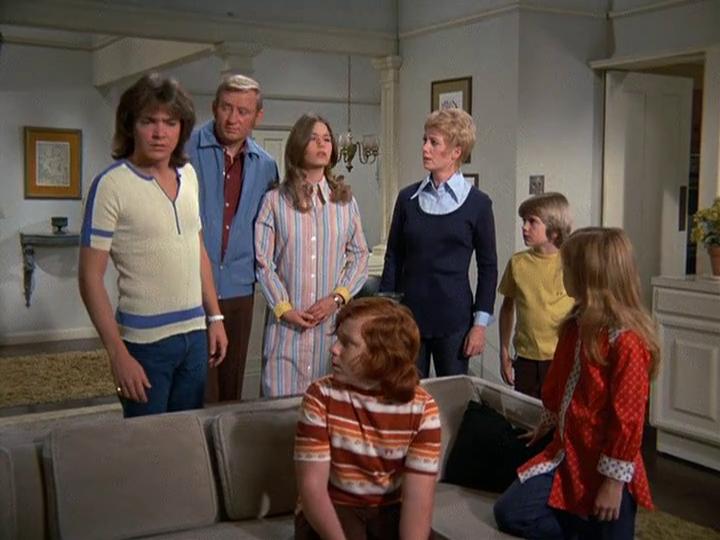
Behind the bright television-pop sheen of The Partridge Family, “There’ll Come a Time” offered something rarer than a catchy chorus: a glimpse of David Cassidy writing in his own name and voice.
On the 1972 album Shopping Bag, The Partridge Family included a song that stands apart for a simple but meaningful reason. “There’ll Come a Time” is notable as a rare track in the group’s catalog written solely by David Cassidy. That one credit changes the way the song is heard. By the time Shopping Bag arrived, Cassidy was not just the visible center of a television and pop phenomenon; he was also living inside the strange tension of being adored as a teen star while trying to be taken seriously as a musician. In that setting, a song carrying only his name as writer feels less like a footnote and more like a quiet act of authorship.
That matters because The Partridge Family was, from the beginning, a carefully built pop enterprise. The television series was a family comedy with music at its center, and the records were crafted with professional precision. Strong songwriters, arrangers, producers, and studio musicians helped create the group’s polished sound. The songs were made to travel easily from television screen to transistor radio, and many of them still do. But in a catalog shaped so often by the machinery of commercial pop, “There’ll Come a Time” carries a different kind of interest. It is not simply another good album cut. It is one of the places where Cassidy’s artistic identity becomes visible inside the larger brand.
By 1972, that identity was becoming harder to ignore. Cassidy had already become one of the most recognizable young entertainers in the world, and the intensity of that fame could blur everything else. Posters, magazine covers, screaming crowds, television exposure, and a public image marketed with remarkable efficiency all threatened to reduce him to a surface: the face, the smile, the star attraction. Yet there was always more happening beneath that image. He cared about music deeply, took recording seriously, and increasingly wanted room to grow beyond the role that had made him famous. A sole songwriting credit on a Partridge Family album may seem like a small thing, but for anyone looking back at his career, it feels revealing. It suggests a young performer trying to leave a personal mark in a space that often spoke for him before he could speak for himself.
The title “There’ll Come a Time” already carries a sense of waiting, change, and inward promise. Even before one begins to think about where the song sits in the album sequence, the phrase itself sounds reflective. It points toward a future moment, but it also contains a present uncertainty: not yet, but someday. That emotional shape suited Cassidy more than many listeners may have realized at the time. His public image was bright, immediate, and everywhere; a title like this suggests patience, distance, and a private horizon. In that contrast lies much of the song’s appeal. It lets us hear not only the performer delivering a tune, but the possibility of the young man measuring time, pressure, and expectation from within.
Shopping Bag as an album belongs to an interesting moment in the Partridge Family story. The project was still active, still tied to a successful television property, still producing records that fit comfortably within early-1970s pop. Yet the culture around it was shifting. The first burst of pure novelty and craze had begun to settle into something more complicated. Cassidy, meanwhile, was also building a career beyond the show, especially as a solo artist. That makes “There’ll Come a Time” feel almost like a bridge between identities. It remains part of the Partridge Family world, but it also hints at an artist thinking beyond it.
What gives the track its lasting fascination is not that it announces a rebellion. It does not need to. The significance is quieter than that. In a discography where image and industrial efficiency were always part of the story, personal authorship carries its own emotional weight. The song asks to be heard not merely as product, but as expression. For longtime listeners, that can subtly change the listening experience. A familiar voice begins to sound a little closer. The distance between star and person narrows. The record still belongs to its era, still carries the clean craft of early-1970s pop, but there is another layer now: the awareness that Cassidy was not only interpreting material. Here, he was shaping it.
That is one reason songs like this often grow in importance over time. They may not be the biggest hits, the most heavily promoted tracks, or the songs that dominate memory at first glance. But later, when the noise of fame has faded and the mythology has softened, they become essential clues. “There’ll Come a Time” tells us something quietly durable about David Cassidy: that inside a highly managed success story, he was still looking for authorship, still reaching toward a fuller musical self. For listeners who know him mainly through the glare of his public persona, that realization can be unexpectedly moving.
In the end, the song’s power lies in how modestly it reveals all this. It does not wave a flag or demand a revisionist history. It simply sits there on Shopping Bag, waiting to be heard with fresh attention. And when it is, it becomes more than a rarity. It becomes a small, clear window into a performer whose gifts were often discussed in terms of fame before they were discussed in terms of craft. Sometimes that is how the truth arrives in pop music: not through the loudest single, but through an album track where, for a few minutes, the machinery quiets down and the artist’s own handwriting comes into view.
