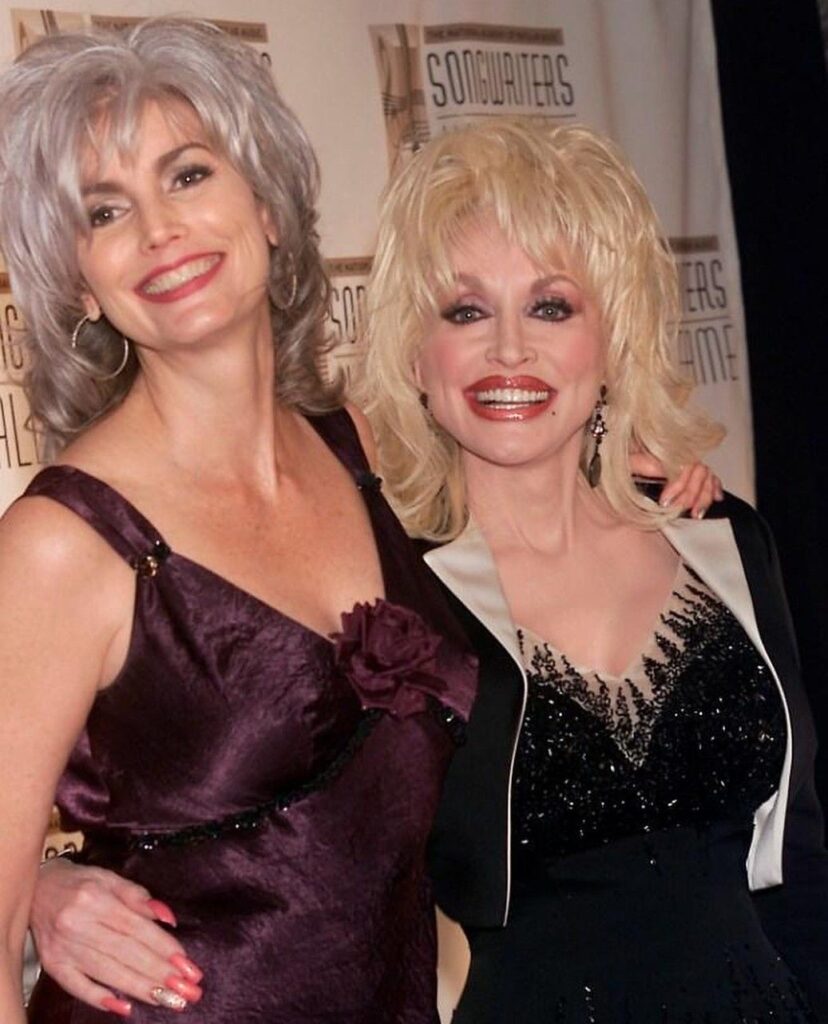
Light of the Stable is one of those rare Christmas songs that feels humble and radiant at once, turning the Nativity into a country hymn of warmth, wonder, and quiet grace.
When Emmylou Harris released Light of the Stable in 1979, she did not give the season a loud holiday spectacle. She gave it reverence. The title track, lifted by the unmistakable presence of Dolly Parton and Linda Ronstadt, arrived as the emotional center of a Christmas album that stood apart from the shinier seasonal marketplace. The album itself reached No. 22 on Billboard’s country albums chart, a solid showing for a holiday release, but the title song was never really about chasing the usual singles race. Its afterlife has been deeper than that. It has endured as a winter hymn, a piece of music people return to when they want Christmas to feel intimate again.
That matters, because by 1979 Emmylou Harris was already one of the most respected voices in American roots music. She had spent the decade restoring grace, intelligence, and old-soul feeling to country music, and that same sensibility carries through Light of the Stable. Released the same year as Blue Kentucky Girl, the song showed another side of her artistry: less heartbreak, less road dust, more stillness. Yet it never sounds separate from the rest of her work. It belongs to the same world of acoustic honesty, moral clarity, and emotional restraint that made her records feel timeless even when they were brand new.
One of the most beautiful things about Light of the Stable is that it sounds older than it is. Many listeners assume it must be a traditional carol handed down through generations, because its language is so simple and its melody so natural. But that is precisely the song’s quiet achievement. It was written in a way that feels inherited rather than manufactured. There is no sense of modern cleverness fighting for attention. Instead, the song breathes like a hymn remembered from childhood, or perhaps from a church too small to need grandeur. It comes to the manger scene not with pageantry, but with humility.
And then there are the voices. Long before the landmark Trio album made their partnership official, Emmylou Harris, Dolly Parton, and Linda Ronstadt were already proving how naturally they belonged together. On this recording, the blend is not flashy. That is the key to its power. No one tries to dominate the moment. The harmonies rise like candlelight, surrounding Harris rather than competing with her. It is one of those country-music miracles in which technique disappears and what remains is pure feeling. You hear not just three great singers, but three sensibilities meeting in the same sacred space: Harris with her lonesome purity, Parton with her mountain radiance, Ronstadt with her grounded emotional strength.
The song’s meaning lives in its nearness. Light of the Stable does not describe the Christmas story as something distant, formal, or unreachable. It brings it down to earth. The stable is not a symbol of splendor; it is a place of straw, animals, night air, shelter, and miracle arriving in ordinary surroundings. That is why the song continues to touch listeners so deeply. It suggests that holiness does not always enter with thunder. Sometimes it comes quietly, through poverty, through tenderness, through the small human act of gathering near a newborn child. Even for listeners who approach it from memory rather than doctrine, the emotional truth remains powerful. The song makes humility feel luminous.
Produced with the tasteful restraint that marked so much of Harris’s best work, the recording avoids the traps that date many holiday albums. There is no syrup here, no heavy seasonal decoration trying to force emotion. The arrangement stays rooted in acoustic textures and open space, allowing the words and voices to do the real work. That is why the performance ages so beautifully. It belongs to winter, certainly, but not merely to shopping-season winter. It belongs to the quieter part of the season, the part that arrives after the noise settles and the heart starts listening.
There is also something moving about the historical moment itself. In 1979, these were not yet nostalgic legends gathered in hindsight; they were living artists at a creative peak, shaping American music in real time. Hearing Dolly Parton and Linda Ronstadt on Light of the Stable now, one can feel the early outline of something cherished long before the music business gave it a formal name. That gives the recording an added layer of beauty. It is not only a Christmas song. It is also a document of friendship, respect, and the kind of musical trust that cannot be faked.
What lasts, finally, is the song’s spiritual temperature. It does not try to overwhelm the listener. It simply glows. In a season that often grows louder every year, Emmylou Harris chose softness, and in doing so she made something stronger than spectacle. Light of the Stable remains one of the most affecting holiday performances in her catalog because it understands a truth many seasonal records miss: the deepest Christmas songs do not perform wonder, they make room for it. That is exactly what happens here, in this gentle 1979 recording where three extraordinary voices turn a stable into a sanctuary.
