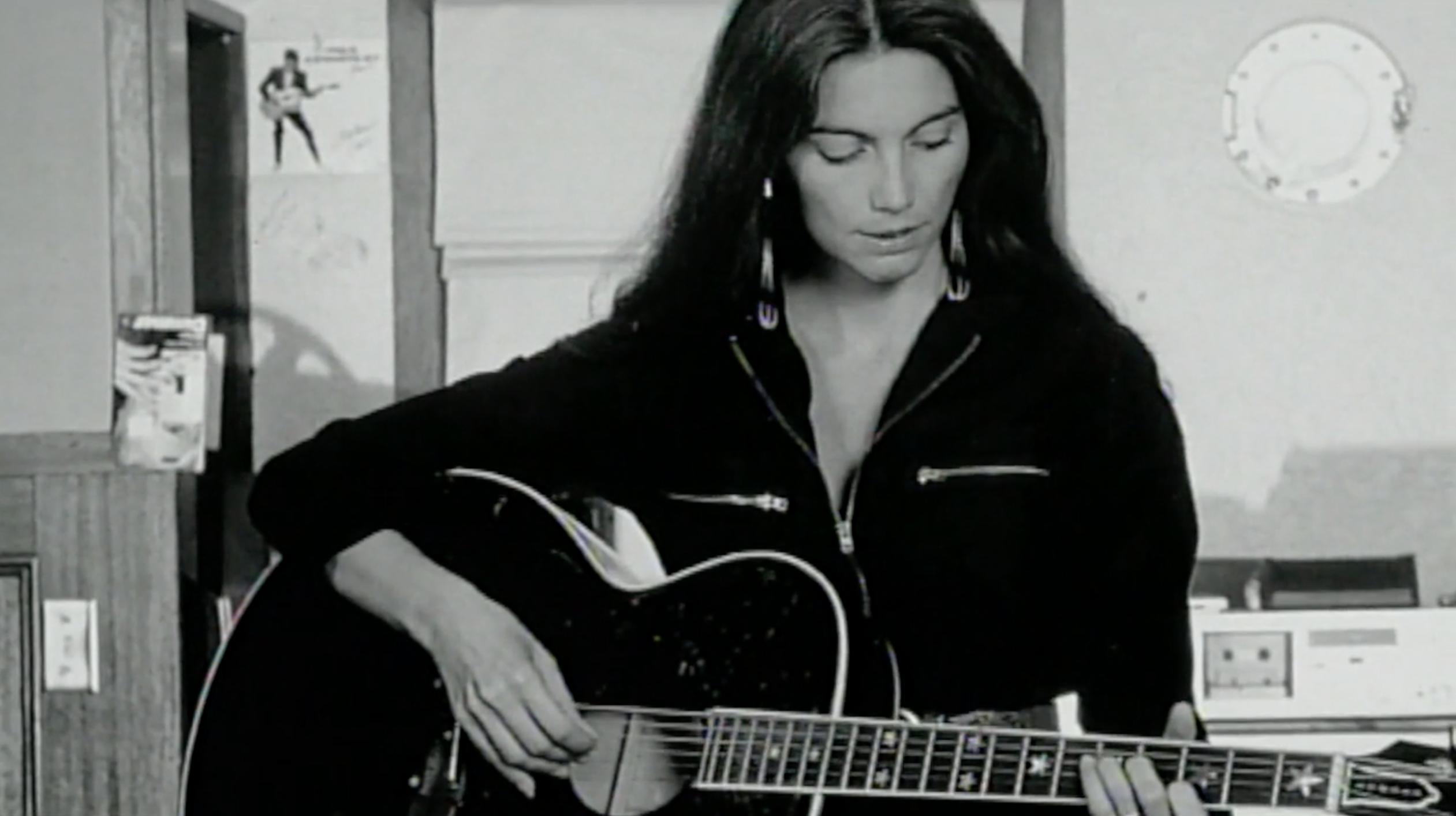
“I Still Miss Someone” is the kind of song that doesn’t “move on”—it simply learns to live beside the ache, like a familiar shadow that returns with the season.
When Emmylou Harris recorded “I Still Miss Someone”, she wasn’t chasing a trend or polishing up a classic for easy nostalgia. She was doing something far more Emmylou: stepping quietly into a song’s inner room and letting its loneliness speak in a new, steadier voice. Her version appears on Bluebird (released January 10, 1989), an album shaped largely around interpretive grace—Harris as curator, translator, and emotional witness rather than loud protagonist.
In terms of its public “arrival,” her recording was issued as the third and final single from Bluebird, and it reached No. 51 on Billboard’s Hot Country Singles & Tracks chart in 1989. That number may look modest, but it tells a truthful story: this is not a song built for flash-bulb success. It’s built for the long relationship between a listener and a memory. Trade press at the time treated it exactly that way—Cash Box singled it out as a “feature pick” in August 1989, praising Harris’ delivery and naming the songwriters outright: Johnny Cash and Roy Cash Jr., with production credited to Emmylou Harris and Richard Bennett.
And that lineage matters, because “I Still Miss Someone” is one of those songs that seems to have been born with mileage on it. Johnny Cash first recorded it on July 24, 1958, for his Columbia debut album The Fabulous Johnny Cash, and it originally appeared as the B-side of “Don’t Take Your Guns to Town.” Even in that early form, the song carried a rare emotional maturity—heartbreak not as youthful catastrophe, but as something quieter: an absence that becomes part of the weather.
By 1989, Emmylou Harris had lived enough life—and sung enough of other people’s songs—to understand that kind of weather intimately. Bluebird itself was made in Nashville in 1988, with Harris and Richard Bennett co-producing, and the album’s premise was almost humble: mostly interpretations, chosen for their writing and emotional truth rather than for their commercial promise. In that setting, “I Still Miss Someone” lands like a page turned carefully, without creasing the spine.
What is the meaning of the song? It’s not simply “I’m sad you’re gone.” It’s the more unsettling confession: time has passed and I’m still not free of you. The lyric’s images are plain—leaves falling, cold wind coming, sweethearts walking by together—ordinary scenes that become unbearable because they keep happening in a world where the beloved is missing. In other words, it’s grief without ceremony, longing without a deadline. The title phrase—“I still miss someone”—is devastating precisely because of that small word still. It implies effort. It implies years. It implies that the heart can be faithful long after the relationship has ended, faithful even when it no longer receives anything back.
Harris sings that “still” with a kind of seasoned tenderness. She doesn’t throw herself onto the floor of the lyric; she stands inside it. There’s a difference. With Emmylou, sorrow isn’t used for drama—it’s treated like truth, handled with clean hands. That restraint becomes its own emotion: you hear the strength it takes to admit you haven’t “gotten over it,” and you hear the dignity of saying it without trying to win anyone’s sympathy.
And perhaps that’s why her version belongs so naturally on Bluebird. The album’s very title suggests something delicate and restless—beauty that can’t be held, only witnessed. In that light, “I Still Miss Someone” feels like a confession made to the evening air: not a message sent to the person who left, but a message acknowledged inside the self. The song doesn’t ask for reunion. It doesn’t promise recovery. It simply honors the stubborn fact that love can outlast its circumstances.
That is the quiet triumph of Emmylou Harris’ “I Still Miss Someone”: it refuses to rush the soul. It treats remembrance as something human rather than something to be “fixed.” And when the last line fades, what remains is not just sadness—it’s recognition. The kind that arrives softly, like the first cold wind of the season, and tells you that some names are never fully left behind.
