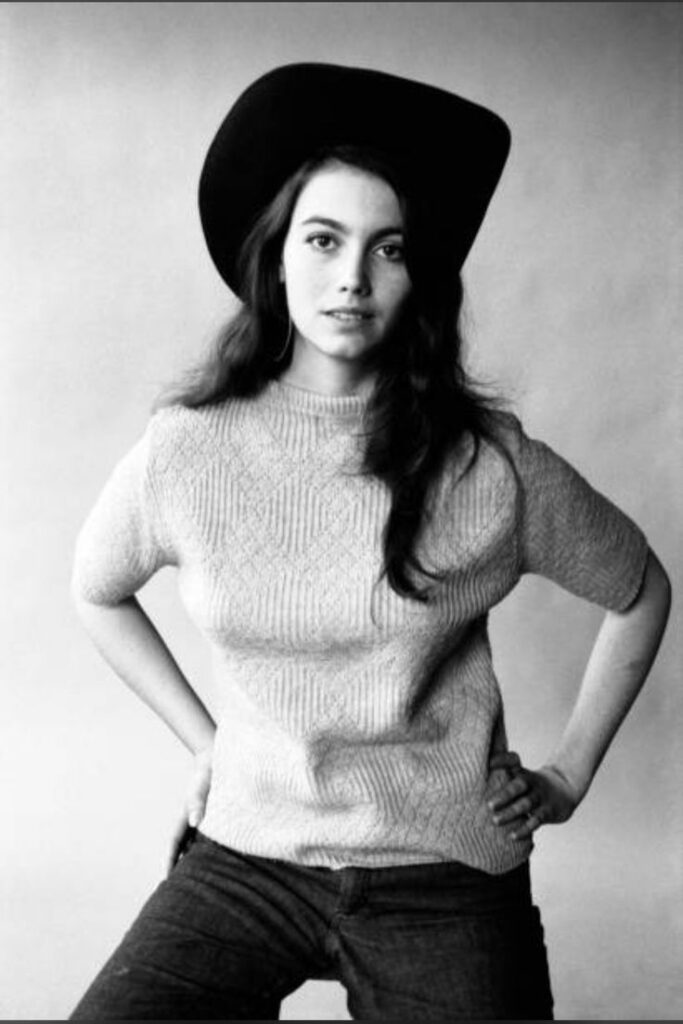
On “Queen of the Silver Dollar”, Emmylou Harris turned a barroom portrait into something warmer, stranger, and more human, with Linda Ronstadt already close enough in the harmony to hint at a partnership still taking shape.
“Queen of the Silver Dollar” appeared on Emmylou Harris’s 1975 album Pieces of the Sky, a crucial early record in her solo career and one of the albums that helped define the graceful borderland between country tradition and the California singer-songwriter world. Written by Shel Silverstein, the song had a theatrical, slightly comic surface: a woman enters the bar each night like royalty, admired, mythologized, and reduced all at once by the men who watch her. In Harris’s hands, though, the track becomes more than a clever character sketch. It becomes a study in tenderness, distance, and the way a voice can notice the ache inside a scene that might otherwise be played only for color.
The detail that gives this 1975 recording an added emotional charge is the presence of Linda Ronstadt on harmony vocals. Long before the long-awaited Trio album with Dolly Parton arrived in 1987, Harris and Ronstadt were already discovering how naturally their voices could lean into each other. Their association in the mid-1970s was not a marketing idea or a polished supergroup concept. It grew out of the shared musical air of Los Angeles, where country, folk, bluegrass, rock, and old-time songcraft were being folded together by artists who respected the past without wanting to live inside a museum.
Pieces of the Sky, produced by Brian Ahern and released on Reprise Records, came at a defining moment for Harris. After her work with Gram Parsons, she was still carrying the emotional resonance of that collaboration, but this album made clear that she was not simply an echo of someone else’s vision. She had a way of choosing songs that made them feel newly illuminated. On the same record, she moved through material associated with country, folk, rock, and traditional song, but the unity came from her phrasing: clear, disciplined, and emotionally alert.
“Queen of the Silver Dollar” benefits from that restraint. A less careful performance might have exaggerated the song’s barroom pageantry, leaning hard into the wink of Silverstein’s writing. Harris does not drain the song of its humor, but she refuses to let humor flatten the woman at its center. Her vocal is bright enough to carry the melody, yet there is a kind of observant compassion in it. The “queen” is presented as a familiar figure in a public room, but Harris sings as if she understands that a public role can become a private cage.
That is where Ronstadt’s harmony matters. Her voice does not arrive as decoration; it gives the track a second emotional temperature. Ronstadt, already a major presence by the mid-1970s, had a voice capable of open, ringing force, but in harmony she could also soften her brightness into something supportive and intimate. Behind Harris, she adds lift without taking command. The blend is not yet the fully enshrined sound that listeners would later associate with Harris, Ronstadt, and Parton, but the seeds are audible: two distinct singers finding a common line without losing their individual characters.
There is something quietly powerful about hearing them this early, before the mythology had settled around their collaborations. Harris’s voice carries the narrative with poise; Ronstadt’s harmony widens the room around it. Together, they make the song feel less like a lone singer describing a barroom scene and more like a shared act of witness. The arrangement has the easy confidence of 1970s country-rock, but the human center is in the vocal relationship: the lead and the harmony moving like two glances at the same person, one direct, one illuminating from the side.
Shel Silverstein’s songwriting often carried a gift for vivid characters and sharp turns of phrase, and “Queen of the Silver Dollar” shows that gift in a country setting. Yet Harris’s recording softens the edges just enough to bring out the song’s melancholy undertow. The bar may be lively, the image may be colorful, but beneath the sparkle is the old question of how women in songs are looked at, named, admired, and misunderstood. Harris does not turn the track into a lecture. She simply sings it with enough humanity that the listener begins to hear the cost of the crown.
As part of Pieces of the Sky, the track also reflects Harris’s larger gift as an interpreter. She could take a song from another writer and make the performance feel inevitable, as if the melody had been waiting for the exact shape of her voice. On this album, she was building a language of her own from inherited materials: old country heartbreak, folk clarity, bluegrass precision, and the spacious feel of West Coast recording rooms. “Queen of the Silver Dollar” sits comfortably in that world, but Ronstadt’s early harmony gives it an added historical glow.
Looking back, the recording feels like a small but meaningful doorway. It is not just an album cut from a breakthrough era; it is an early audible trace of a musical friendship that would later become one of American roots music’s most beloved vocal alliances. The song still works because it never asks too loudly for importance. It lets a clever lyric, a graceful lead vocal, and a sympathetic harmony do the work. And somewhere in that blend, before the grander chapters arrived, Harris and Ronstadt were already showing how two strong voices could make a song feel more generous than it first appeared.
