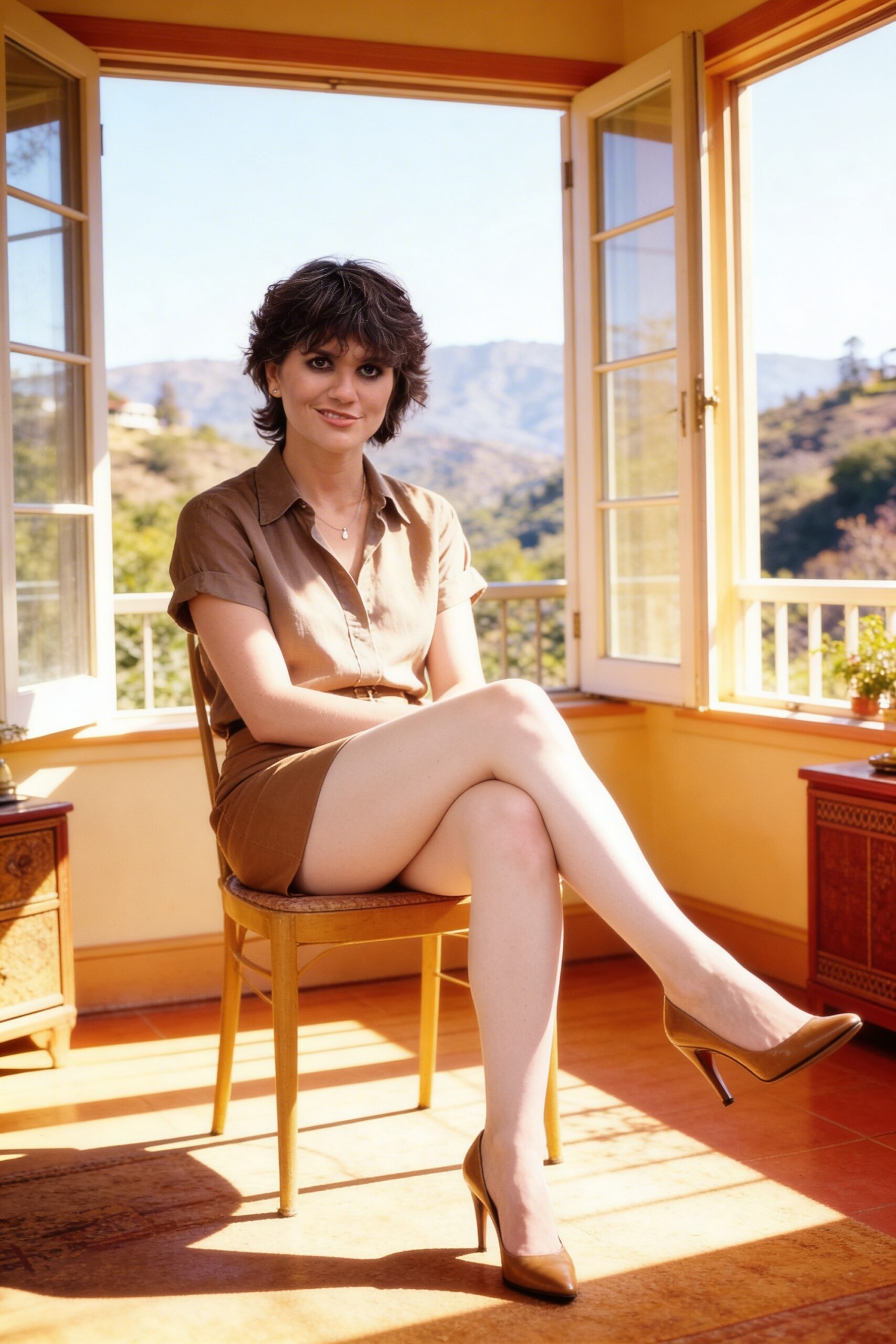
At The Troubadour, Linda Ronstadt turned Neil Young’s “Birds” into a small, suspended moment where a nightclub room seemed to lean closer to every word.
The version of “Birds” that appears on Linda Ronstadt’s 1972 self-titled album is not simply a cover of a Neil Young song. It is a live recording from The Troubadour in West Hollywood, and that detail changes the way the performance breathes. Instead of arriving as a polished studio statement, it carries the nearness of a room, the faint pressure of an audience, and the fragile attention that gathers when a singer chooses not to overwhelm a song but to stand inside it carefully.
Neil Young first released “Birds” on his 1970 album After the Gold Rush, a record filled with strange tenderness, spare imagery, and songs that seemed to drift between private confession and wide-open American unease. In Young’s hands, “Birds” is brief and wounded, almost severe in its simplicity. Its melody does not rush toward resolution. Its words suggest departure, distance, and the quiet recognition that love sometimes leaves without making a grand speech. Ronstadt’s live reading at The Troubadour respects that stillness, but it does not imitate Young’s guarded tone. She lets the song become more openly human, less shadowed by mystery and more touched by flesh and breath.
By 1972, Ronstadt was in a fascinating in-between place. She had already made her name with Stone Poneys and the 1967 hit “Different Drum”, and she was deepening her solo identity in the Los Angeles country-rock and singer-songwriter world. Her album Linda Ronstadt, released on Capitol Records, captured her as an artist still searching, testing the edges of country, folk, rock, rhythm and blues, and the new California sound forming around her. Around this period, the circle of musicians near her included figures who would help define West Coast rock in the decade ahead, but on “Birds” the focus narrows to something more intimate: a singer, a song, and a club known for making careers feel both public and personal at the same time.
The Troubadour mattered because it was more than a venue. It was a listening room with history in its walls, a place where songs could be tried in front of people who understood both craft and risk. The stage did not require spectacle. It rewarded concentration. For a song like “Birds,” that environment was ideal. The performance does not depend on volume or dramatic gesture. Its force comes from Ronstadt’s control: the way she holds a line just long enough, the way she lets a phrase settle before moving on, the way her voice carries emotion without pushing it into melodrama.
What makes her interpretation so affecting is the tension between youth and command. Ronstadt was still before the massive commercial ascent that would bring albums such as Heart Like a Wheel and Simple Dreams later in the 1970s. Yet the essential qualities were already present: the clarity, the instinct for choosing songs that suited her emotional range, and the rare ability to make borrowed material feel personally inhabited. She did not need to write “Birds” to make it sound as though it had passed through her own life on the way to the microphone.
There is also something revealing about her choice of a Neil Young composition. Ronstadt had a gift for hearing the inner life of songs written by others. She could draw out country ache from a rock lyric, or bring pop immediacy to an old standard without flattening its original character. With “Birds,” she finds the space between folk restraint and country lament. The melody remains delicate, but her voice gives it a warmer contour. Where Young’s original can feel like a message sent from a lonely room, Ronstadt’s live version feels like that message being read aloud in front of people who suddenly understand more than they expected to.
Because it was included on her self-titled 1972 album rather than left as a concert footnote, the Troubadour performance became part of the official story of Ronstadt’s early solo years. It sits among songs by writers and interpreters connected to the era’s restless musical crosscurrents, helping show how carefully she was building a vocabulary of feeling. She was not yet presenting herself as one fixed kind of singer. She was gathering songs that allowed her to reveal different temperatures of the same voice: strength, vulnerability, wit, longing, and restraint.
Listening to this live “Birds” now, the most powerful thing may be how little it tries to announce itself. It does not demand importance. It asks for quiet. It asks the listener to notice the small changes in tone, the breath before a phrase, the dignity of a singer trusting the song’s plain shape. The Troubadour setting gives the recording a sense of shared silence, as if the audience understood that applause would come later, but the real moment was happening in the space between notes.
That is why this performance still deserves attention. Not because it is the largest or most famous recording in Linda Ronstadt’s catalog, but because it shows her art at a revealing angle. Before the full blaze of stardom, before the great run of albums that made her one of the defining voices of her generation, she was already doing something subtle and difficult: taking another writer’s song and making its sorrow feel newly present, without claiming it too loudly. At The Troubadour, “Birds” did not need to fly far to leave a mark. It only needed a room willing to listen.
