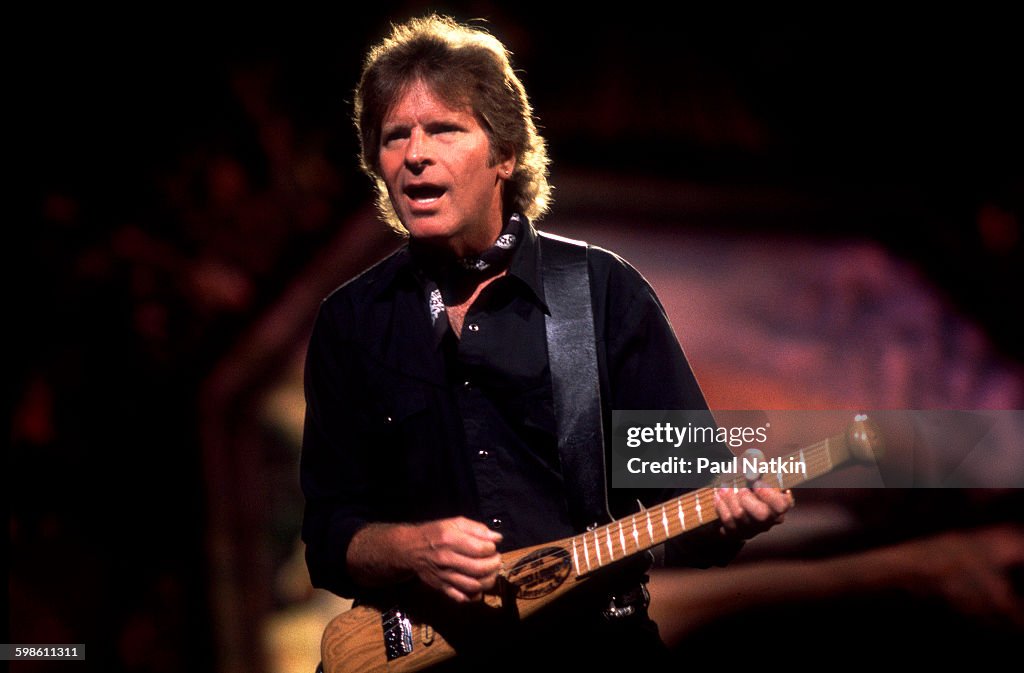
“Rockin’ All Over the World” was more than a hit single in 1975—it was John Fogerty’s bright, defiant way of stepping out of the long shadow of Creedence Clearwater Revival and proving his voice could still shake the air.
There is something wonderfully direct about “Rockin’ All Over the World”. It does not arrive wrapped in mystery, and it does not ask for patience. It kicks the door open with rhythm, motion, and that unmistakable John Fogerty urgency—the kind of sound that seems built for movement, for highways, radios, open windows, and the feeling that life is trying to start again. Released on John Fogerty’s 1975 self-titled solo album, the song climbed to No. 27 on the Billboard Hot 100, a strong showing for an artist who was no longer fronting one of the most beloved American bands of the era, but trying to define what came next on his own terms.
That context matters, because this was not just another rock single. It was a statement. By 1975, Fogerty had already lived through the astonishing rise of Creedence Clearwater Revival, one of the most potent run-making bands of the late 1960s and early 1970s. In just a few short years, CCR had produced an almost impossible string of classics—songs that sounded rooted in American soil yet somehow larger than geography itself. But success had come with strain, and after the band’s collapse, Fogerty entered a far more uncertain chapter. The public still knew the voice. They still knew the writing. But the question hanging in the air was whether John Fogerty, standing alone, could create a new identity without turning away from the gifts that made him essential in the first place.
The album John Fogerty answered that question with grit and clarity. It was not an attempt to escape his musical instincts. If anything, it showed how deeply those instincts belonged to him. “Rockin’ All Over the World” carried the same plainspoken force that had always made Fogerty such a singular songwriter: simple language, relentless momentum, and a chorus so natural it feels less like composition than instinct. The song is built on motion and release. It sounds like someone refusing to stay cornered by the past.
Lyrically, the song is not complicated, and that is part of its strength. Fogerty was never an artist who needed ornate lines to make something memorable. He understood how repetition, phrasing, and drive could turn a straightforward idea into something communal. In “Rockin’ All Over the World”, the phrase itself becomes a kind of promise. It suggests connection, durability, and sheer musical reach. Coming from an artist in transition, it can also be heard as something more personal: a declaration that the music would keep traveling, that the signal was still strong, that he was not finished.
What makes the track especially moving in hindsight is how naturally it bridges two different lives in Fogerty’s career. On one side is the writer and singer associated forever with CCR, with all the mythology and pressure that came with that legacy. On the other is the solo artist trying to claim his own name in public. This song stands right on that threshold. It does not sound wounded, though there had been plenty to be wounded by. It sounds energized. It sounds like a man choosing momentum over bitterness.
Musically, that confidence is everywhere. The beat is urgent without being heavy. The guitar work is clean and punchy. The arrangement wastes no time. There is a craftsman’s economy in the recording—nothing ornamental, nothing indulgent, just a sharp sense of how to make a song move. And above it all is Fogerty’s voice, still one of the most instantly recognizable instruments in American rock. He sings as if the road is already beneath him.
Of course, the song’s story did not end with its original chart run. Over time, “Rockin’ All Over the World” grew far beyond its first life as a 1975 solo hit. It would later become internationally famous through Status Quo’s hit cover version, which helped turn it into a true stadium standard. That later chapter is important, but it should never erase the emotional power of Fogerty’s original. Before crowds made it thunder from arenas and festival fields, it was a solo-era record by a songwriter rebuilding himself in plain view.
That is why the song still lands with such force. It carries uplift, yes, but not the empty kind. The joy inside it feels earned. This is not the sound of someone pretending the past never happened. It is the sound of someone stepping through it. In that sense, the single’s success on the charts was meaningful, but the deeper victory was artistic. John Fogerty proved that his voice, his drive, and his sense of rock and roll purpose were still entirely his own.
Many songs become anthems because they are loud enough, catchy enough, or easy enough for crowds to claim. “Rockin’ All Over the World” did become that kind of anthem eventually. But its first and most human meaning may be the one heard in 1975: a gifted artist, carrying history on his back, finding a way to sound free again. That is the heartbeat inside the song. And perhaps that is why it has traveled so far. It was born not just from celebration, but from renewal.
