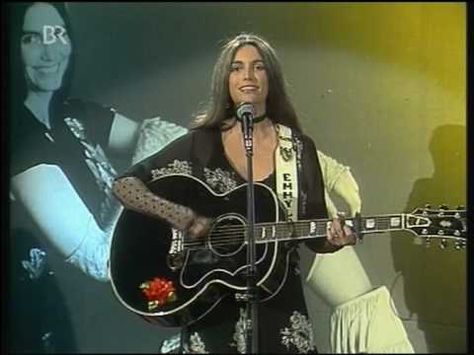
Before The Oak Ridge Boys made it a No. 1 country hit, Emmylou Harris had already lit the fuse — and on “Leaving Louisiana in the Broad Daylight,” she turned speed, danger, and desire into one of the most thrilling deep cuts of her 1970s run.
There is something deeply satisfying about setting the record straight on “Leaving Louisiana in the Broad Daylight.” Yes, The Oak Ridge Boys took the song to No. 1 on the country chart in 1980, after releasing it as a single in December 1979. But before that chart coronation, Emmylou Harris had already recorded and released it on her 1978 album Quarter Moon in a Ten Cent Town. In other words, the fire was already burning — the Oak Ridge Boys made it a smash, but Emmylou had already shown just how alive, how fast, and how irresistible the song could be.
That matters because Emmylou’s version does not feel like a rehearsal for somebody else’s hit. It feels definitive in its own right. The song was written by Rodney Crowell and Donivan Cowart, and that authorship is part of the story. Crowell had been in Harris’s band in the late 1970s, so this was not some random outside tune dropped into her lap. It came from within her own musical orbit, from the same circle of players and writers helping shape the sound around her. That gives the song a naturalness in her catalog — as if it belonged there from the start, waiting for exactly her voice to kick it into motion.
And what motion it has. “Leaving Louisiana in the Broad Daylight” is one of those country songs that moves like a getaway car with the windows down. The title alone is magnificent — bold, visible, almost reckless. Nobody is sneaking away under cover of darkness here. They are leaving in daylight, in plain sight, with all the consequences already chasing behind. The lyric’s story of Mary running off with a traveling man while her father gives chase has the shape of pure Southern folklore: romantic, comic, dangerous, and a little wild around the edges. That built-in velocity is exactly why the song catches so hard. It is not merely about escape. It sounds like escape.
What Emmylou Harris adds is a kind of control inside the rush. A lesser singer might have leaned too hard into the novelty of the story or made the whole thing sound cute. Harris never does that. She keeps the performance light on its feet, but never flimsy. Her voice gives the song brightness, but also poise. She sounds like someone who understands that the fun of the song depends on its danger staying real. That is one of her great strengths as an interpreter: she could make a track feel breezy without draining it of emotional stakes. On this song, she does exactly that. The excitement is there, the humor is there, the momentum is there — but so is a grown-up sense of consequence humming underneath it all. That tension is what makes the performance catch fire.
The album around it helps explain why the song lands so perfectly. Quarter Moon in a Ten Cent Town reached No. 3 on the Billboard country albums chart and came from a period when Harris was making some of the richest records of her career. The album also featured “To Daddy,” “Two More Bottles of Wine,” and “Easy From Now On,” but part of what makes it such a rewarding record is the depth of the non-single material. “Leaving Louisiana in the Broad Daylight” was one of those album cuts that serious listeners kept close because it revealed something essential about Harris: she was not only a singer of sorrow and grace. She could also ride a song with snap, nerve, and sheer pleasure.
There is also a lovely irony in the song’s later history. The Oak Ridge Boys version became the commercial benchmark, spending a week at No. 1 and helping carry the song into mainstream country memory. But that later success almost proves the original point in Emmylou’s favor. Songs only become hits like that when the writing is already strong — and Harris had already recognized its force, already cut it, already given it a first life vivid enough that later artists could hear the potential. One country critic even noted that several early-1980s No. 1 country hits were first heard through Emmylou Harris recordings, which says a great deal about her ear. She was often hearing tomorrow’s hit before the rest of country radio caught up.
So yes — before The Oak Ridge Boys took it to No. 1, Emmylou Harris was already setting “Leaving Louisiana in the Broad Daylight” on fire. Her version still feels like the spark: quick, elegant, story-rich, and full of that wonderful Emmylou mix of beauty and bite. The Oak Ridge Boys made it famous in the most obvious chart sense. But Harris had already made it thrilling. And that is why her recording still matters so much — not as a footnote to the hit, but as the first great ride the song ever took.
