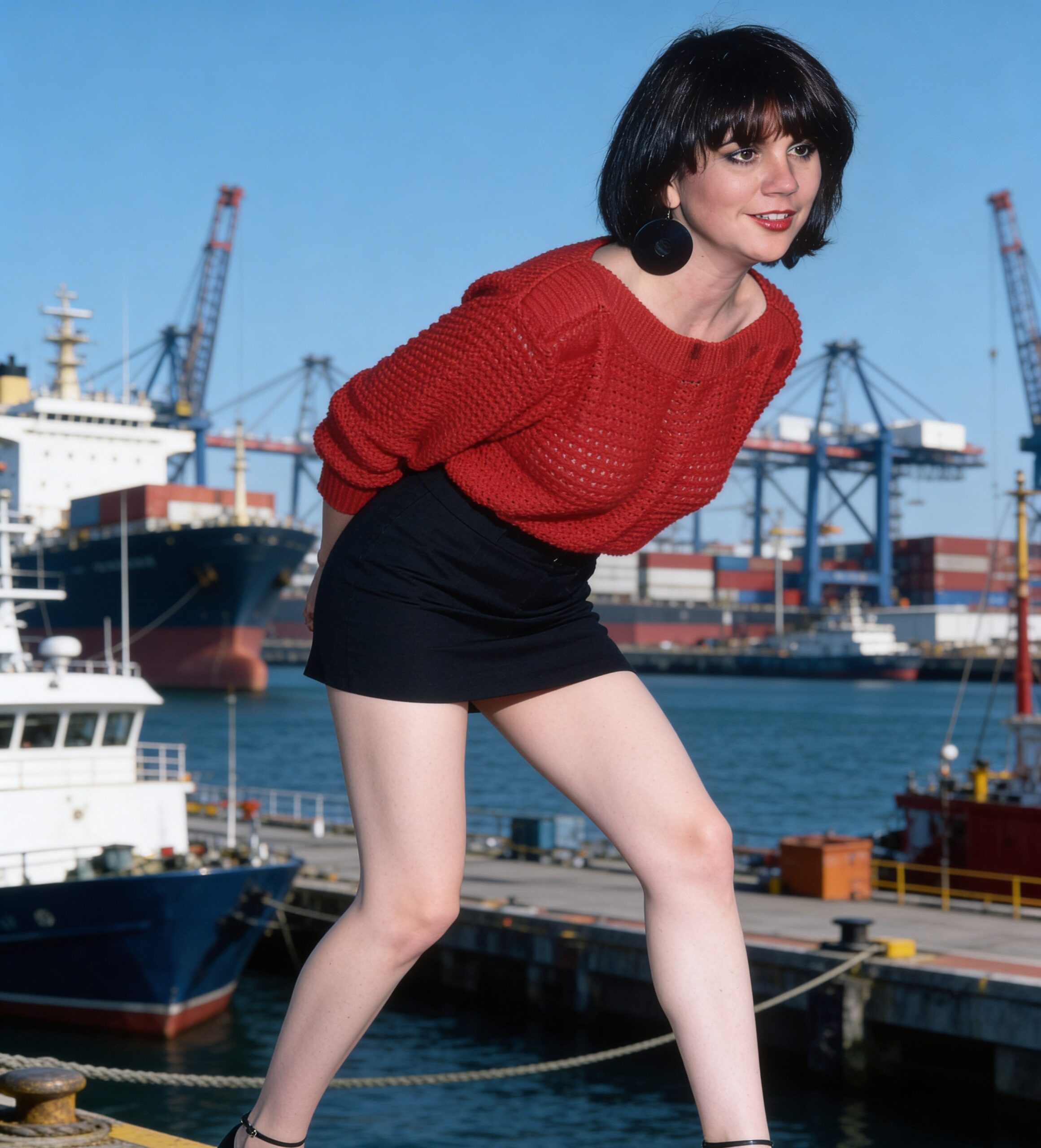
In a studio built for television, Linda Ronstadt turned Elvis Costello’s sharp-edged Party Girl into a live confession, caught between new-wave bite and her own generous ache.
Linda Ronstadt‘s live performance of Party Girl, recorded at Television Center Studios for her 1980 HBO special, belongs to a very particular moment in her career: the point where one of America’s most beloved voices stepped directly into the charged air of new wave and proved she could make its clipped nerves sound deeply human. The song was written by Elvis Costello and first appeared on his 1979 album Armed Forces, a record full of sharp angles, wordplay, and emotional evasions. Ronstadt brought Party Girl into her own world on Mad Love, the 1980 album produced by Peter Asher that found her trading some of the Californian softness associated with earlier hits for tougher guitars, quicker tempos, and a more restless vocabulary.
That context matters because the HBO performance is not simply a television run-through of an album cut. It is a document of an artist in motion. By 1980, Ronstadt had already moved through country-rock, Mexican-rooted songs, ballads, rock and roll revivals, and pristine pop heartbreak with remarkable assurance. She was not a singer who needed to borrow credibility from anyone. Yet Mad Love placed her beside songwriters and sounds that some listeners associated with a younger, nervier scene. Costello’s songs, especially, carried a kind of emotional compression. They often seemed to say one thing while meaning three others. For a singer as open-throated and emotionally legible as Ronstadt, that created a fascinating tension.
On the 1980 HBO special, filmed in the controlled setting of Television Center Studios, that tension becomes visible. A television studio is different from an arena. It has its own pressure: the cameras are close, the performance is framed, and every glance or breath feels less protected by distance. Ronstadt’s gift was never only volume or range, though she had both in abundance. It was the way she could enter a lyric and make it sound as if the singer had arrived at the feeling a second before the audience did. In Party Girl, she does not merely imitate Costello’s sneer or reproduce the brittle surface of the original. She opens the song from within.
Costello’s version has the sting of a man watching social performance become emotional damage. It is sharp, unsparing, and self-aware. Ronstadt’s live reading does something subtler. She keeps the song’s edge, but she lets the lines breathe. The phrase Party Girl can sound accusatory in one mouth and wounded in another. In Ronstadt’s, it carries both judgment and pity, as though the singer is looking at someone across a room and seeing the mask, the performance, and the loneliness underneath it all at once. That is what makes the Television Center Studios version so compelling: it respects the song’s cool surface while refusing to leave it cold.
The arrangement around her leans into the rock energy of the period without burying the voice. The guitars have urgency, the rhythm keeps the song moving, and the production style of the special gives the performance a clean immediacy. There is no need for theatrical excess. Ronstadt stands inside the song with the discipline of a seasoned performer and the curiosity of someone still willing to be challenged by new material. That combination was one of her great strengths. She could make a standard feel newly discovered, a country song feel conversational, a rock song feel elegant, and a new-wave lyric feel less like attitude than confession.
It is easy, in retrospect, to smooth Ronstadt’s career into a neat story of versatility. But performances like this one are more interesting than that word suggests. Versatility can sound casual, as though she simply moved from style to style without friction. The 1980 HBO Party Girl has friction. It carries the sound of a singer testing how far her interpretive instincts could go inside a song built from a different emotional architecture. The result is not Costello softened, nor Ronstadt hardened. It is a meeting point: his angular songwriting, her command of feeling, and a television studio performance that catches the exchange in real time.
For listeners who know Ronstadt mainly through Blue Bayou, You’re No Good, When Will I Be Loved, or the grander ballads that later filled her songbook, this live version can feel like a door opening onto another room. The voice is familiar, but the room is sharper, brighter at the edges, less forgiving. She does not ask the song to become comfortable. Instead, she shows that discomfort can be musical, that elegance can have teeth, and that a polished singer can still sound exposed when the right lyric presses against her.
What remains, decades later, is not only the novelty of Linda Ronstadt singing Elvis Costello on HBO in 1980. It is the deeper pleasure of hearing a great interpreter refuse to treat interpretation as decoration. She listens to the song’s trouble. She follows its quick turns. She finds the ache under the pose. In that studio, under the demands of television and the pulse of a changing rock landscape, Party Girl becomes something more than a cover. It becomes a glimpse of Ronstadt at a crossroads, fully herself because she was willing to step into unfamiliar light.
