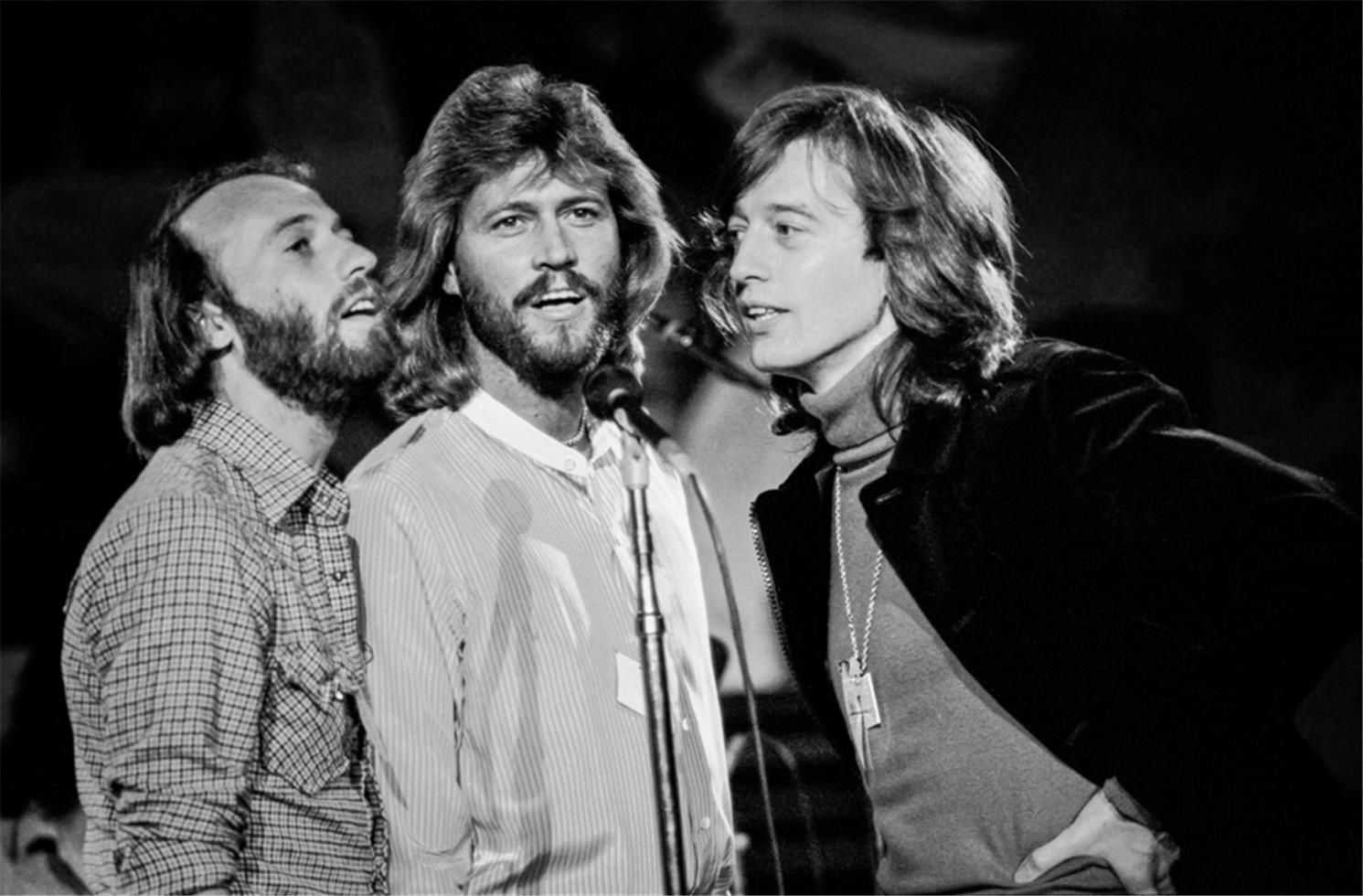
Before the harmonies conquered the world, “Spicks and Specks” revealed the young Bee Gees as songwriters of unusual sadness, beauty, and quiet ambition in 1966 Australia.
When Bee Gees released “Spicks and Specks” in Australia in September 1966, they were still a hardworking local act rather than an international phenomenon. Yet this single would become the record that changed the emotional weather around them. It rose steadily and reached No. 1 on Australia’s Go-Set national chart in early 1967, giving Barry, Robin, and Maurice Gibb their first major nationwide breakthrough just as the group was preparing to leave Australia and head back to Britain. In hindsight, that timing feels almost cinematic. The song arrived at the exact moment when one chapter was closing and another, far bigger one, was about to begin.
That is why “Spicks and Specks” matters so much. It was not simply a hit. It was a bridge. Everything the world would soon recognize in the later Bee Gees was already here in fragile, beautiful outline: the melancholy, the careful melody, the sense that even a pop single could carry a bruise beneath the surface. Long before the band’s grand reinvention in Britain, long before the orchestral sweep of “Massachusetts” or the emotional majesty of “To Love Somebody”, this Australian record hinted that the brothers were reaching for something more lasting than passing radio excitement.
The story behind the song is inseparable from the group’s Australian years. The Gibb family had moved to Australia in 1958, and by the mid-1960s the brothers had spent years learning the trade through local television, club appearances, and a run of early singles. They were talented, busy, and increasingly ambitious, but they had not yet found the song that would gather all their strengths into one unforgettable statement. Barry Gibb, still very young, wrote “Spicks and Specks” with a sensitivity that already felt older than his years. The title phrase itself means little bits and pieces, scraps, fragments left behind. That image becomes the heart of the lyric: a person trying to live among the remains of a lost love, surrounded not by dramatic wreckage but by small reminders that refuse to disappear.
That emotional modesty is one of the song’s greatest strengths. “Spicks and Specks” is not loud heartbreak. It is the quieter pain that lingers after the room has gone still. The arrangement, shaped in the group’s Australian recording environment with producer Nat Kipner playing a crucial role in this phase of their career, does not overpower the feeling. Instead, it supports the vocal blend and lets the melody carry the sadness. There is a distinctly mid-1960s pop frame around it, of course, but inside that frame is something deeper and more inward-looking. You can hear a young band moving away from simple beat-group energy and toward a more reflective, crafted kind of songwriting.
That is what makes the record so fascinating today. If someone knows the Bee Gees mainly from their later worldwide fame, especially the disco era, “Spicks and Specks” can come as a revelation. There is no glittering dance-floor pulse here, no swagger, no reinvention yet. What you hear instead is vulnerability, precision, and a kind of emotional weather that would remain central to the group even as their sound changed dramatically over the years. The famous harmony blend is already deeply expressive. The brothers were not merely singing together; they were learning how to make sorrow sound elegant.
The single’s success also had practical consequences. It became the title track of the 1966 Australian album Spicks and Specks, and its popularity strengthened the sense that the brothers were ready for a larger stage. Soon after, the group returned to England, where their career would be reshaped and relaunched for an international audience. Under new circumstances and with stronger industry support, they would quickly emerge as one of the era’s most distinctive pop acts. But that later triumph can sometimes make people forget that the turning point happened first in Australia. Before the reinvention, before the mythology widened, “Spicks and Specks” was the proof that the songcraft was real.
There is also something especially moving about hearing the record now with the full sweep of history behind it. It captures the Bee Gees at the edge of transformation, still close enough to their beginnings that you can hear the hunger in the performance. They sound like artists who know more is possible, even if they cannot yet see the full shape of what is coming. That gives the song an extra layer of poignancy. It is about fragments and memory, yes, but it has also become a fragment of the group’s own story: the last great Australian signal before the international world opened.
For many listeners, that is why “Spicks and Specks” still lands with such force. It belongs to 1966, but it does not feel trapped there. It remains one of those early records that lets you hear destiny before it becomes obvious. In just a few minutes, Bee Gees moved beyond being promising local entertainers and sounded like what they truly were becoming: major songwriters, master harmonists, and artists whose sense of longing would carry across decades. The breakthrough was Australian. The future was global. And this song, wistful and precise, stood right in the doorway between the two.
