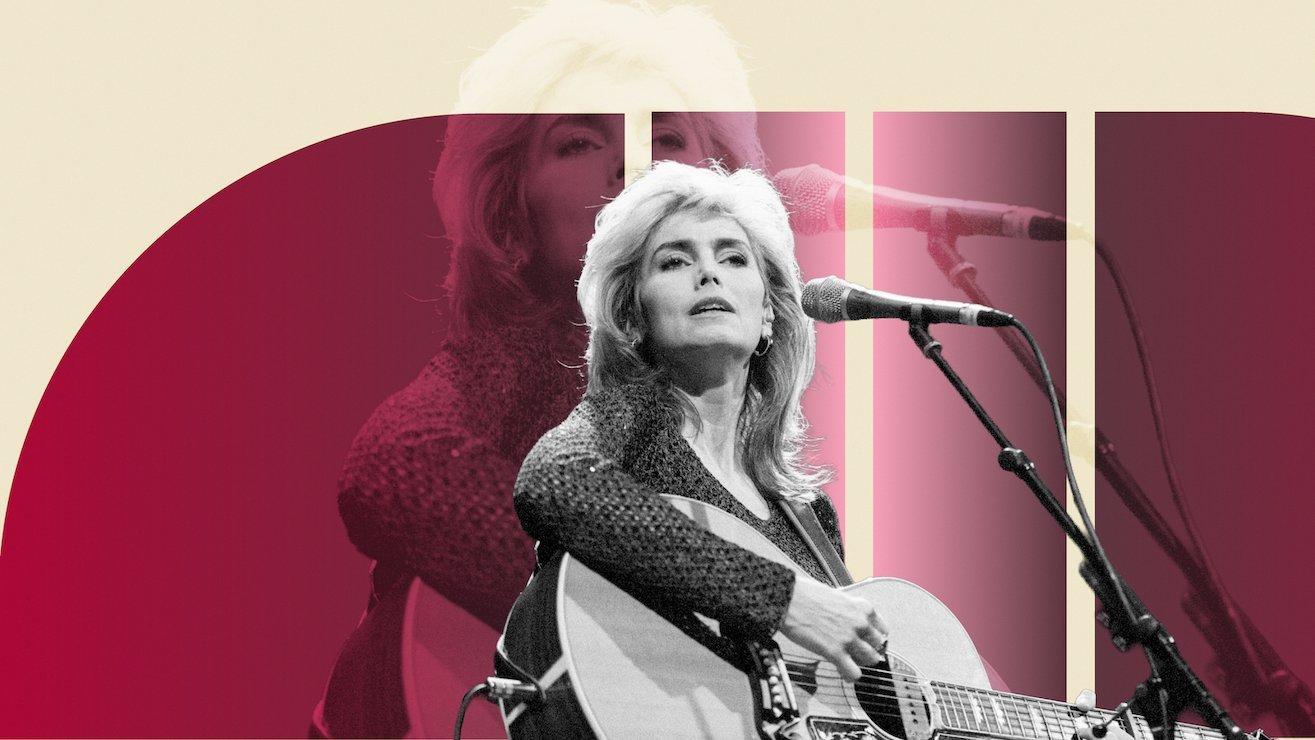
On Wrecking Ball, Emmylou Harris turned “Orphan Girl” into something both new and ancient—a 1995 recording that revealed the coming power of Gillian Welch while sounding as old as the hills.
When Emmylou Harris released Wrecking Ball in 1995, she was already one of the great interpreters in American music. Yet this album did not feel like a victory lap. It felt like a brave change in weather. Produced by Daniel Lanois, the record wrapped Harris’s voice in mist, echo, and midnight space, moving her away from tidy Nashville expectations and toward something more elemental. “Orphan Girl” sits quietly inside that masterpiece, but it is one of the album’s most important tracks. The song was not a major chart single, and Wrecking Ball itself was more slow-burning than radio-dominating, reaching the country album chart before growing far beyond chart arithmetic through critical acclaim and word of mouth. By the time the album earned the Grammy for Best Contemporary Folk Album, its importance was already clear. Harris had made one of the defining records of her later career.
What makes “Orphan Girl” so special is the lineage hidden inside it. On paper, this was not an old Appalachian relic rescued from the past. It was a contemporary composition by Gillian Welch, a young songwriter who had not yet released her own debut album, Revival, which would arrive in 1996. That detail matters. In 1995, many listeners had never even heard Welch’s name. Emmylou Harris heard the depth immediately. She recognized that this was not merely a well-written new song. It was the kind of song that seemed to carry dust from church floors, family sorrows, and mountain hymns inside its bones.
That is the marvel of Gillian Welch’s writing, and it is one reason the world she would soon deepen with David Rawlings became so important to modern roots music. Welch could write songs that sounded inherited rather than manufactured. “Orphan Girl” is built in the language of old-time gospel and rural lament: the lonely child of earth, the absent family, the hope of heavenly belonging. The words are plain, but they travel far. “I have no mother, no father,” the song says in essence, and from that stark opening it reaches toward a home beyond earthly loss. It is spiritual, yes, but it is also emotional in a more human sense. The ache is not only religious. It is the ache of dislocation, of standing in the world without protection, without sure claim, without a place where one fully belongs.
Emmylou Harris was almost uniquely qualified to sing that kind of song. Throughout her career, she had been a keeper of tradition without ever sounding museum-bound. She carried the country sorrow of the Louvin Brothers, the haunted folk-country beauty linked to Gram Parsons, and the discipline of a singer who understood that understatement can wound more deeply than display. On Wrecking Ball, she brought all of that history into a new sonic frame. So when she sang “Orphan Girl”, it did not feel like a veteran artist borrowing from a younger writer. It felt like one great musical bloodline recognizing another.
Daniel Lanois deserves special credit for the atmosphere of the 1995 recording. He did not dress the song in heavy drama. Instead, he gave it distance and air. The production floats, but the song itself stays rooted. That balance is essential. Too much reverence and it might have turned into a period piece; too much polish and the old-time spell would have broken. Instead, Harris’s voice arrives like a lantern moving through fog. The result is not antique re-creation, and not modern country either. It is a dream-state where gospel memory, folk minimalism, and ambient production meet in the same room.
The meaning of “Orphan Girl” deepens when heard in the context of Wrecking Ball as a whole. This was an album of searching, surrender, weathered faith, and emotional endurance. Harris sang songs by Neil Young, Lucinda Williams, Steve Earle, Bob Dylan, and others, but she did not treat them as trophies from famous writers. She made them chapters in one emotional book. Within that sequence, “Orphan Girl” becomes one of the record’s most tender revelations. It is small in scale, but enormous in feeling. It tells us that Harris was listening not only backward to the traditions she loved, but forward to the next generation of American songwriting.
That is why the song still lingers. It preserves a beautiful moment of artistic recognition: Emmylou Harris, already revered, hearing in Gillian Welch a voice that could renew the oldest forms without cheap imitation. And it also preserves one of Harris’s finest gifts as an interpreter. She did not simply sing songs well; she knew how to reveal their ancestry. In her hands, “Orphan Girl” sounded like a hymn remembered, a family story half-lost, and a modern composition all at once.
For listeners who return to Wrecking Ball after all these years, that may be the deepest pleasure of the track. It reminds us that musical tradition is not a fixed museum shelf. It is a living chain of recognition, passed from writer to singer, from elder voice to emerging one, from old forms into new hands. “Orphan Girl” may speak in the voice of abandonment, yet the song itself proves the opposite. It belongs to a lineage—and on Emmylou Harris’s 1995 recording, that lineage became impossible to ignore.
