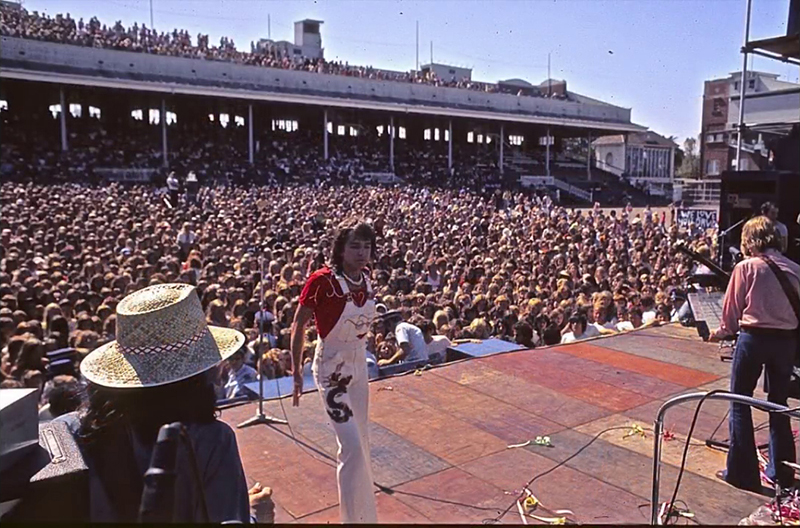
In 1973, David Cassidy made room for something quieter with “Song for a Rainy Day”—an overlooked recording that sounded less like teen-idol triumph and more like a young star turning inward after the first great rush of fame.
By the time “Song for a Rainy Day” arrived in 1973, David Cassidy was no longer simply a promising pop figure. He was already a phenomenon. The fame generated by The Partridge Family and his early solo records had become enormous, especially in Britain, where “How Can I Be Sure” had reached No. 1 in 1972. That chart success matters here, because it reminds us just how loudly the world was hearing him at the time. And yet this particular song did not become one of the big chart-signaling moments of his career. It was not the sort of release that stamped itself onto the singles race. Instead, it slipped by more quietly, which may be exactly why it feels so revealing now.
There is something deeply human about that contrast. Publicly, David Cassidy was still associated with adoration, posters, magazine covers, sold-out shows, and the feverish energy of early-1970s pop stardom. But “Song for a Rainy Day” suggests a different emotional weather altogether. It sounds like a pause. It sounds like someone stepping away from noise rather than trying to compete with it. That is what makes the recording so interesting in the context of 1973: it arrived after his first fame peak, when the image was already fixed in many people’s minds, yet the song itself hints at an artist trying to make space for something gentler, more private, and more truthful.
What gives the recording its lasting appeal is not grand drama but restraint. So many songs attached to teen-idol fame are remembered for brightness, immediacy, or a push toward instant affection. “Song for a Rainy Day” moves in another direction. Its mood is reflective rather than showy. Its emotional force comes from softness, from a sense of interior weather, from the feeling that the singer is no longer performing only for the crowd but also for himself. That inward quality is easy to miss if one approaches David Cassidy only through the biggest headlines of his career. But once heard in the right spirit, the song opens a door into a more nuanced portrait of him.
The title alone carries a quiet wisdom. A rainy day song is not necessarily about heartbreak in the blunt, dramatic sense. It is about mood, memory, distance, and the kinds of thoughts that arrive when the world slows down. Rain has always been one of popular music’s most reliable emotional backdrops, but here it feels less like decoration and more like metaphor. The song suggests retreat, reflection, and the strange honesty that appears when excitement has passed and a person is left alone with his own thoughts. Coming from someone whose life at the time was so public, that emotional angle feels especially poignant.
There is also a broader career story underneath it. In 1973, David Cassidy was already struggling against the limits of how the industry and the public saw him. That tension would become a major part of his artistic life: the desire to be heard as a serious singer and musician, not merely as a manufactured heartthrob frozen inside a commercial image. “Song for a Rainy Day” may not be the most famous example of that struggle, but it is one of the gentlest. It does not announce rebellion. It simply reveals depth. And sometimes that is more moving. Sometimes the quiet correction of an image tells us more than any grand reinvention ever could.
What makes the song resonate now is the way time has changed the listening experience. In its own day, it could be overshadowed by the scale of David Cassidy’s celebrity and by the expectation that every notable recording should arrive with chart heat and instant cultural noise. Heard now, removed from that pressure, the song can be appreciated for what it actually is: a subtle, inward-sounding recording from a pivotal year. It captures the moment when fame and self-awareness seem to brush against one another. The idol is still visible, but so is the artist behind the image.
That is why “Song for a Rainy Day” deserves another hearing. Not because it was a blockbuster, and not because it altered the official story overnight, but because it preserved something rarer: a quiet emotional truth in the middle of a very loud career. For listeners who only know David Cassidy through the obvious hits, this song can feel like an unexpected room in a familiar house. The voice is still recognizable, of course, but the atmosphere is different—softer, older somehow, and touched by a thoughtful melancholy that reveals how much more was there than the frenzy of first fame ever allowed the world to see.
