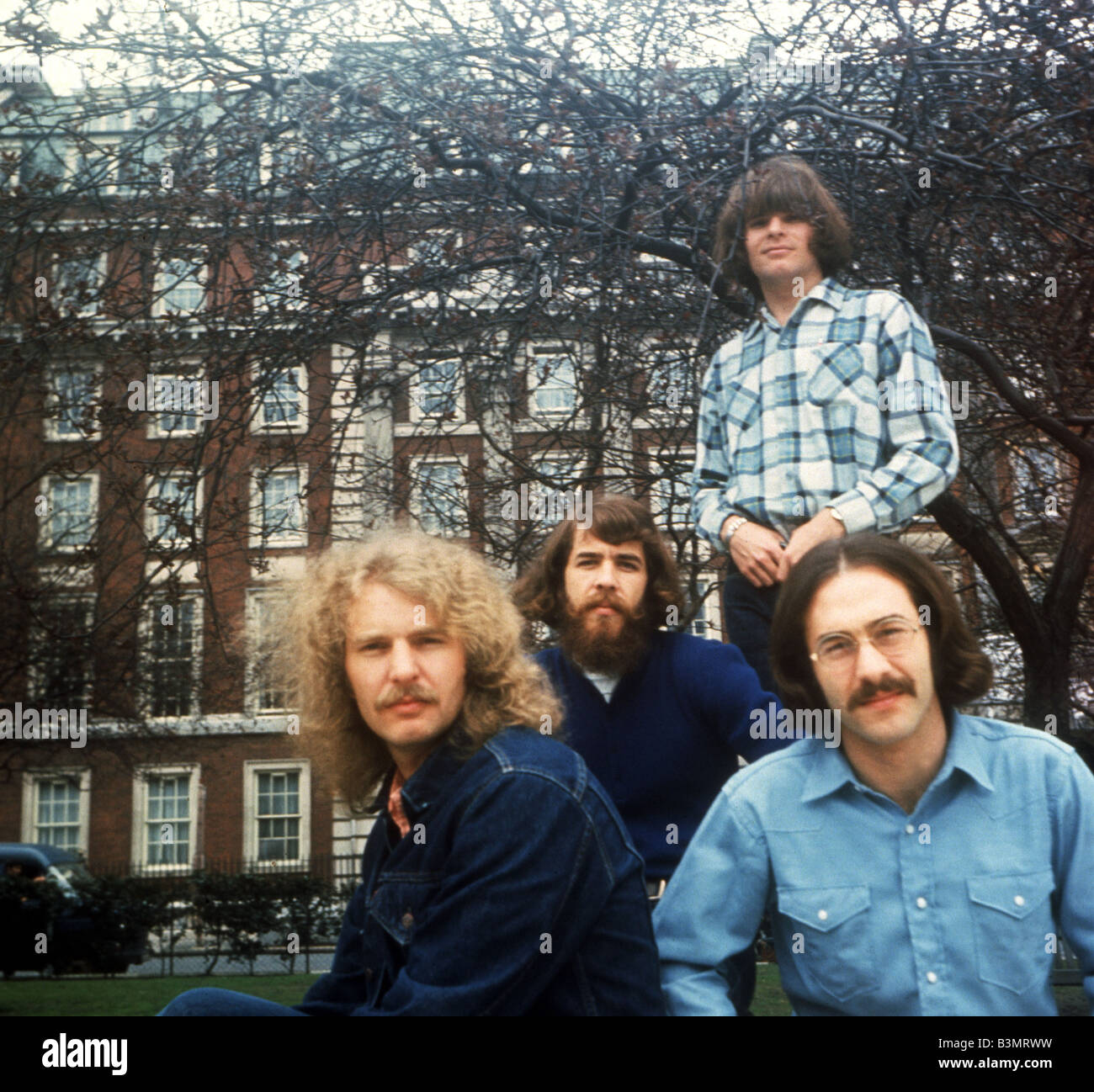
Down on the Corner was more than a hit single for Creedence Clearwater Revival; it was a front-porch dream carried onto national television, where ordinary American joy suddenly looked timeless.
There are television moments that feel polished, famous, and carefully preserved for history. Then there are the rarer ones that feel almost accidental in their power, as if a camera simply happened to be there when a band showed the country who they really were. Creedence Clearwater Revival’s “Down on the Corner” on ABC’s The Music Scene in 1969 belongs in that second category. It was not grand in the usual network-TV way. It did not depend on glitter, choreography, or fashionable mystery. Its force came from something much harder to fake: the sense that America was watching a homemade sound become national property in real time.
That mattered because “Down on the Corner” was already an unusual hit. Released in 1969 and associated with the album Willy and the Poor Boys, the song rose to No. 3 on the Billboard Hot 100 in the United States. In chart terms, it was a major success. But charts only tell part of the story. What made the song endure was its personality. At a time when rock music often arrived wrapped in psychedelia, heavy self-seriousness, or the glare of celebrity, Creedence Clearwater Revival offered a tune that sounded as if it had been built from wood, dust, rhythm, and neighborhood memory. It felt local, even intimate, yet somehow it spoke to everybody.
That is why the The Music Scene appearance remains so evocative. ABC’s The Music Scene was a distinctly late-1960s attempt to bring contemporary popular music into the television mainstream, and for a band like CCR, it provided one of those uncommon national showcases. Creedence Clearwater Revival never relied on glamorous mystique. They were not trying to look aristocratic, cosmic, or untouchable. On television, that plainness became a statement. When “Down on the Corner” reached living rooms through that 1969 broadcast, the group’s whole identity came into focus: this was a band that could make folk memory, country echoes, rock-and-roll punch, and working-American imagery feel like one shared language.
The song itself is deceptively simple. Written by John Fogerty, “Down on the Corner” imagines Willy and the Poor Boys, a loose, cheerful street-corner band inviting passersby to stop, smile, and tap their feet. The lyrics are full of affection for old-fashioned, communal music-making. There is nothing exclusive about it. No velvet rope. No elite distance. Even the famous line about bringing a nickel carries a sweet, democratic spirit. The song celebrates music as neighborhood glue, something played close to the ground, close to real life. In that sense, it was not merely catchy; it was philosophical in a modest American way. It argued that joy does not need luxury to be convincing.
Seen in the context of 1969, that message becomes even richer. This was a year crowded with upheaval, experiment, protest, and transformation. Rock music was expanding outward in every direction. Yet Creedence Clearwater Revival, a band from the Bay Area, found a way to sound as though they had emerged from some older national bloodstream. Their music carried echoes of Southern blues, country storytelling, swamp rhythm, and pre-television American vernacular, but it never sounded like an academic reconstruction. It felt alive. On The Music Scene, that quality became visual as well as musical. The band’s unvarnished presentation made “Down on the Corner” seem not like a concept, but like a place you already knew.
That may be the deepest reason this television moment still lingers. A record can suggest atmosphere, but television can reveal posture, restraint, and attitude. In this appearance, CCR did not seem to be asking for approval from the culture machine. They looked like working musicians bringing a finished song to the public. That quiet confidence gave “Down on the Corner” its national dimension. It took a song built around the image of a humble roadside performance and broadcast it across the country without stripping away its small-town soul. In other words, television did not modernize the song so much as enlarge its porch.
There was also a beautiful tension at the center of Creedence Clearwater Revival that this appearance captured well. They were already stars, but they did not present themselves like stars. They could dominate radio and still seem suspicious of excess. They could make hit records and still sound closer to hand-played American tradition than to pop spectacle. “Down on the Corner” may be one of the clearest expressions of that identity. Pairing such a song with a national TV platform could have flattened it into novelty. Instead, it did the opposite. It confirmed that the so-called homemade values in CCR were not too small for America. They were exactly what America recognized.
And that is what gives the 1969 ABC performance its lasting glow. It reminds us that some of the biggest cultural moments do not arrive with thunder. Sometimes they arrive with a grin, a groove, and a song about a ragtag band on the corner. Creedence Clearwater Revival took that image into homes across the country and made it feel immediate, unpretentious, and shared. Long after the broadcast faded into television history, the feeling remained: this was music that belonged everywhere precisely because it sounded like it came from somewhere real.
In the end, “Down on the Corner” is one of those rare records that grows larger the more plainly it is presented. On ABC’s The Music Scene, the song did not need embellishment to make its case. It simply needed to be seen as well as heard. What the country witnessed was not only a hit performance, but a statement of identity from Creedence Clearwater Revival: American music could still be handmade, warm, funny, sturdy, and deeply communal, even at the center of mass media. That is why this rare TV moment still feels so moving. It showed a band carrying the spirit of the corner all the way to the nation.
