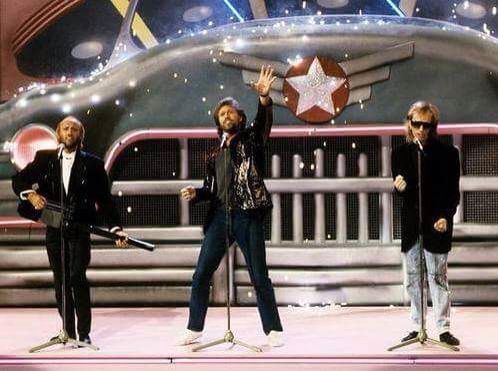
If I Can’t Have You proved that the Bee Gees did not need to sing every major song on Saturday Night Fever to define its heartbeat; in Yvonne Elliman‘s voice, their writing still shaped the longing, glamour, and restless ache of the era.
When Yvonne Elliman took If I Can’t Have You to No. 1 on the Billboard Hot 100 in 1978, and into the Top 5 in the UK, it confirmed something larger than a successful single. Saturday Night Fever was not only a soundtrack powered by songs the Bee Gees sang themselves. It was a musical world they built. Even when another voice stepped into the spotlight, the emotional design, melodic instinct, and rhythmic urgency of the film still carried the unmistakable fingerprint of Barry Gibb, Robin Gibb, and Maurice Gibb. That is what makes If I Can’t Have You so fascinating even now. It is one of the clearest examples of how completely the brothers shaped the soundtrack, even from a slight distance.
By the time Saturday Night Fever arrived in late 1977, the Bee Gees were no longer simply hitmakers. They had become architects of a cultural mood. Asked to create music connected to the film, they responded with a run of songs so strong that they did more than accompany the story; they became part of its identity. Most listeners first think of Stayin’ Alive, Night Fever, and How Deep Is Your Love. Yet If I Can’t Have You deserves to stand beside them, because it reveals another dimension of the Bee Gees‘ brilliance. They could write a song so emotionally complete that it could become a defining part of the soundtrack without their own voices carrying the lead.
That lead belonged to Yvonne Elliman, a singer with a tone very different from the Bee Gees‘ soaring male blend and Barry’s famous falsetto edge. Elliman already had a strong musical identity, and many listeners knew her from Jesus Christ Superstar. What she brought to If I Can’t Have You was not theatrical excess, but a controlled ache. Her performance is smooth, elegant, and almost deceptively calm, yet underneath it there is hunger, impatience, and emotional dependence. The brilliance of her version is that it never turns desperation into melodrama. Instead, it lets longing move with the beat. That balance gave the song enormous crossover power.
The chart story helped seal its legacy. Closely tied to the unstoppable momentum of Saturday Night Fever, If I Can’t Have You became Elliman’s biggest hit and reached No. 1 in America in May 1978. It also appeared on her album Night Flight, but its public identity was inseparable from the soundtrack phenomenon surrounding it. At a moment when Saturday Night Fever seemed to be everywhere, this single proved that the audience was not responding only to the songs most visibly sung by the Bee Gees. They were responding to a whole soundscape the brothers had created. Even when the face and voice at the front were different, the writing still held the same emotional voltage.
And what a piece of writing it is. The lyric of If I Can’t Have You is direct, almost plainspoken, but the Bee Gees always understood that simple language can cut deepest when melody and phrasing do the heavy lifting. The title line returns again and again, but never feels static. Each repetition seems to tighten the feeling, as if the singer has already argued with herself and arrived at the same painful truth. There is no practical compromise in the song. No second-best answer. That refusal gives it its emotional center. Beneath the disco sheen, this is a song about fixation, about wanting one person so completely that every other possibility feels empty.
That emotional shape fits Saturday Night Fever beautifully. For all its dance-floor electricity, the film has always carried a strong undercurrent of loneliness, yearning, and frustrated hope. The nightlife glitters, but it does not erase uncertainty. In that sense, If I Can’t Have You is more than a dance record placed on a famous soundtrack. It reflects the inner climate of the story. The groove moves forward, but the heart remains suspended. That tension between motion and emotional standstill is one of the reasons the track still feels so alive.
It also helps explain why the song matters so much in the larger Bee Gees story. Saturday Night Fever is often remembered through performance, image, and cultural impact, but it was equally an achievement of authorship. The brothers did not merely contribute songs. They gave the soundtrack continuity. Whether they were singing themselves or whether artists like Yvonne Elliman and Tavares were delivering the material, the Bee Gees supplied the emotional language: soaring choruses, clean melodic lines, tightly wound desire, and that remarkable ability to make dance music shimmer with wistfulness. If I Can’t Have You is central to that achievement because it shows how their reach extended beyond their own performances.
There is something quietly moving in that. Elliman made the song unmistakably hers, and she deserves every bit of credit for the grace and strength of the record. But the deeper truth is that the Bee Gees were shaping the fever from every angle. They were guiding the soundtrack not only as singers, but as storytellers and mood-makers. That is why If I Can’t Have You still feels essential. It reminds us that some artists leave their mark not only by stepping to the microphone, but by building the emotional architecture around everyone else. In the case of Saturday Night Fever, that is exactly what the Bee Gees did, and few songs prove it more beautifully than the one they placed in Yvonne Elliman‘s hands.
