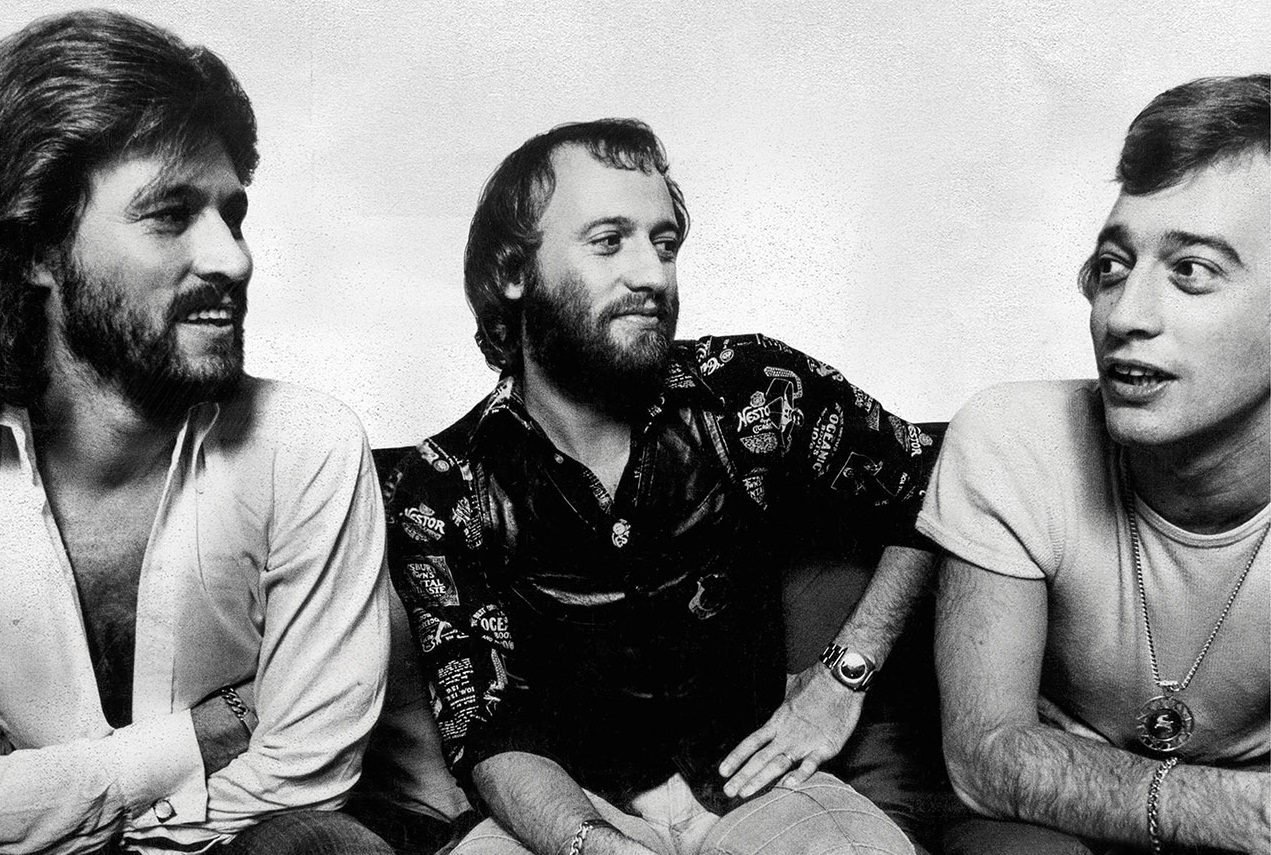
More than a late-80s hit, You Win Again restored the Bee Gees to the top of the British charts and reminded listeners that their greatness had never begun or ended with disco.
When the Bee Gees released You Win Again in 1987 as the lead single from E.S.P., it did far more than announce a new album. It marked one of the most meaningful chart returns in pop history. The song climbed to No. 1 on the UK Singles Chart and stayed there for four weeks, giving Barry, Robin, and Maurice Gibb their first British chart-topper since Massachusetts in 1967. That gap of nearly twenty years is the kind of statistic that tells its own story. In Britain, where the group’s journey had always been followed with unusual affection, You Win Again felt less like a surprise than a correction. It was proof that the brothers still belonged at the summit.
The timing mattered. By 1987, public memory of the Bee Gees had become strangely narrow in some corners, as if their identity could be reduced to the white suits, falsettos, and glitter of the late 1970s. Of course, those years were enormous. Saturday Night Fever had changed popular music, and the soundtrack’s success turned the group into global symbols of an era. But the size of that phenomenon also trapped them inside it. When the backlash against disco arrived, it was crude, loud, and unfair. Too many people spoke as if the brothers had only one sound, one season, one story. You Win Again answered that misunderstanding without needing to argue. It simply existed, and it worked.
That is part of what makes the single so satisfying. After the commercial disappointment of Living Eyes in 1981, the brothers had not vanished creatively at all. They shifted their energy into songwriting and production for other artists, and in those years their fingerprints were everywhere. They wrote for Dionne Warwick, helped shape major crossover records, and reminded the industry that their melodic instincts had not dimmed in the slightest. So when E.S.P. arrived, it was not the sound of a group crawling back. It was the sound of craftsmen returning under their own name, with all the discipline and confidence they had sharpened in the shadows.
Musically, You Win Again was a smart and elegant comeback choice. It did not try to imitate the fevered pulse of their disco peak, nor did it retreat into a soft exercise in nostalgia. Instead, it embraced the polished, electronic texture of the late 1980s while keeping the emotional architecture unmistakably theirs. The rhythm has a taut, clipped momentum; the melody moves with that familiar Bee Gees ache; and Barry’s lead vocal carries both vulnerability and control. Around him, the harmonies bring in the family sound that always made the group different from trend-driven acts. However contemporary the production may have felt in 1987, the emotional DNA was pure Bee Gees.
The song’s meaning also deserves more attention than it usually gets. You Win Again is not a triumphant love song, despite its title. It is a song about emotional defeat, about surrendering yet again to someone whose pull cannot be resisted. That repeated phrase becomes less a complaint than an admission: the heart knows it is overmatched, and still it returns. There is maturity in that idea. This is not the melodrama of teenage heartbreak. It is adult vulnerability, delivered with style rather than self-pity. The brothers had always been excellent at giving pain a graceful shape, and here they wrapped it in sleek late-80s pop without losing the sting underneath.
Its chart performance confirmed that listeners heard something lasting in it. In the UK, the single’s run to No. 1 was more than a commercial success; it carried historical weight. To return to the top after nearly two decades, especially after the world had tried to freeze your reputation in a single era, is a rare kind of vindication. Across Europe, the song was also a major hit, reinforcing that this was not merely a local burst of nostalgia. It was a broad, enthusiastic embrace of the group as a living force in contemporary pop. In the United States, the picture was more complicated: You Win Again reached only No. 75 on the Billboard Hot 100, a modest placing that said more about American radio’s hesitation than about the song’s quality. Even so, its deeper legacy was already secure elsewhere.
What made the British response especially poignant was the shadow of Massachusetts. That earlier hit belonged to a very different chapter of the Bee Gees story, back when they were still seen first as melodic, emotionally rich songwriters with a gift for melancholy and grandeur. By taking You Win Again to UK No. 1, listeners connected those chapters instead of separating them. They were not just rewarding a comeback single. They were recognizing continuity. The same brothers who once sang with aching elegance in the 1960s had now found a new vocabulary for the 1980s without losing their identity.
That is why the song matters so much in any honest view of their career. It proved that the Bee Gees were never merely survivors of a trend, and certainly never prisoners of the disco label. Their real power was older and deeper than that: melody, harmony, instinct, and emotional precision. E.S.P. gave them a platform to show it again, but You Win Again was the moment that crystallized the truth. Not every comeback record announces itself with fanfare. Some simply step into the room and make the old assumptions look small.
Today, listening back to You Win Again, one hears more than a polished 1987 hit. One hears resilience dressed as pop. One hears three brothers reclaiming their place with dignity and quiet force. And one hears the beautiful irony at the heart of the title: in the song, someone else wins again, but in the larger story, it was the Bee Gees who did. They won back the chart, won back the narrative, and reminded the world that true musical identity can outlast fashion, backlash, and every lazy simplification that history tries to impose.
