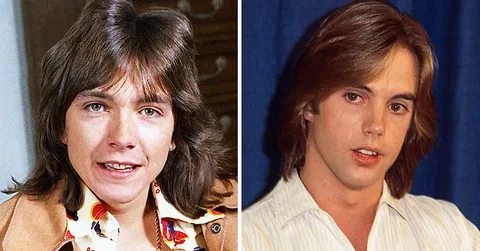
Please Please Me in David Cassidy‘s voice feels like more than a cover; it sounds like a young star stepping out from the noise and reaching for something honest, eager, and deeply musical.
There is something especially touching about hearing David Cassidy take on Please Please Me, because it brings together two different kinds of pop history in one performance. On one side is the song itself, a Lennon-McCartney composition that helped launch The Beatles into the first great rush of British pop immortality. On the other is Cassidy, a singer who spent much of his career fighting to be heard as a serious artist beneath the blinding glare of teen-idol fame. When those two stories meet, the result is far more revealing than a casual cover version might suggest.
The chart history is important, because Please Please Me was no ordinary old hit to borrow. In its original Beatles form, the song became one of the records that changed everything. In Britain, its chart story has long carried a small but famous debate: the official Record Retailer listing placed it at No. 2, while other major charts of the time, including NME and Melody Maker, ranked it at No. 1. In the United States, the song reached No. 3 on the Billboard Hot 100 in 1964. By contrast, David Cassidy‘s version is remembered not as a towering chart single in its own right, but as a revealing piece of his catalog, the kind of recording longtime listeners return to because it shows taste, instinct, and musical ambition rather than simple commercial calculation.
That difference matters. By the time Cassidy recorded Please Please Me, he was already one of the most recognizable young stars of the era, thanks in no small part to The Partridge Family and a run of hugely successful solo releases. But fame can distort as much as it amplifies. Cassidy had the face magazines wanted, the hysteria promoters loved, and the audience adoration most performers spend a lifetime chasing. What he also had, too often overlooked, was a real singer’s ear for phrasing, melody, and emotional shading. A song like Please Please Me gave him a chance to show that.
The story behind the song itself has always been one of youthful urgency. John Lennon later spoke about being influenced by the emotional style of Roy Orbison, and producer George Martin helped shape the number into something faster and more immediate than its earliest conception. What emerged was a song that felt both simple and clever: a direct plea for affection, but with just enough wit in the title and lyric to give it a sly edge. It is a song about wanting to be loved back, but also about impatience, vulnerability, and the restless ache of being young enough to ask for everything at once.
When David Cassidy sings it, some of the original Merseybeat sharpness gives way to a smoother early-1970s pop polish, and that change is part of the appeal. He does not attack the song in the same breathless, revolutionary way The Beatles did. Instead, he humanizes it in a different direction. His reading feels more polished, more romantic, and in its own way more exposed. You hear not the sound of a musical movement being born, but the voice of a performer trying to reclaim space inside a public image that had become almost too large to live in comfortably.
That is why the song can feel unexpectedly moving today. People often remember Cassidy first as a phenomenon: the posters, the screaming crowds, the headlines, the impossible speed of it all. But songs like Please Please Me remind us that he was also a careful interpreter of material. He understood that a familiar song can become a mirror. By choosing a title already loaded with pop history, he was not simply borrowing nostalgia. He was stepping into a lineage, measuring himself against it, and quietly asking to be heard on musical terms.
There is also a certain poignancy in hearing a singer so associated with public adoration perform a song built on asking for love rather than receiving it. That contradiction gives the recording a special afterglow. Beneath the bright melody, the song still carries longing, and Cassidy knew how to sing longing without overplaying it. He brings warmth to the plea, but also restraint. It is the sound of someone reaching forward, not grandly, not theatrically, but sincerely.
So while David Cassidy‘s Please Please Me may never sit at the center of his legend the way his biggest hits do, it remains one of those recordings that tells a deeper truth. It shows the musician inside the phenomenon, the interpreter inside the idol, and the young man behind the image. And for anyone willing to listen past the surface of old fame, that may be the part that lingers longest of all.
