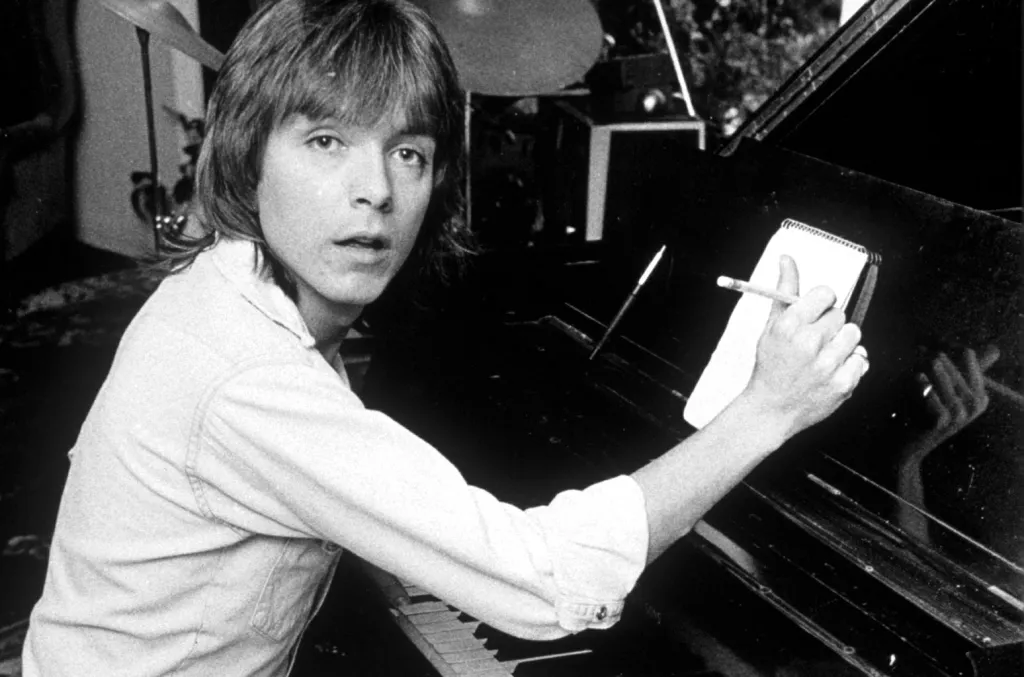
Halloween Party shows a lighter, stranger corner of David Cassidy’s world, where teen-pop polish meets the playful shadows of a seasonal song that never became a major hit but still lingers in memory.
When people speak of David Cassidy, they usually return to the records that defined an era: the breathtaking surge of The Partridge Family, the posters on bedroom walls, the bright ache of songs that seemed to belong to youth itself. That is precisely why Halloween Party feels so intriguing. It is not one of the towering chart signatures of his career, and that is an important part of its story. Unlike the enormous commercial impact of I Think I Love You, which took The Partridge Family to No. 1 on the Billboard Hot 100 in 1970, or Cassidy’s own major solo successes in the early 1970s, Halloween Party is generally remembered as a lesser-known recording rather than a headline chart smash. No widely cited major U.S. or U.K. singles-chart peak is commonly attached to this title, and that very obscurity gives it its charm.
There is something deeply revealing about an artist’s smaller records. The huge hits tell us what the world wanted. The forgotten ones often tell us what the artist’s image could not fully contain. Halloween Party sits in that quieter corner of the catalog, where novelty, atmosphere, and personality matter more than chart muscle. It is easy to hear the title and assume it is only a seasonal trifle, a playful detour with costumes, mischief, and party energy. But with David Cassidy, even a lightweight idea can open a more interesting conversation, because his entire career carried a tension between public brightness and private pressure.
That tension matters here. Cassidy was marketed, especially in the early 1970s, as the golden face of accessible pop romance: handsome, warm, charming, and emotionally available in a way fans could instantly recognize. Yet behind that image was a performer trying to be taken seriously as a singer and musician, not merely as a phenomenon. Songs like How Can I Be Sure, Cherish, and Could It Be Forever showed how naturally he could bring sensitivity to a melody. Halloween Party, by contrast, belongs to a more theatrical lane. It reminds listeners that pop in that era was not always built around confession or grandeur; sometimes it lived in occasion, mood, and character. A seasonal song can seem slight on paper, but it can also reveal how an artist moves inside a concept, how he shades a performance, how he leans into fun without losing identity.
What makes the song meaningful is not that it tries to compete with his defining ballads. It does not. Its appeal lies in contrast. The title itself suggests masks, disguises, and a room full of people pretending to be something else for a night. That idea lands differently when connected to David Cassidy. Few stars of his generation understood more sharply what it meant to live behind an image. So even if Halloween Party is approached as playful entertainment first, it carries an accidental resonance. In retrospect, one can almost hear a faint metaphor inside it: the star at the party, the famous face in costume, the public figure surrounded by noise while remaining somehow separate from it. That is the kind of echo that makes an obscure song more interesting as the years pass.
There is also the broader cultural setting to consider. Novelty and seasonal songs have always occupied a peculiar place in pop history. They are often released outside the main prestige lane, remembered affectionately rather than critically, and rediscovered later by collectors who enjoy the side roads of an artist’s catalog. Halloween Party fits that tradition beautifully. It belongs less to the world of career-defining statements than to the world of atmosphere, curiosity, and fan memory. That does not make it disposable. In many ways, it makes it more human. It allows listeners to step outside the well-worn story of David Cassidy the idol and meet David Cassidy the recording artist navigating the lighter, stranger corners of popular music.
For longtime listeners, that can be unexpectedly moving. The biggest hits arrive with history attached to them: chart numbers, television appearances, magazine covers, screaming crowds. A song like Halloween Party arrives more quietly. It feels discovered rather than inherited. And when a song is discovered, it often creates a different kind of attachment. One begins to hear not only the record itself, but the space around it: the forgotten radio hour, the seasonal compilation, the shelf of old singles, the lingering aftertaste of a period when pop culture still made room for records that were simply meant to delight, amuse, and color a moment.
In the end, Halloween Party matters because it enlarges the picture. It reminds us that David Cassidy was not only the sum of his biggest hits, his television fame, or his teen-idol mythology. He was also part of a wider musical landscape filled with detours, curiosities, and affectionate oddities. That is why this song still draws attention from dedicated listeners. Not because it conquered the charts, but because it reveals a different texture of his career: lighter on the surface, perhaps, yet unexpectedly evocative when heard now. Sometimes the records that sold the least tell us the most lasting things about an artist’s world.
