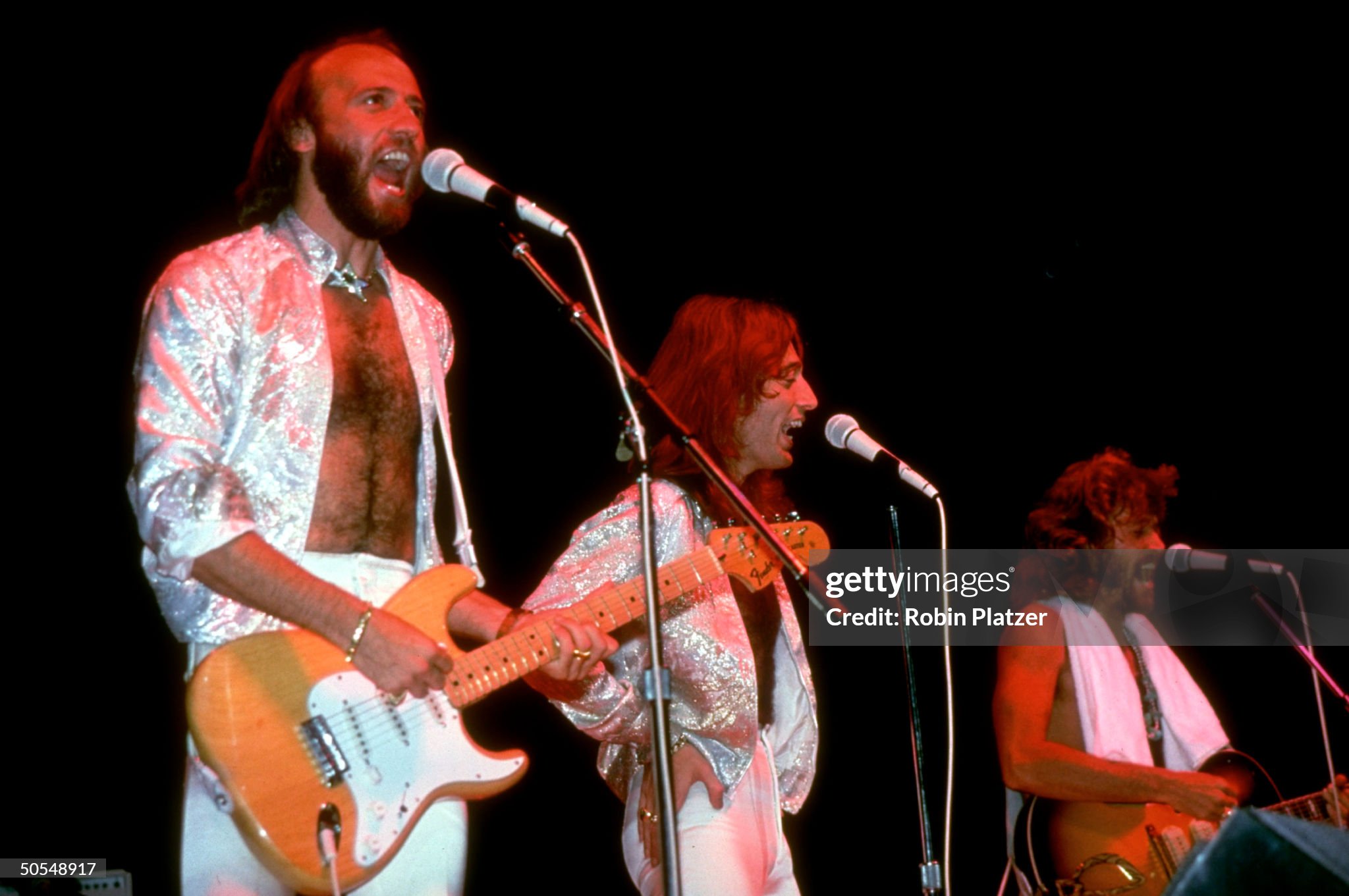
A proud, pulse-driven deep cut, Can’t Keep a Good Man Down captures the Bee Gees turning survival into style and confidence into song.
Released on the 1976 album Children of the World, Can’t Keep a Good Man Down was not one of the record’s main charting singles, so it did not build a separate chart legacy the way You Should Be Dancing, Love So Right, or Boogie Child did. But that does not make it a minor piece of the story. If anything, it makes the song more revealing. It sits inside one of the most important turning-point albums of the Bee Gees‘ career, a record that reached No. 8 on the Billboard 200 and confirmed that the brothers were no longer simply trying to recover their footing. They had found a new one.
By 1976, the Bee Gees had already lived through the kind of career swings that would have broken many groups. They were once celebrated as poetic pop craftsmen, then dismissed by some corners of the industry as yesterday’s sound, and then reborn through rhythm, instinct, and sheer musical intelligence. Children of the World arrived after the breakthrough of Main Course, and it carried forward the sleek, Miami-shaped blend of soul, pop, and dance music that would soon define an era. On this album, the group also stepped further into self-production, working with Karl Richardson and Albhy Galuten. That mattered. The sound was not only modern; it was personal. They were not just adapting to the times. They were shaping them.
That is why Can’t Keep a Good Man Down feels so striking. Even before one begins to parse the lyrics, the title alone carries a certain biographical electricity. It sounds like a boast, but not an arrogant one. It sounds earned. Heard in the context of where the Bee Gees stood in 1976, the song becomes more than a lively album track. It becomes a statement of endurance. There is swing in it, polish in it, and a kind of smiling defiance running underneath the beat. This is not the sound of men asking for another chance. It is the sound of artists who already know they belong.
Musically, the track belongs to that glorious mid-1970s moment when the Bee Gees learned how to make elegance move. The rhythm has lift, the arrangement has snap, and the vocal design carries that unmistakable family signature: tight harmonies, melodic confidence, and a sense that the song is always gliding even when it is driving forward. Barry Gibb’s phrasing brings urgency and style, while the layered group vocals give the record warmth and identity. Even when the groove is strong, the emotional intelligence is stronger. That balance was one of the Bee Gees‘ great gifts. They could make a record feel danceable without ever making it feel empty.
The meaning of Can’t Keep a Good Man Down is part resilience, part self-possession. Like many fine Bee Gees songs, it works on two levels at once. On the surface, it carries the confidence of someone refusing defeat, refusing humiliation, refusing to disappear. Beneath that, there is something more human and more touching: the recognition that setbacks do happen, that pride can be bruised, and that survival often requires grace as much as toughness. The song’s emotional force comes from that mixture. It is upbeat, yes, but not careless. It knows what it means to be counted out.
That is one reason the song continues to reward listeners who go deeper than the hits. The biggest singles from Children of the World earned their rightful place in radio history, but album tracks like this one reveal character. They show how the brothers thought about themselves in motion, how they translated recent struggle into rhythm. For long-time listeners, there is something deeply satisfying about that. You can hear a group that has stopped second-guessing its identity. The writing by Barry Gibb, Robin Gibb, and Maurice Gibb carries the assurance of brothers who had already weathered enough to know that conviction matters as much as fashion.
And perhaps that is the quiet beauty of this song. It does not ask to be treated as a tragic confession or a grand manifesto. It simply steps forward with certainty and lets the groove do the persuading. In that sense, it mirrors a larger truth about the Bee Gees themselves. Their most enduring strength was not only melody, not only harmony, not only reinvention. It was composure. Time and again, they found a way to move through changing seasons without losing the emotional core that made them unmistakable.
So while Can’t Keep a Good Man Down may not be the first title mentioned in casual conversations about the Bee Gees, it remains a wonderfully revealing one. It catches them between comeback and coronation, standing at the edge of their late-1970s peak with a song that sounds light on its feet and strong at its center. Some records become classics because they dominate the charts. Others become cherished because they tell the truth of an artist’s spirit. This one does a little of both, even without the headline numbers. It reminds us that sometimes the most honest line in a catalog is also the simplest: when the music is this sure of itself, no setback lasts forever.
