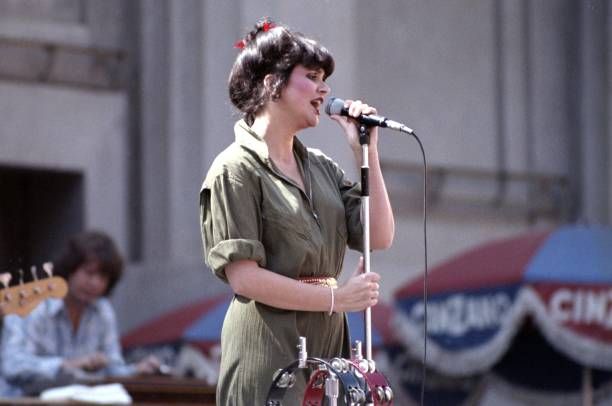
On Don Kirshner’s Rock Concert in 1974, Linda Ronstadt and the Eagles turned Silver Threads and Golden Needles into something larger than a cover song: a blazing snapshot of country-rock finding its nerve, its harmony, and its wounded pride.
There are performances that entertain, and then there are performances that seem to gather history into one room. The 1974 Don Kirshner’s Rock Concert appearance by Linda Ronstadt with the Eagles on Silver Threads and Golden Needles belongs in that second category. It was not simply a television spot. It was a moment when old musical loyalties, emerging stardom, and the tough emotional grain of country music all met under one spotlight. Watching it now, what stands out is not only the force of Ronstadt’s voice, but the sense that this was music made by people who already shared a deep road history.
That history matters. Before the Eagles became one of the defining American bands of the 1970s, Don Henley and Glenn Frey had worked in Ronstadt’s orbit, part of the musical circle that helped shape the Southern California country-rock sound. So when Linda Ronstadt stood with the Eagles on Don Kirshner’s Rock Concert, it felt less like a casual collaboration than a reunion with roots. There is something deeply satisfying about that exchange: the singer who helped open the door, and the band that would soon stride through it in spectacular fashion, joining forces on a song built from heartbreak and backbone.
The song itself already had a rich past. Silver Threads and Golden Needles was written by Dick Reynolds and Jack Rhodes, and it first became widely known through The Springfields in 1962. Their version reached the U.K. Top 20, helping establish the tune as a sharp, female-voiced statement of refusal at a time when too many songs still asked women to endure quietly. Linda Ronstadt recorded her own version years before the DKRC appearance, placing it on her 1969 debut solo album Hand Sown… Home Grown, a record often remembered as an early landmark of country-rock. Her studio cut did not become one of her biggest chart singles, but it revealed something essential about her instincts: she knew how to find songs where tenderness and defiance could live in the same breath.
By 1974, Ronstadt was standing at the edge of a commercial breakthrough that would soon change her career forever. Later, Heart Like a Wheel would reach No. 1 on the Billboard 200, and You’re No Good would become her first No. 1 hit on the Billboard Hot 100 in early 1975. That is part of what makes this television performance so compelling. It catches her just before the full scale of superstardom settled in. The confidence is already there. The authority is already there. But there is still a rawness, a working-musician urgency, that makes the performance feel wonderfully alive.
Lyrically, Silver Threads and Golden Needles remains one of the toughest songs in Ronstadt’s repertoire. Its central idea is simple but devastating: love cannot be replaced by comfort, status, or money. The woman in the song refuses the empty security offered by a man who expects wealth and position to excuse betrayal. That line of thought still lands hard because it is not melodramatic. It is clear-eyed. It does not beg. It does not bargain. It draws a boundary. In Linda Ronstadt’s hands, those lyrics become even more powerful. She sings them with a kind of bright steel, never overplaying the hurt, never softening the refusal. The effect is unforgettable. You hear pain, yes, but you also hear self-respect.
And then there are the harmonies. That is where the Eagles make this DKRC version feel so special. Their backing does not cushion the song; it sharpens it. The group harmonies bring a glint to the chorus, while the band gives the arrangement a driving pulse that keeps one foot in country and the other in rock. This was always one of the great strengths of that whole California scene: the music could sound clean and beautiful on the surface, but underneath there was tension, ache, and a very American loneliness. On this performance, Ronstadt sits at the emotional center while the band builds the frame around her. She does not disappear into the ensemble. She commands it.
There is also something symbolic in the song choice. Silver Threads and Golden Needles is not a fragile ballad meant to showcase prettiness. It is a statement song. Choosing it for a major television appearance said a great deal about who Linda Ronstadt was as an artist. She could sing standards, rockers, country laments, and pop songs with astonishing ease, but she was never merely decorative. She brought intelligence to material that lesser singers might have treated as genre exercise. In this performance, she sounds like a woman taking ownership of a musical language that men often dominated on paper, but that she could inhabit with even greater emotional authority.
That is why the 1974 Don Kirshner’s Rock Concert performance still matters. It preserves more than a strong live rendition. It captures a turning point in American music, when Linda Ronstadt and the Eagles were both helping define the shape of modern country-rock, each in different ways, each carrying pieces of the same story. For listeners coming back to it now, the magic is not only nostalgia. It is recognition. Recognition that this was real talent, real connection, and a real song of dignity delivered with fire. Long after chart numbers have faded into trivia, that kind of performance keeps speaking in a voice that never quite grows old.
