
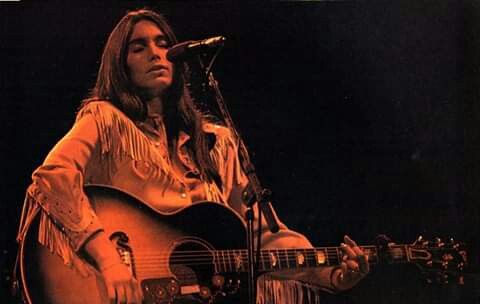
“I Don’t Wanna Talk About It Now” captures the weary dignity of a heart too bruised for explanations, and Emmylou Harris sings it with the kind of restraint that makes the sadness feel even more real.
Some songs arrive like a storm, declaring themselves in a flash of drama. Others come in softly, almost under their breath, and stay with you longer because they understand something difficult and deeply human. “I Don’t Wanna Talk About It Now” belongs to that second kind of song. In Emmylou Harris’s hands, it becomes less a performance than a private reckoning—an intimate moment set to music, where pain is not shouted but carried with grace.
Unlike the biggest radio landmarks in Harris’s catalog, “I Don’t Wanna Talk About It Now” is remembered more as a cherished deep cut than as a major chart single. It was not one of the signature standalone hits that stormed the top of the country charts in the way songs like “Together Again”, “Sweet Dreams”, or “To Daddy” did. And perhaps that is part of its power. It feels discovered rather than delivered, a song listeners come to with time, when they are ready for its kind of quiet truth. In that sense, its “chart position” tells only a small part of the story. Its real place has been in the emotional memory of those who recognize the ache behind the title almost immediately.
What makes the song so striking is the way Harris refuses to oversell it. That was one of her great gifts across the finest years of her recording career: she could take material rooted in country sorrow, folk reflection, or rock-era weariness and sing it with an elegance that never turned cold. Her voice has always had that rare combination of clarity and vulnerability. On “I Don’t Wanna Talk About It Now”, she uses both beautifully. She does not sound theatrical. She sounds tired, wise, and honest—like someone who knows that some feelings are too fresh, too complicated, or too painful to explain on demand.
The title itself carries the whole emotional architecture of the song. It is not a refusal born of indifference. It is the plea of someone trying to hold herself together. There is an entire emotional history inside that one sentence. Not “I don’t care.” Not “It doesn’t matter.” But: I cannot speak about this now. The wound is still warm. The words would only fail me. That distinction is everything, and Harris understands it instinctively.
In the world of country and roots music, songs of heartbreak are everywhere, but not all heartbreak songs are equal. Many describe betrayal, regret, or longing in direct strokes. This one lingers in a more fragile place—the moment after the blow, when language itself feels like too much. That emotional hesitation gives the song its unusual tenderness. Rather than offering neat resolution, it honors emotional delay. It recognizes that silence can be its own form of truth.
That sensibility fits Emmylou Harris perfectly. Throughout albums such as “Pieces of the Sky”, “Elite Hotel”, “Luxury Liner”, “Quarter Moon in a Ten Cent Town”, and beyond, she became one of the great interpreters in American music—not simply because she had a beautiful voice, but because she knew how to inhabit a song’s emotional center without crowding it. She could sing sorrow with steel, tenderness with intelligence, and memory with astonishing lightness. Even when the lyrics dealt in loss, her phrasing often suggested endurance. That is very much the spirit here.
There is also something especially moving about hearing Harris sing songs like this in the context of her broader career. She was never merely a country star chasing trends. She was a curator of feeling, a guardian of songcraft, someone who treated words with reverence. That is why a less famous track can sometimes reveal as much about her artistry as any hit record. “I Don’t Wanna Talk About It Now” reminds us that Harris’s greatness was not confined to radio success. It lived just as fully in the album tracks, the hidden corners, the songs that asked listeners to lean in rather than simply applaud.
Musically, the song’s beauty lies in its restraint. The arrangement leaves room for breath, and that space matters. Too much production would have weakened its emotional honesty. Harris and her collaborators understood that a song built on emotional exhaustion should not be cluttered. The result is a performance that feels lived-in. You hear not only sadness, but composure—the effort of someone trying to remain gracious when the heart is anything but calm.
And perhaps that is why the song continues to resonate. There comes a season in life when the loudest songs are no longer the truest ones. What lasts are often the recordings that understand hesitation, dignity, and the complicated silence that follows disappointment. Emmylou Harris has always excelled at that emotional shading, and “I Don’t Wanna Talk About It Now” is a fine example of her ability to turn understatement into something unforgettable.
It may not be the first title named when casual listeners discuss her catalog, and it may never occupy the same public pedestal as her most celebrated hits. But that is often the fate of the most delicate songs: they wait patiently until someone needs them. When that moment comes, this recording reveals its full strength. It is a song about not being ready to speak, yet Emmylou Harris somehow says everything that matters.
