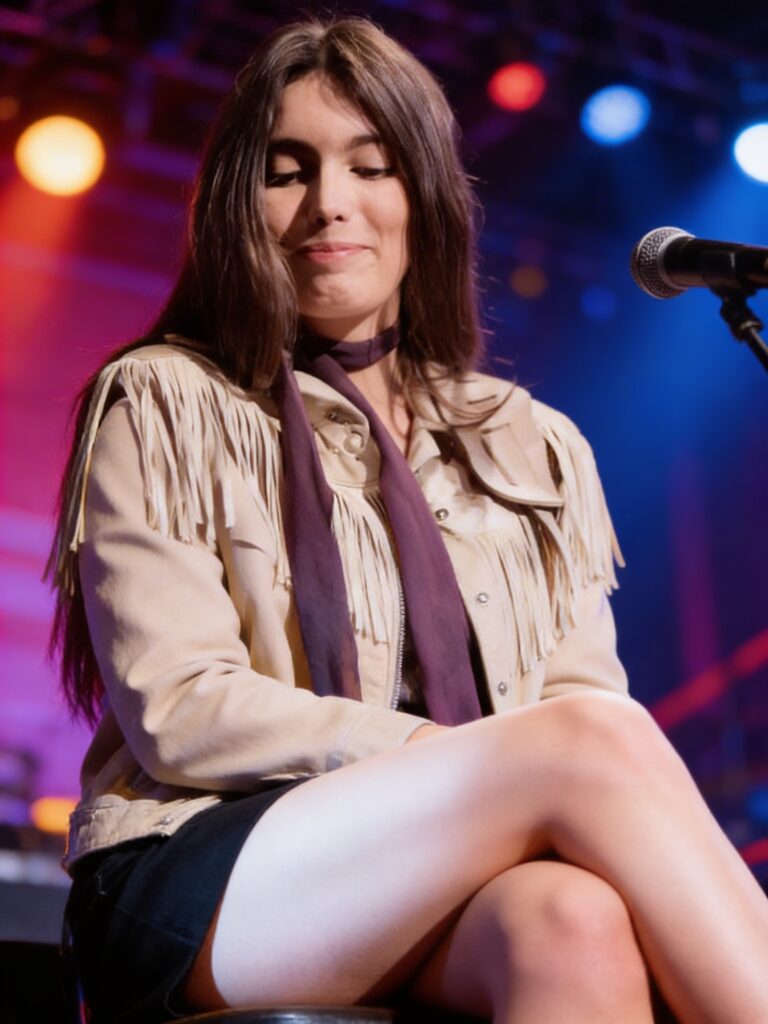
In Emmylou Harris’s hands, “Pancho and Lefty” loses none of its myth, but it gains a colder sadness — less outlaw legend than the sound of memory watching two ruined lives disappear into dust.
When Emmylou Harris recorded “Pancho and Lefty” for Luxury Liner, she stepped into one of the great American story-songs and somehow made it feel even more solitary. Her version appeared on the album released on December 28, 1976, produced by Brian Ahern, and that album became her second straight No. 1 country album on Billboard. The song itself was not the record’s chart single centerpiece, but it has endured as one of the album’s most important artistic statements. In fact, Luxury Liner is often remembered in part because it included the first cover version of Townes Van Zandt’s 1972 song, years before the better-known Willie Nelson and Merle Haggard duet took it to No. 1 on the country chart in 1983.
That history matters, because “Pancho and Lefty” already arrived bearing its own mystery. Townes Van Zandt wrote and recorded it for The Late Great Townes Van Zandt in 1972, and although the song would later become his best-known composition, neither it nor its parent album made much commercial noise at the time. It was one of those songs that seemed born with a legend inside it, yet had to wait for the world to catch up. Even the title carried its own strange instability: early releases spelled it “Poncho and Lefty,” including Van Zandt’s original and Harris’s version on Luxury Liner, before the now-familiar “Pancho” spelling settled in more permanently later.
What makes Emmylou Harris so haunting here is that she does not treat the song as a swaggering outlaw ballad. Many listeners come to “Pancho and Lefty” expecting a frontier tale full of dust, betrayal, and fatal glamour. All of that is there, of course. The song still gives us the mythic Pancho, the betrayal of Lefty, the federales, the desert, the old, unresolved question of loyalty and guilt. But Harris shifts the center of gravity. In her reading, the song feels less like a campfire legend traded between drifters and more like a memory already fading into moral fog. She lets the sadness spread wider than the plot.
That is one of the great things Emmylou Harris could do as an interpreter. She heard not only the story in a song, but the weather around the story. On “Pancho and Lefty,” she understands that the lyric’s deepest power is not really in the killing or the betrayal. It is in the aftermath. It is in the sense that whatever happened out there on the border has already been swallowed by time, rumor, dust, and regret. Her voice does not dramatize the legend. It mourns what the legend cost. That is why the ballad turns darker in her hands. The men seem smaller. The emptiness around them seems larger.
There is also something profoundly right about Harris being the first major artist to carry the song forward in this way. According to the song’s recorded history, Willie Nelson first heard “Pancho and Lefty” through Emmylou Harris’s version, which gives her interpretation an even deeper place in the song’s afterlife. She did not simply cover a masterpiece after it had already been made famous by others. She helped lead it from cult brilliance into wider musical life.
And yet her version remains distinct from the later hit. The Willie and Merle recording is magnificent in its own right—bigger in cultural reach, more overtly iconic, more tied to the mythology of outlaw country. But Harris’s “Pancho and Lefty” is lonelier. It is less public, less performative, and in some ways more sorrowful. She seems drawn not to the gunfighter romance of the song but to its spiritual fatigue, its quiet recognition that by the end of every outlaw tale, someone is forgotten, someone is compromised, and someone is left to grow old under the weight of what was done.
That darker feeling suits Luxury Liner beautifully. Though the album contained stronger charting singles such as “(You Never Can Tell) C’est la Vie” and “Making Believe,” it also showed how wide Harris’s emotional range already was in the late 1970s. She could sing bright country-rock, classic honky-tonk, and aching balladry, but she was equally gifted at material that lived half in folklore and half in sorrow. “Pancho and Lefty” gave her a song spacious enough for that gift.
Why does the song feel darker in her hands? Because Emmylou Harris hears the human ruin beneath the myth. She sings as though she already knows that legends are what remain after real lives have been thinned to shadows. Pancho is no longer just a hero or victim. Lefty is no longer just a betrayer or survivor. They become two men drifting toward disappearance, and the song becomes not only a story of outlaw fate, but a lament for the way time erases certainty.
That is why her performance still lingers so powerfully. “Pancho and Lefty” is one of the great outlaw ballads, yes. But in Emmylou Harris’s voice, it becomes something even sadder and more lasting: a border ghost story where the dust never settles, the truth never quite arrives, and the silence after the last verse is almost as haunting as the song itself.
