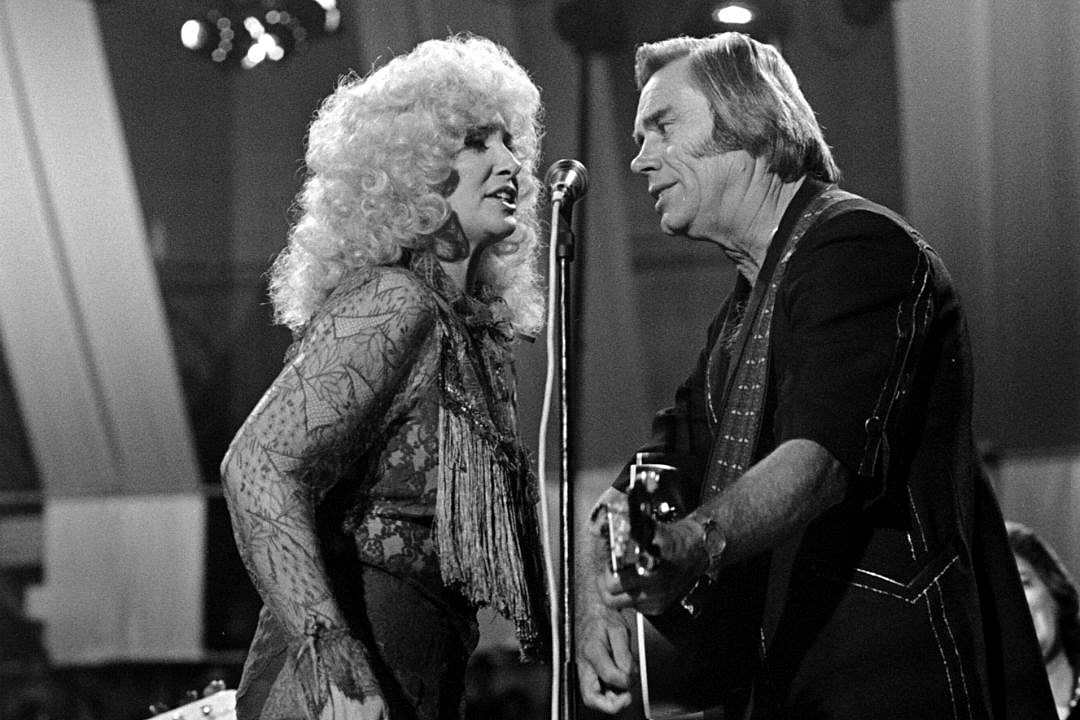
A pawn-shop ring became a country duet about love, ceremony, and the quiet return of loss.
George Jones and Tammy Wynette released “Golden Ring” in 1976, and the record arrived with a weight no arrangement could have manufactured. Written by Bobby Braddock and Rafe Van Hoy, the song became the title track of their duet album Golden Ring and reached the top of the country chart. Yet its power has never depended only on its chart success. It comes from the way a simple object—a wedding ring in a pawn shop—becomes a witness to hope, marriage, conflict, separation, and return.
The song’s structure is almost deceptively plain. It begins not with a confession, but with a scene: a ring waiting behind glass, detached from the lives it may enter. A couple sees it, buys it, gives it meaning, and carries it into a marriage. Later, after the relationship collapses, the ring returns to the pawn shop, stripped of the promise it once seemed to hold. That circular design is the genius of the composition. The ring does not change, but the people around it do. Country music has often understood that objects can hold emotional history, and “Golden Ring” turns that idea into a miniature drama.
What makes the 1976 recording so enduring is the duet itself. Jones and Wynette had already built a public identity around songs of domestic devotion, strain, and heartbreak, and by the time “Golden Ring” appeared, their own marriage had ended. That biographical fact can easily be overplayed, but it cannot be ignored. The record does not require listeners to know their history, yet knowing it adds a shadow around every phrase. They are not acting out a private diary; they are singing a carefully written country song. Still, the blend of those two voices gives the story an unusual nearness.
Jones sings with the bending, wounded precision that made him one of country music’s most expressive interpreters. He could make a syllable feel as if it had been pulled from the far edge of regret, and on “Golden Ring” he does not need to overstate anything. His voice carries the male part of the story with a kind of rueful steadiness, letting the melody sag and lift in small human motions. Wynette, by contrast, brings clarity and composure. Her phrasing has softness, but not weakness; it gives the woman in the song dignity even as the story moves toward disappointment. Together, their voices make the narrative feel less like a lesson and more like a memory being replayed from two sides.
The arrangement supports that restraint. Produced in the polished Nashville style associated with the era, the record gives the singers room without leaving them exposed. The instrumentation is smooth and carefully balanced, with the warmth of country balladry and the kind of melodic framing that lets a story unfold clearly. Nothing in the production tries to outdo the image at the center of the song. The ring remains the focus, and the arrangement seems to move around it like a slow turn of glass in a display case.
There is also a quiet theatrical intelligence in how the duet assigns perspective. “Golden Ring” is not simply two famous singers harmonizing on a sad song. It is a staged exchange in which each voice enters the shared narrative and then joins the other at the emotional hinge points. When they sing together, the record suggests the public language of marriage: vows, ceremony, the shared shape of a life. When they separate into individual lines, the distance between them becomes part of the storytelling. The performance understands that a duet can be intimate not only because two voices meet, but because they sometimes fail to fully merge.
That is why the song has continued to feel larger than its brief storyline. Its details are specific—a pawn shop, a wedding ring, a couple whose promise does not last—but its emotional movement is recognizable. Many country songs describe heartbreak after the fact. “Golden Ring” does something more severe: it shows how an emblem of forever can outlive the feeling that gave it meaning. The ring is passed along, sold, worn, returned. It survives as property, but the human dream attached to it proves fragile.
The 1976 success of “Golden Ring” also belongs to a particular moment in country music, when polished production and traditional storytelling could still meet at the center of mainstream radio. Jones and Wynette were not newcomers testing a formula; they were established artists whose voices carried years of recorded emotion. Their duet albums made use of that familiarity, but “Golden Ring” stands apart because the song’s circular construction matched the public knowledge surrounding them with almost uncanny neatness. Again, the record does not need speculation to work. Its facts are enough: two great country singers, once married, singing a song about a marriage symbol that ends where it began.
What remains most moving is the discipline of it. Neither singer turns the performance into spectacle. The sorrow is shaped, measured, and sung in service of the song. That restraint is part of its dignity. In an era and genre often associated with direct emotional expression, “Golden Ring” proves that understatement can cut just as deeply. It trusts the listener to understand the distance between a ring in a shop window and a ring on a hand, between an object’s shine and the life it cannot protect.
Nearly half a century later, the record still feels like a small country parable about the promises people make with complete sincerity, and the ways life can return those promises to the world in altered form. The ring keeps moving, but the duet pauses long enough to let us see what has passed through it: hope, ceremony, disappointment, and the strange endurance of a song that knows how quietly love can leave evidence behind.
