A small gold ring moves through one marriage, while two country voices carry the weight of another.
In 1976, George Jones and Tammy Wynette released “Golden Ring”, the title track of their duet album Golden Ring. Written by Bobby Braddock and Rafe Van Hoy and produced by Billy Sherrill, the song became a number-one country single, but its power has never depended only on chart success. It endures because it uses one ordinary object — a wedding band in a pawn shop window — to trace the whole bright rise and painful collapse of a love story.
The premise is almost cinematic in its simplicity. The ring begins behind glass, waiting to be chosen. A young couple sees it, buys it, and gives it meaning. It becomes a promise, then a symbol of domestic life, then a witness to disappointment. By the end, the same ring has returned to the pawn shop, stripped of its private history and ready to be purchased again. The circular structure is the song’s quiet brilliance: love does not vanish in a dramatic final scene; it is placed back into the world, carrying marks no stranger can see.
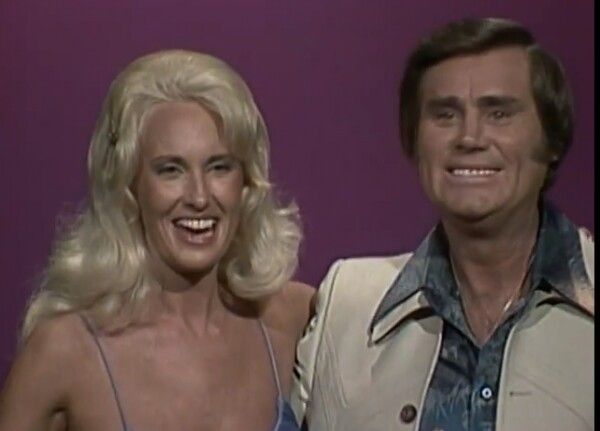
For many listeners, the emotional force of “Golden Ring” is inseparable from the voices singing it. George Jones and Tammy Wynette had married in 1969 and divorced in 1975, yet they continued to record together. That public fact gives the 1976 duet a delicate tension. The song does not require the listener to turn biography into spectacle, and the performance never sounds like confession in any literal sense. Still, the nearness of real history makes the recording feel unusually exposed. Two artists known for making heartbreak sound precise were singing a story about a marriage told through an object made to represent permanence.
Jones enters with the kind of phrasing that made his voice seem able to bend around regret without overstating it. He does not merely sing the lines; he lets them sag slightly at the edges, as if the words have already lived through the ending. His tone carries sympathy for the man in the story without excusing or dramatizing him. There is a plainness in the delivery that suits the pawn shop image. The emotion is not decorated. It sits in the melody, waiting for the listener to notice how much has been lost.
Wynette brings a different kind of ache. Her voice has firmness as well as vulnerability, and that balance matters. She does not make the woman in the song a fragile figure waiting to be broken. Instead, she gives the lyric a human steadiness, the sound of someone who understands both the beauty of a vow and the loneliness that can follow when a vow no longer protects the people inside it. When her voice meets Jones’s, the duet becomes less a conversation than a shared narration, two perspectives moving around the same small circle of gold.
The arrangement reflects the careful craft of mid-1970s Nashville country. Under Billy Sherrill’s production, the record has polish, but it does not smother the story. The instrumentation frames the singers with gentle dignity: country textures, measured pacing, and a melodic shape that allows the lyric to remain clear. Nothing in the track rushes toward tragedy. It proceeds almost like a display case turning slowly, letting each stage of the ring’s journey come into view. The restraint is part of what makes the song so piercing.
As a duet, “Golden Ring” also belongs to a tradition in which country music treats marriage not as an idealized ending, but as a place where hope and failure often occupy the same room. Earlier Jones and Wynette recordings had drawn on the chemistry of contrast: his mournful elasticity, her clear emotional command. Here, that contrast serves a song built around aftermath. The chorus does not simply lament a lost relationship. It suggests that symbols can outlive the promises attached to them. A ring may remain perfectly shaped while the life around it falls apart.
That idea is why the song has kept its sharpness. Many heartbreak songs focus on the person who leaves, the one left behind, or the memory that refuses to fade. “Golden Ring” shifts attention to an object that cannot speak and therefore cannot defend anyone’s version of events. It is passed from commerce to romance and back to commerce again. In doing so, it becomes a witness to the way private devotion can be transformed, over time, into something anonymous. The pawn shop setting is not merely sad; it is honest about how the world keeps moving after intimate worlds end.
The 1976 success of the single confirmed that audiences heard something deeply recognizable in that story. Yet the recording’s lasting appeal lies in how little it forces. George Jones and Tammy Wynette do not sing as though they are trying to overpower the listener. They trust the image, the melody, and the ache between their voices. That trust gives the duet its dignity. It allows heartbreak to be specific without becoming cruel, familiar without becoming ordinary.
In the end, “Golden Ring” is a song about the fragile distance between what an object promises and what people can sustain. A wedding band is made to close into a perfect circle, but a life together is made of days, choices, silences, and repairs. Jones and Wynette sing from inside that difference with remarkable restraint. The ring returns to the window, but the song leaves behind a more difficult truth: love can fail and still have been real, and the proof of it may rest quietly in the smallest thing left behind.
