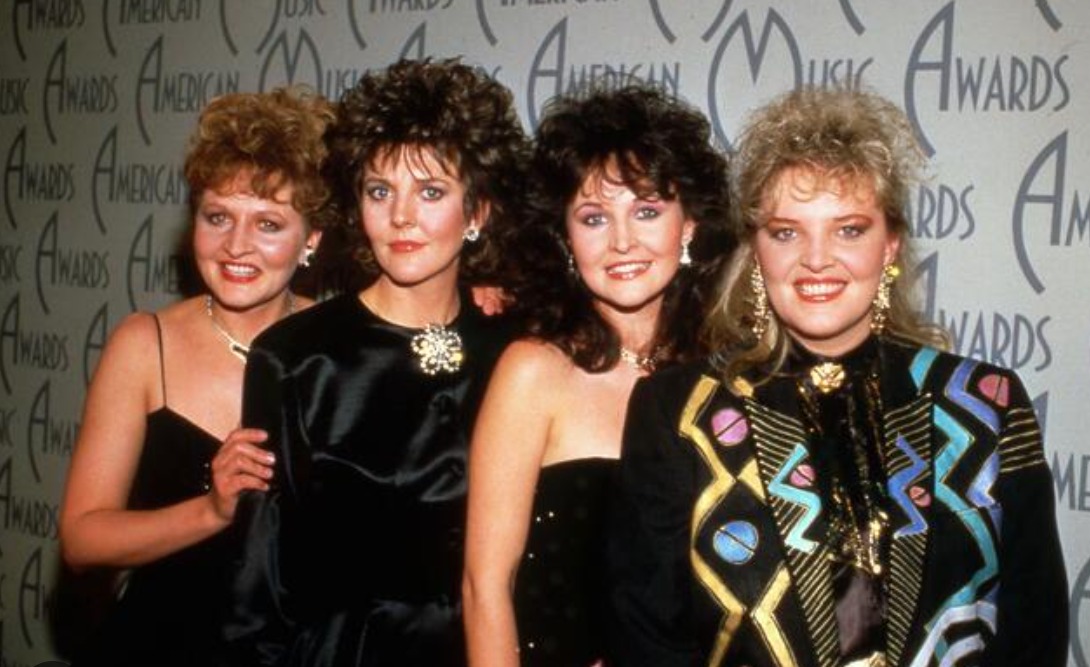
A gentle country No. 1 where four sisters let closeness become the arrangement.
In 1985, The Forester Sisters carried I Fell in Love Again Last Night to No. 1 on the country chart, giving the Georgia-born family quartet its first chart-topping country single. Written by Paul Overstreet and Thom Schuyler and released from the group’s self-titled debut album, the recording introduced a sound that did not need to push forward in order to be persuasive. Its strength was the soft acoustic frame, the unhurried romantic premise, and the way four related voices could make a simple line feel newly discovered.
The song arrived during a mid-1980s country moment that could lean polished, urbane, and radio-ready. The Forester Sisters certainly fit within that professional landscape, but I Fell in Love Again Last Night kept its emotional center close to the human scale. The rhythm is easy, the country-pop surface is clean, and the acoustic texture gives the voices room to stand together rather than compete with the track. Nothing in the recording feels oversized. That is part of its charm. It trusts softness as a form of confidence.
Family harmony has a particular kind of authority. It does not automatically make a record meaningful, but when the song is right, a sibling blend can carry a shared musical instinct that is difficult to manufacture. Kathy, June, Kim, and Christy Forester were not presented here as four separate personalities taking turns in the spotlight. The single works because the voices become one expressive body: one voice carrying the phrase, others rounding its edges, the harmony tightening and widening without drawing attention away from the lyric.
That matters because the lyric itself is built on renewal, not spectacle. I Fell in Love Again Last Night is not a song about the first shock of romance. It is about recognition returning inside an existing love. The title suggests a feeling that has happened before and can still happen again, which gives the song its modest emotional maturity. In another arrangement, that idea might have been played as dramatic revelation. In the hands of The Forester Sisters, it becomes something gentler: a domestic miracle spoken in a steady voice.
Paul Overstreet and Thom Schuyler gave the group a song with plainspoken architecture. The melody does not require acrobatics, and the language does not hide behind elaborate imagery. That plainness becomes useful because it leaves space for tone. The sisters can lean into the title phrase without forcing it, letting the harmony provide the lift that a bigger production might have tried to create with volume. The performance understands that sincerity often depends less on emphasis than on placement: where a note lands, where a harmony enters, where the breath of the arrangement allows the sentiment to sit.
The acoustic sound is central to that balance. The guitar-centered feel keeps the record from becoming too glossy, while the rhythm section gives it enough movement to belong on country radio. The chorus opens gracefully, not like a curtain being pulled for a grand scene, but like a room becoming warmer because more voices have entered it. The harmonies do not decorate the song from the outside. They clarify it from within. Each time the sisters gather around the emotional center, the idea of falling in love again becomes communal, as if affection is being affirmed by more than one witness.
As part of The Forester Sisters, the song helped define the group at the beginning of its mainstream country career. Before later hits expanded their catalog, this single established the quality that would remain most closely associated with them: a bright but tender vocal blend, precise enough for radio and warm enough to suggest a living-room closeness. The record’s success was not built on novelty or dramatic reinvention. It was built on a recognizable human pleasure: hearing voices that belong together find a song that benefits from their belonging.
That may be why I Fell in Love Again Last Night still feels distinctive within its era. It does not try to overwhelm the listener with heartbreak, desire, or triumph. It offers the quieter satisfaction of affection renewed. Country music has often found strength in ordinary moments, and this recording honors that tradition without leaning heavily on rural imagery or sentimental excess. The setting is emotional rather than scenic. The place it describes is the small private distance between familiarity and surprise, where someone known can suddenly feel newly beloved.
There is also a quiet artistic lesson in the way the record is made. Harmony asks for discipline. It asks singers to listen as carefully as they sing, to leave room for another voice, to make individual beauty serve a shared shape. On this 1985 No. 1, The Forester Sisters turned that discipline into feeling. The sweetness of I Fell in Love Again Last Night is not fragile because it is soft; it is steady because every part knows how to support the others. In that sense, the song becomes a small portrait of what lasting affection can sound like when no one needs to overpower the room.
