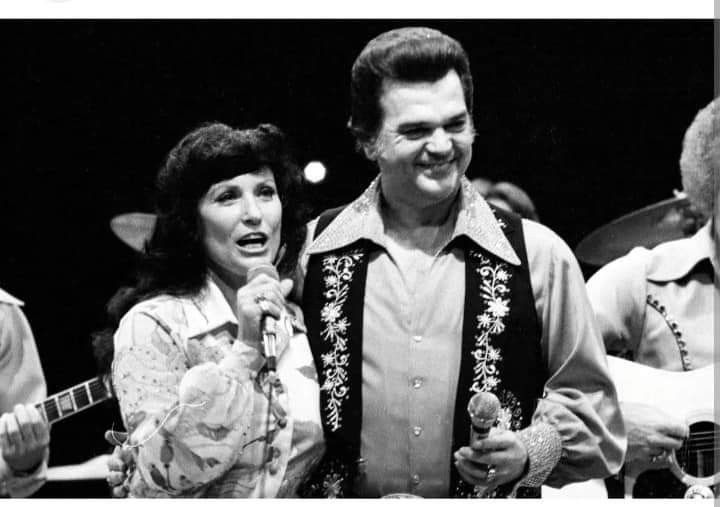
A river, two voices, and the bright rush of country music discovering how playful desire could sound.
Released in 1973, “Louisiana Woman, Mississippi Man” paired Conway Twitty and Loretta Lynn at full speed, turning a state-line romance into one of the defining duet moments of early-1970s country. Written by Becki Bluefield and Jim Owen, the song became the title track of the duo’s album Louisiana Woman, Mississippi Man and rose to No. 1 on the country chart. Yet the record’s endurance is not only a matter of commercial success. Its real force lies in the way it makes distance feel temporary, flirtation feel like motion, and two highly recognizable country voices sound as if they are racing toward the same shore.
Country duets had long made room for domestic humor, heartbreak, temptation, and reconciliation, but Twitty and Lynn brought a particularly vivid balance to the form. He had a smooth, controlled vocal presence that could lean into tenderness without losing authority. She sang with a directness that carried wit, bite, and emotional clarity. On “Louisiana Woman, Mississippi Man”, those qualities do not simply sit beside each other; they create the record’s engine. The song is built around separation, but the performance refuses to sound lonely. Every line seems to close the gap.
The premise is simple and cinematic: a woman in Louisiana, a man in Mississippi, and the Mississippi River between them. Instead of treating geography as an obstacle, the arrangement turns it into rhythm. The track moves with a brisk country pulse, bright and insistent, giving the feeling of wheels on pavement or a boat cutting across water. The lyric’s references to the river and the urgency of reunion are matched by a vocal exchange that rarely feels static. The singers answer, overlap in spirit, and push the song forward with the kind of buoyant confidence that made the duet sound less like a confession than a shared adventure.
Part of the pleasure is how little the record depends on grand declarations. The title itself has the sturdy shape of a folk phrase, almost like a regional emblem, but the performance keeps it personal. Loretta Lynn does not soften her edges to fit the duet; she brings a lively, grounded presence that makes the Louisiana woman feel alert and self-possessed. Conway Twitty does not overpower the exchange; he gives the Mississippi man a warmth that complements her spark. Their voices meet in a way that suggests partnership rather than performance trickery. Each singer remains fully identifiable, and that difference is exactly what makes the blend work.
By 1973, both artists were already major figures in country music, and their collaborations had become an important part of the decade’s sound. Their earlier duet “After the Fire Is Gone” had established them as a powerful recording pair, especially in songs that carried adult tension and emotional realism. “Louisiana Woman, Mississippi Man” did something brighter. It showed that a country duet could be charged with desire and humor without turning heavy, that it could be theatrical without becoming false, and that the push-pull of two voices could make a record feel almost physical.
The song also belongs to a moment when country music was expanding its reach while holding tightly to regional identity. Nashville production in the early 1970s could be polished, but this single still keeps its feet on familiar ground: rivers, borders, longing, and plainspoken attraction. Its energy comes from the way it transforms those familiar materials into momentum. The arrangement does not ask listeners to admire complexity. It asks them to feel pace, place, and personality. The record is carefully made, but it wears its craft lightly.
What distinguishes the duet, even decades later, is its sense of mutual lift. Some duet records are built as arguments, others as reconciliations, others as displays of harmony. This one feels like pursuit in both directions. Neither singer is waiting passively. The emotional world of the song is active, almost athletic. The river may separate the lovers, but the performance keeps insisting that song itself can cross it. That idea is modest, but it is also central to why the record still carries such charm: it turns ordinary distance into a reason to sing louder, move faster, and meet halfway.
There is nostalgia in “Louisiana Woman, Mississippi Man”, but not the fragile kind. It is the nostalgia of a record that remembers when country duets could sound like front-porch theater and radio-ready craft at once. It carries the texture of its era: the clean instrumental drive, the conversational male-female exchange, the confidence that a vivid setting and two distinct voices could create a whole world in under three minutes. The song does not need to explain its appeal because the appeal is embedded in the motion of the performance.
For Conway Twitty and Loretta Lynn, the duet helped confirm what their best collaborations understood: chemistry on record is not merely a matter of sweetness or blend. It can come from contrast, timing, restraint, and the willingness to leave space for the other voice to shine. In “Louisiana Woman, Mississippi Man”, they made a river sound narrow, a border sound playful, and a love song sound like it had somewhere urgent to go. The record remains a bright reminder that country music’s most durable stories often begin with simple places and become memorable through the way voices travel across them.
