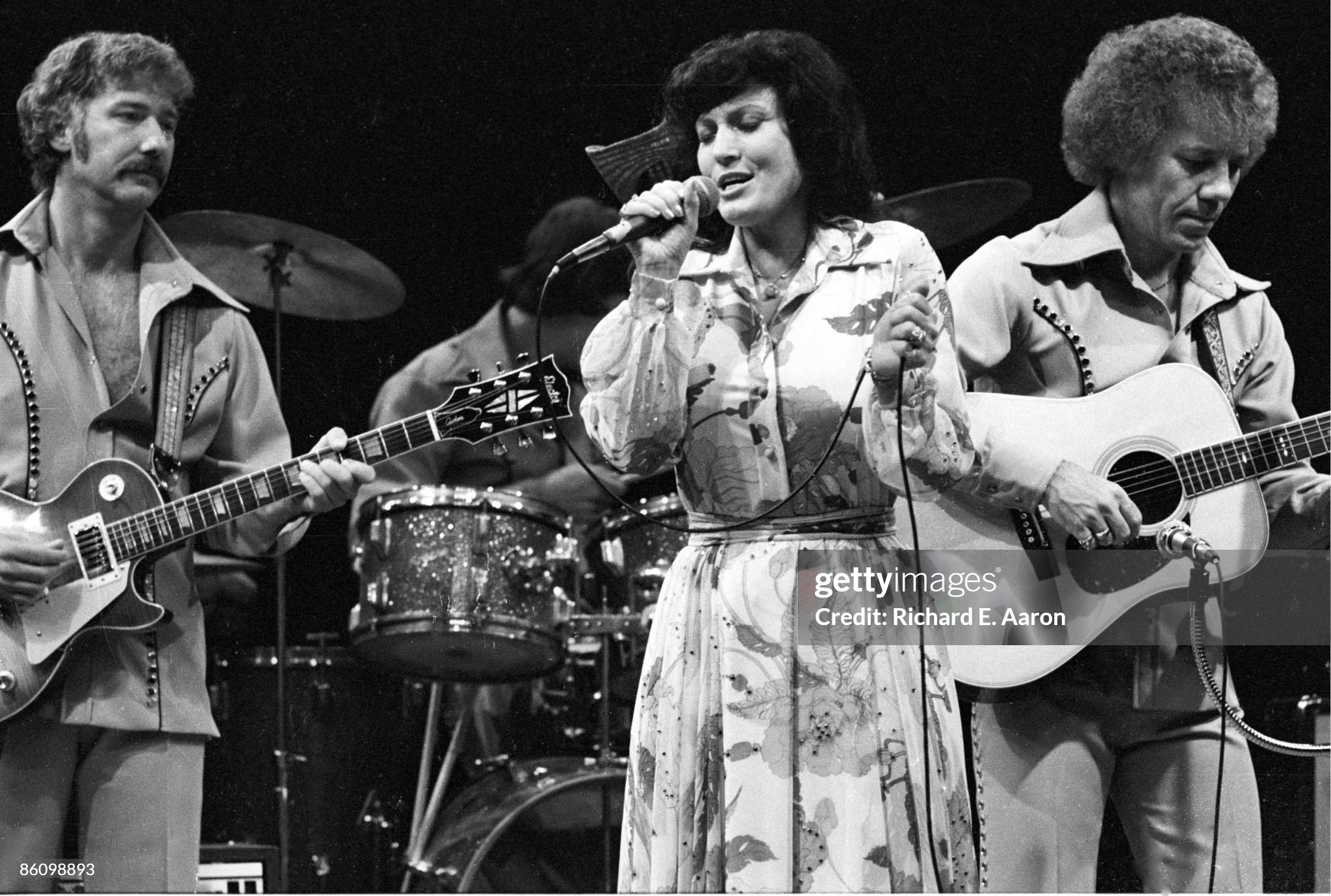
In 1973, two country voices turned a river crossing into one of the genre’s clearest pictures of romantic momentum.
“Louisiana Woman, Mississippi Man”, recorded by Conway Twitty and Loretta Lynn and released in 1973, became one of the defining songs of their celebrated country duet partnership. Written by Becki Bluefield and Jim Owen, it served as the title track of their album Louisiana Woman, Mississippi Man, arriving at a moment when Twitty and Lynn had already proven that their voices could do more than simply share a melody. They could create a whole dramatic weather system between them.
The song’s premise is direct enough to feel almost folkloric: a woman in Louisiana, a man in Mississippi, and the Mississippi River standing between desire and reunion. In lesser hands, that setup might have become a simple novelty of place names and Southern color. With Twitty and Lynn, it becomes movement. The river is not just geography; it is a pulse, a barrier, a dare. The recording feels built around the idea that attraction has velocity, and that two people singing toward each other can make distance sound temporary.
What makes the duet so vivid is not merely that their voices blend. In fact, part of the electricity comes from how distinct they remain. Loretta Lynn sings with a bright, cutting directness, her phrasing carrying the practical confidence that marked so much of her best work. She does not sound ornamental beside Twitty; she sounds like the force that gives the song its forward edge. Conway Twitty, with his smoother and darker tone, answers with warmth and control. His voice bends into the lyric with ease, but it never overwhelms hers. Together, they create the feeling of two strong personalities meeting in the middle rather than one voice leading and the other following.
That balance was central to the larger appeal of the Twitty-Lynn partnership. Country music has a long history of male-female duets built on flirtation, domestic tension, heartbreak, reconciliation, and comic sparring. Twitty and Lynn understood that a duet could be a small play, but they rarely made it feel theatrical in a stiff sense. Their best recordings work because the exchange sounds lived-in, conversational, and rhythmically alert. On “Louisiana Woman, Mississippi Man”, the conversation is charged with anticipation, yet the performance remains disciplined. The song moves quickly, but the singers never rush past the words.
The arrangement supports that sense of restless motion. The rhythm has a brisk country drive, giving the track the feel of travel rather than still longing. The instrumentation keeps the atmosphere lively and uncluttered, leaving room for the vocals to carry the narrative. This is important because the song depends on contrast: the land and the water, the woman and the man, separation and arrival. Each line seems to shorten the distance. The musical energy suggests wheels turning, water moving, and two voices closing in on a shared destination.
There is also a useful kind of theatrical symmetry in the title itself. “Louisiana Woman, Mississippi Man” names both figures with equal weight. It does not frame the woman as the prize or the man as the only pursuer. The title gives them both a place, both an identity, and both a claim on the story. That equality is audible in the performance. Lynn’s voice carries the spark of assertion; Twitty’s carries the answering pull. The chemistry lies in the fact that neither has to soften into the other for the duet to work. They meet through contrast.
By 1973, both artists were already major country figures in their own right. Lynn had reshaped the possibilities for women in country songwriting and performance through songs that spoke plainly about marriage, hardship, pride, and survival. Twitty had moved from early rock and roll success into a country career defined by smooth phrasing and romantic intensity. Their pairing did not erase those separate histories. Instead, it drew on them. In this duet, Lynn’s plainspoken strength and Twitty’s controlled sensuality become complementary forces, each making the other sound more vivid.
That is why the recording still feels like a benchmark for classic country partnerships. It is not just a successful duet; it is a lesson in proportion. The singers leave space. They answer rather than compete. They understand that chemistry in music is not the same as volume, and that romantic energy can be built through timing, tonal difference, and trust in the shape of a phrase. The track’s brightness should not obscure the craft beneath it. Every exchange is measured enough to sound effortless.
Many country duets are remembered for heartbreak, but “Louisiana Woman, Mississippi Man” is remembered for motion. Its emotion is not regret; it is urgency with a grin at the edge of it. The song captures a romance that has not settled into memory yet. It is still on the road, still crossing water, still charged by distance. Twitty and Lynn make that feeling believable because they sing as equals moving toward the same center.
In the end, the duet’s lasting power comes from its clarity. Two places, two voices, one river, one pull. Conway Twitty and Loretta Lynn did not need to complicate the story to make it resonate. They simply gave the song a living current, and let their unmatched vocal chemistry carry it across.
