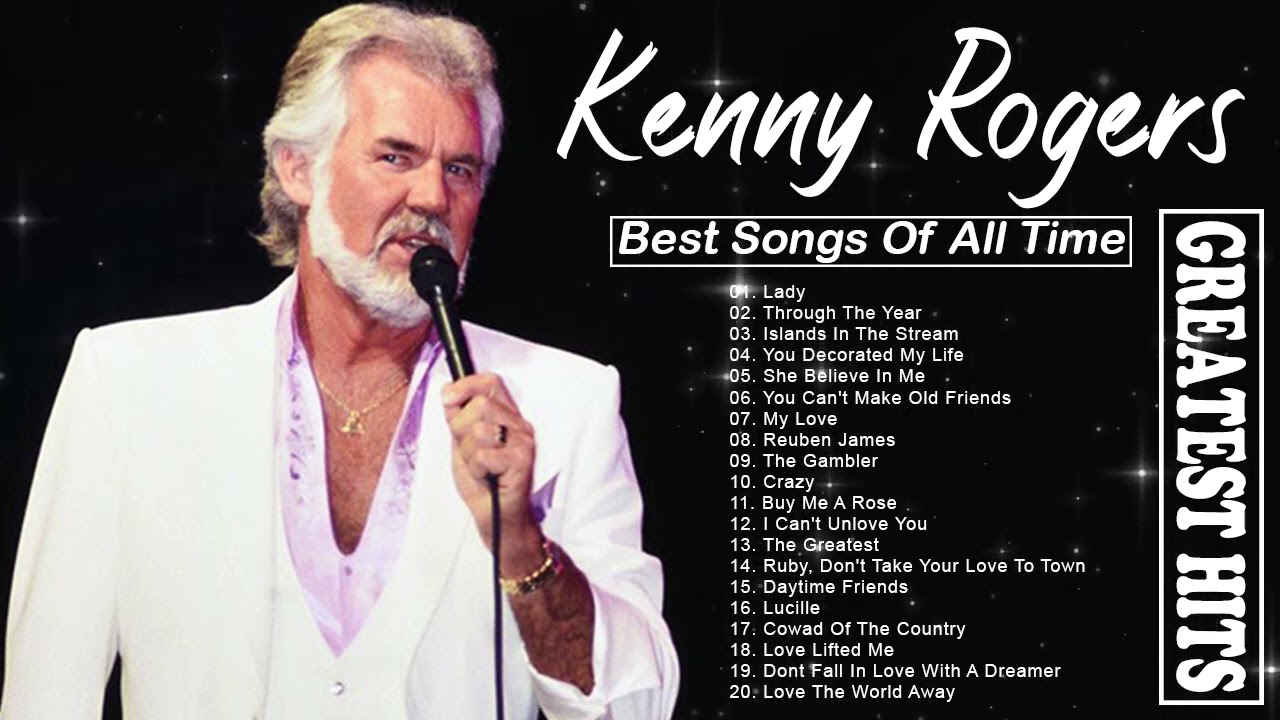
In “The Gambler”, Kenny Rogers found the rare story-song that could become a voice, a lesson, and a life emblem.
Kenny Rogers released “The Gambler” in 1978, and the recording quickly became the song most closely associated with his name. Written by Don Schlitz, it appeared on Rogers’ album The Gambler and became a major country hit, later crossing beyond genre lines into pop culture, television, and public memory. Rogers had many successful records before and after it, but this one settled differently. It did not merely give him another hit; it gave him a persona that seemed to fit his voice with unusual precision.
The song’s design is deceptively simple. A narrator meets an old gambler on a train “bound for nowhere,” and the stranger offers advice framed in the language of cards: know when to hold, fold, walk away, and run. In less careful hands, the idea might have become a novelty, a string of slogans dressed up as country wisdom. Schlitz’s writing avoids that by giving the advice a setting, a face, and a final quiet turn. The listener is not handed a lecture from above; the lesson arrives in the half-light of a moving train, from a weary figure who seems to understand both risk and resignation.
That is where Rogers’ interpretation becomes essential. His vocal performance does not push the drama too hard. He sings like someone reporting what happened, not like someone trying to prove the importance of the event. The verses move with narrative patience, allowing the listener to enter the compartment and sit across from the gambler. Rogers’ voice had warmth, but here it also carries a measured distance, a steadiness that lets the story breathe. He trusts the lyric’s plain language, and that trust is part of the recording’s strength.
The arrangement supports that restraint. Produced by Larry Butler, Rogers’ version places the story at the center, with instrumentation that feels direct and unfussy. The rhythm suggests forward motion without hurrying the tale. The chorus opens up just enough to become memorable, but not so much that it breaks the spell of the verses. The song’s famous lines land because the recording has earned them. They feel less like catchphrases than weathered advice passed across a table after long observation.
By 1978, Rogers was already an established artist, known both for his work with The First Edition and for a solo career that had moved successfully into country-pop territory. Yet “The Gambler” sharpened his public identity. Its success on the country chart and its reach into wider audiences showed how effectively Rogers could occupy the space between traditional storytelling and mainstream accessibility. He did not sound like an outsider borrowing country language, nor did he sound confined by format. He sounded like a narrator whose calm made the story available to almost everyone.
Part of the song’s power lies in how little it explains. The gambler’s advice is memorable because it remains flexible. It can be heard as a lesson about cards, money, love, survival, timing, ego, or acceptance. The lyric never pins the meaning down to one situation. That openness helped the song travel far beyond its original context. Listeners could carry it into their own decisions without needing the song to tell them exactly what to do. Its wisdom is not triumphal. It admits that life involves loss, uncertainty, and the discipline of leaving a table before it takes everything.
The recording also gave Rogers a lasting character. The association became so strong that he later starred as gambler Brady Hawkes in a series of television films inspired by the song, beginning with Kenny Rogers as The Gambler in 1980. That extension into television did not create the song’s importance, but it confirmed how vividly the record had shaped the public imagination. Rogers had sung a story so completely that audiences could see a whole world inside it.
It is important, too, that “The Gambler” was not only a performance vehicle. It was a songwriter’s triumph. Don Schlitz gave country music one of its most durable narrative frameworks, and Rogers gave that framework its most widely recognized voice. The partnership between writer and singer is central to the recording’s endurance. Schlitz supplied the architecture: scene, character, metaphor, turn. Rogers supplied the human temperature: calm, sympathy, authority without force. Together, they made a song that feels both crafted and inevitable.
The phrase “career-defining” can sometimes flatten an artist, as if one song explains everything. With Rogers, “The Gambler” does not erase the rest of his work; instead, it clarifies one of his greatest gifts. He could make a polished recording feel conversational. He could sing a story without overacting it. He could let simple words gather weight until they sounded like memory. That quality made him especially suited to a song about judgment, timing, and the quiet art of knowing what a moment requires.
Decades later, the recording still feels composed rather than inflated. Its lesson has become familiar, but familiarity has not emptied it. The best story-songs survive because they leave space for the listener to age alongside them. A young listener may hear the chorus as clever advice; an older one may hear the cost behind it. In Kenny Rogers’ 1978 recording of “The Gambler”, the train keeps moving, the cards stay on the table, and the song waits patiently for each listener to understand the hand they have been dealt.
