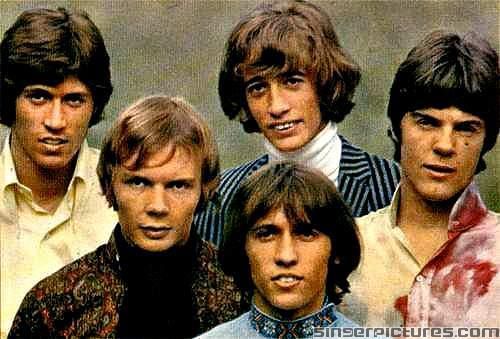
On the 1968 album that carried its name, Bee Gees’ “Idea” moves with a bright, restless pulse, letting Barry and Robin Gibb turn pop craftsmanship into forward motion.
Released in 1968, Idea arrived during one of the most fertile and fast-moving chapters in the early career of the Bee Gees. The group was still years away from the disco-era sound that would redefine their public image, and they were already more than a harmony act with pretty melodies. Barry, Robin, and Maurice Gibb were writing at a pace that seemed almost impatient, moving between orchestral pop, dramatic ballads, British psychedelia, and tighter, rhythm-driven pop-rock. Within that setting, “Idea”, the album’s title track, stands out not because it is the most famous song on the record, but because it captures the band in motion: urgent, melodic, slightly eccentric, and powered by the push-and-pull of Barry Gibb and Robin Gibb sharing the vocal spotlight.
The album Idea is often remembered through the emotional gravity of songs such as “I’ve Gotta Get a Message to You” and “I Started a Joke”, recordings that helped define the Bee Gees’ gift for melodrama without excess. But the title track belongs to another side of the same story. “Idea” does not move like a confession whispered under a dim light. It pushes ahead. Its rhythm has a brisk, driving quality, the sort of forward motion that gives the song a different kind of emotional meaning. Instead of lingering in sadness, it feels alert, almost argumentative, as if the band is testing how much energy their melodic instincts can carry without losing their distinctive shape.
That is where the dual lead vocals become essential. Barry and Robin had very different expressive identities, and “Idea” benefits from the contrast rather than smoothing it away. Barry’s voice brings a clean pop strength, a sense of line and structure, while Robin’s voice cuts through with that unmistakable quiver and dramatic color. When their parts meet and answer each other, the song feels less like a simple lead vocal with harmony support and more like a conversation under pressure. The tension is not theatrical in an obvious way; it is built into the sound of two brothers approaching the same melody from different emotional angles.
The Bee Gees’ early recordings often balanced elegance with strangeness. They could make a song sound polished while still leaving something unsettled inside it. “Idea” carries that quality in a brighter, more kinetic form. The arrangement keeps the song moving, but the vocal presence keeps it recognizably theirs. Even when the track leans into pop-rock muscle, it does not abandon the ornate instincts that marked their late-1960s work. There is still a sense of composition, of carefully placed voices and melodic turns, rather than a band simply leaning on volume or speed.
Heard today, the title track also reminds us how misleading it can be to view the Bee Gees only through the lens of their later fame. In 1968, they were still building an identity in public, and that identity was wider than many later summaries allow. They were young, ambitious, and unusually fluent in mood. A single album could hold grave narrative songs, delicate pop ballads, and something as brisk and charged as “Idea”. The title itself feels fitting for a group constantly trying out new shapes, not casually, but with a songwriter’s hunger to find the emotional center of each one.
There is a special charm in hearing the Bee Gees when they are not floating above the rhythm but riding it. “Idea” shows how effective they could be when melody and momentum met on equal terms. The driving beat gives the track its spine, but the voices give it its personality. Barry and Robin do not sound interchangeable; they sound connected by blood, craft, and contrast. That difference is part of what made the early Bee Gees so compelling. Their harmonies could be beautiful, but their individual voices carried friction, and friction can be just as memorable as sweetness.
As a title track, “Idea” does not need to announce itself as the grand statement of the album. Its importance is more subtle than that. It opens a window onto a band refusing to sit still, a band able to turn a concise pop-rock track into something layered by vocal character and rhythmic insistence. The song may not be the first title people name from the album, but it helps explain the album’s range. It is the sound of the Bee Gees before they became fixed in the public imagination, when their music still seemed to be sprinting toward several possible futures at once.
That is why Bee Gees’ “Idea” still rewards close listening. Beneath its upbeat surface is a portrait of a group learning how many directions its own voice could travel. The track has brightness, but not lightness; drive, but not bluntness; brotherly blend, but also brotherly contrast. It reminds us that a title track can do more than name an album. Sometimes it can reveal the engine inside it.
