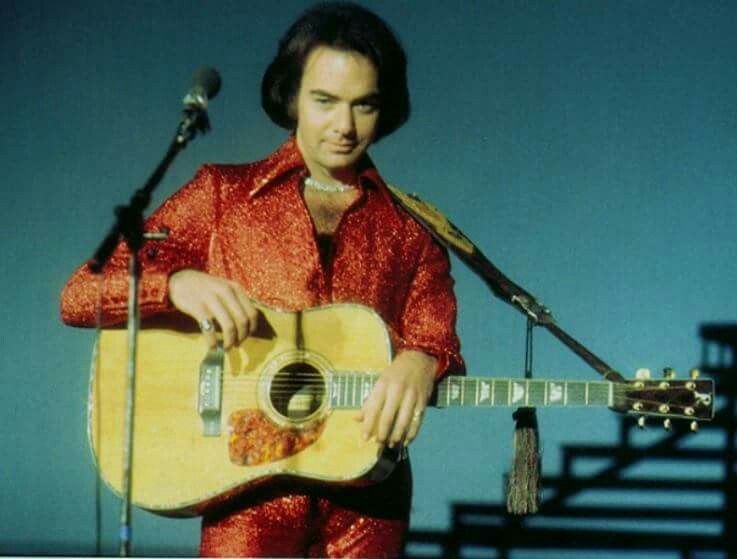
On Man of God, Neil Diamond let the grandeur fall away and turned faith into something intimate, restless, and unmistakably human.
Neil Diamond released Man of God in 2005 as part of 12 Songs, the spare, Rick Rubin-produced album that reintroduced one of American pop’s most recognizable songwriters in a quieter, more exposed light. The context matters. This was not the arena-sized Diamond of Sweet Caroline, the sweeping drama of I Am… I Said, or the polished adult-pop presence that had carried him through decades of radio, stage lights, and cultural memory. 12 Songs was built around a different kind of authority: the authority of a writer sitting close to the source, with fewer barriers between the song and the person singing it.
That is why Man of God feels so revealing. Produced by Rick Rubin, who had already become known for helping major artists rediscover the raw grain of their own voices, the album placed Diamond in an uncluttered acoustic setting. Rubin’s great gift in projects like this was not simply subtraction for its own sake. It was a way of making familiar artists sound as if they were speaking from the room rather than projecting from the balcony. On Man of God, that approach gives Diamond’s voice a closeness that changes the emotional scale of the song.
The title itself could suggest certainty, but the performance does not feel like a sermon. It feels more like a reckoning. Diamond sings with the weight of someone who has lived long enough to know that faith, identity, pride, doubt, gratitude, and need often sit in the same chair. The stripped-down acoustic track allows every phrase to carry more pressure. There is little room for dramatic escape. The guitar does not decorate the song so much as steady it, creating a plain wooden floor beneath the voice. Instead of a grand arrangement telling the listener what to feel, the recording leaves space for the words to breathe and for Diamond’s age, experience, and tone to do the deeper work.
By 2005, Diamond had already earned a place among the durable figures of American popular music. He had written songs that became public rituals, private companions, radio fixtures, and sing-along monuments. But the danger of becoming that familiar is that people can stop listening closely. They remember the choruses, the jackets, the showmanship, the communal lift of the hits. 12 Songs challenged that habit. It asked listeners to hear Diamond again as a craftsman of melody and confession, a songwriter whose plainest lines could carry complicated feeling when the production stopped trying to enlarge them.
Man of God belongs to that late-career tradition in which an artist does not need to prove power through volume. The power comes from restraint. Diamond’s voice, still unmistakably his, carries more weather than gloss. There is a roughness at the edges, but it works in the song’s favor. The recording does not pretend youth; it values presence. In that sense, the track is not merely acoustic as a style choice. It is acoustic as a moral posture. It stands close to the listener and refuses to hide behind spectacle.
Rick Rubin’s production on 12 Songs was often compared in spirit to his work with artists who had long public histories, but Diamond’s case was unique. His catalog had always balanced vulnerability and showmanship, Brill Building discipline and theatrical reach. What Man of God reveals is how much remains when the theatrical frame is narrowed. The melody is direct, the rhythm unforced, and the emotional center sits in the friction between confidence and humility. Diamond does not sound diminished by the smaller setting. He sounds clarified.
There is also something moving about hearing a performer so associated with mass recognition enter a song that feels almost private. The track does not ask for applause. It asks for attention. Its late-career significance lies in that quiet shift: from commanding a crowd to inhabiting a room, from the outer glow of fame to the inner labor of belief and self-understanding. For listeners who know Diamond mainly through the big communal songs, Man of God can feel like discovering a side entrance into the same house, one where the lights are lower and the voice is closer.
Nearly two decades after its release, Man of God still stands as one of the clearest examples of what made 12 Songs such an important chapter in Diamond’s catalog. It did not erase the past. It did not try to modernize him beyond recognition. Instead, it returned him to the durable things: a lyric, a melody, an acoustic pulse, and a voice carrying the evidence of a long road. The result is not grand in the old Neil Diamond sense. It is something smaller, stronger, and more searching—a late-career song that finds its force by letting the silence around it speak.
