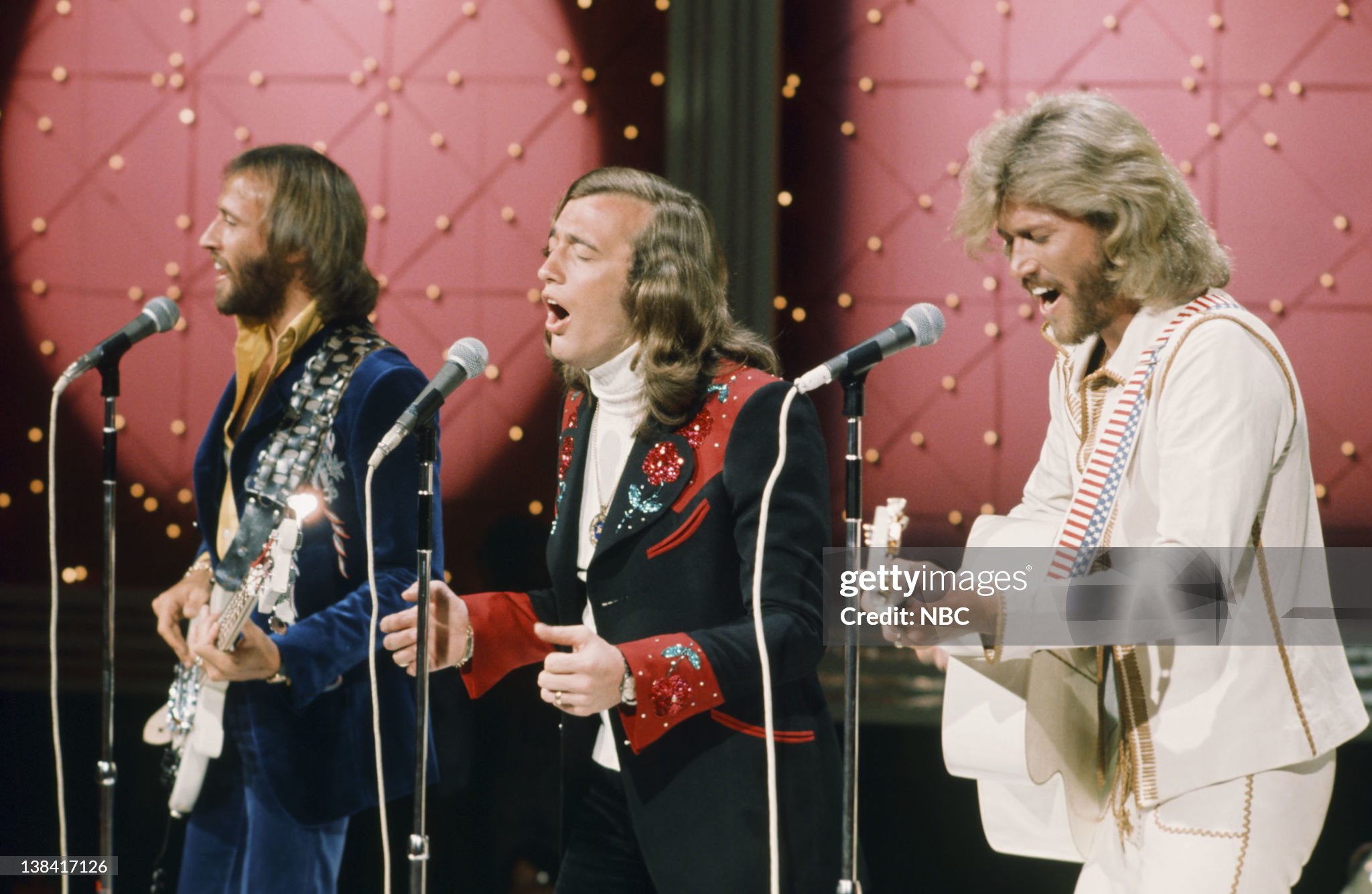
On Main Course, Baby As You Turn Away sounds like a farewell and a threshold: the Bee Gees learning how high their voices could carry a new kind of soul.
Released in 1975 as the closing track on Main Course, Baby As You Turn Away arrived at one of the decisive hinges in the Bee Gees catalog. The album, produced by Arif Mardin and recorded during their Miami period at Criteria Studios, helped move Barry Gibb, Robin Gibb, and Maurice Gibb from the orchestral pop and dramatic balladry of their earlier years toward a more rhythm-conscious language shaped by American R&B, funk, and soul. The famous signposts are easy to name: Jive Talkin’, which returned them to the top of the U.S. singles chart, and Nights on Broadway, where the upper register that would soon define a new era came blazing into view. But tucked at the end of the album, Baby As You Turn Away tells the transition differently.
It is not the loudest announcement on Main Course, and that is part of its value. The song does not swagger into the room the way the album’s funkier material does. It moves with the feeling of someone watching a door close, almost politely, while something inside the music is still reaching upward. Written by Barry, Robin, and Maurice Gibb, it carries the group’s old gift for emotional melodrama, but the surface has changed. The voices are smoother, the air around them more polished, the phrasing more connected to the pull of soul music than to the baroque pop atmosphere that had surrounded many of their late-1960s recordings.
That is what makes Baby As You Turn Away such a revealing transitional track. The Bee Gees had always understood harmony. Long before the disco years, their records were built on the eerie closeness of sibling voices, voices that could sound wounded, formal, theatrical, or almost ghostly depending on the arrangement. On Main Course, however, harmony begins to behave less like a chamber-pop signature and more like a living rhythmic instrument. The higher vocal blend is not simply decorative. It presses against the song’s emotional surface, giving the heartbreak a lift that feels both fragile and newly sensual.
By the time the album reaches Baby As You Turn Away, the heavier use of falsetto harmony is no longer just a dramatic accent. It begins to feel like a new vocabulary. The group’s singing does not abandon sadness; it translates sadness into altitude. The higher the voices rise, the more exposed the feeling becomes. Instead of treating falsetto as a novelty or a trick of range, the Bee Gees let it become a kind of emotional light source, illuminating the ache without making it heavier than the song can bear.
The placement matters. As the final track on Main Course, Baby As You Turn Away comes after the album has already shown several futures at once: the streetwise pulse of Jive Talkin’, the urban rush of Nights on Broadway, the tender polish of Fanny (Be Tender with My Love), and the lingering traces of the group’s older songwriting identity. Closing with this song gives the album a softer landing. It does not end by declaring victory. It ends in suspension, with the sense that the Bee Gees were leaving one room while hearing the echo of another ahead.
There is also a human tension in that transition. The mid-1970s could have easily reduced the Bee Gees to a group searching for a new commercial disguise after a difficult early-decade stretch. But Main Course does not sound like a costume change when listened to closely. It sounds like a band discovering that the emotional instincts they already possessed could survive inside a different groove, a different studio atmosphere, a different kind of vocal brightness. Arif Mardin helped sharpen that setting, but the essential material was already in the brothers: melody, yearning, tension, and the uncanny ability to make three voices feel like one complicated thought.
Baby As You Turn Away stands at the quieter side of that discovery. It may not carry the immediate cultural weight of the album’s biggest singles, yet it helps explain why the transition worked. The song proves that the new Bee Gees sound was not only about dance floors or radio reinvention. It was also about finding fresh colors for vulnerability. The R&B influence gave the music a sleeker body; the falsetto harmonies gave it a new emotional height. Together, they allowed the group to move forward without cutting themselves off from the ache that had always lived at the center of their best work.
Heard today, the song feels like a private page in a very public chapter. Main Course would become the bridge toward the global dominance that followed, but Baby As You Turn Away reminds us that every major reinvention has its quieter evidence. Sometimes the future does not arrive with a shout. Sometimes it appears at the end of an album, in a farewell melody, in voices rising just high enough to reveal that the old sorrow has learned a new shape.
