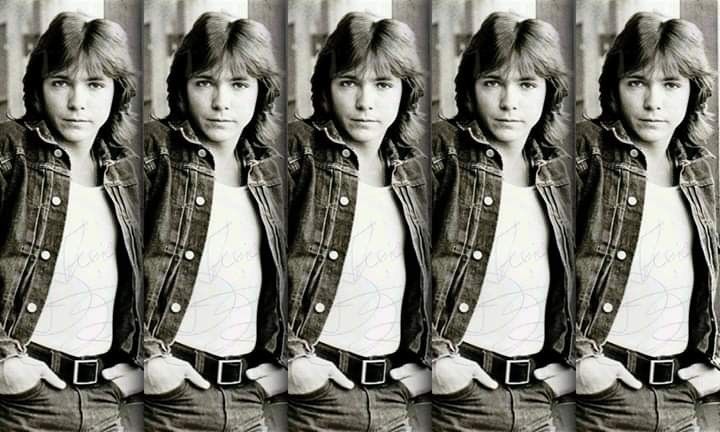
In David Cassidy’s hands, Harry Nilsson’s small song about wishing became the emotional key to a 1973 album caught between innocence and celebrity.
On the 1973 album Dreams Are Nuthin’ More Than Wishes, David Cassidy included his cover of Harry Nilsson’s The Puppy Song, and the choice mattered more than it first appears. The album’s very title came from the song’s central idea, turning Nilsson’s childlike philosophy of dreams and wishes into the frame around Cassidy’s whole record. For an artist living inside one of the brightest pop spotlights of the early 1970s, that was not a small detail. It made a gentle cover song feel like a quiet doorway into the strange gap between being adored and being truly heard.
The Puppy Song had already belonged to Nilsson before Cassidy touched it. Nilsson recorded it for his 1969 album Harry, at a time when his songwriting often blended nursery-rhyme simplicity with grown-up emotional intelligence. He had a rare gift for writing melodies that sounded almost too easy, then letting a line or a turn of phrase reveal something more wistful underneath. In Nilsson’s world, innocence was never merely cute. It had an ache in it. It knew that wanting something simple could sometimes be the most vulnerable thing of all.
When Cassidy brought the song into Dreams Are Nuthin’ More Than Wishes, the meaning shifted. By 1973, he was not just another young singer recording a charming pop tune. He was a face on television, a voice on radio, and a public figure shaped by the enormous success of The Partridge Family. His solo albums existed alongside that fame, sometimes benefiting from it and sometimes trying to move beyond the narrow expectations it created. In that setting, The Puppy Song becomes more than a sweet Nilsson cover. It becomes a mirror held up to a performer whose career was surrounded by other people’s dreams.
The song’s appeal lies in its almost disarming plainness. It does not announce itself as grand or dramatic. It moves with the lightness of a tune someone might hum without realizing how much feeling it carries. In Cassidy’s version, that lightness is important. His voice does not need to wrestle the song into seriousness. Instead, the emotion comes from the contrast between the material and the moment. A singer surrounded by screaming crowds and impossible commercial expectations is singing about the modest language of wishes, companionship, and imagined happiness. The result is soft on the surface, but it is not empty.
That is what makes this cover worth hearing as a reinterpretation rather than a simple remake. Cassidy was often marketed through brightness: the smile, the youth, the clean pop image, the approachable charm. The Puppy Song fits that surface perfectly, which may be why it can be underestimated. But the album title drawn from it changes the weight of the song. Dreams Are Nuthin’ More Than Wishes sounds playful, almost casual, yet the phrase carries a deeper question. What happens when a dream belongs to millions of fans, but the person at the center of it is still trying to locate his own voice?
The 1973 album arrived during Cassidy’s intense early solo period on Bell Records, when his records moved easily between polished pop, covers, romantic ballads, and theatrical touches. He was working within a commercial machine, but that does not mean every song inside it was disposable. Covers were often a way for pop singers of the era to reveal taste, alignment, and emotional instinct. By choosing a Nilsson song, Cassidy connected himself to a songwriter admired for wit, melancholy, and melodic intelligence. He did not turn The Puppy Song into a Nilsson pastiche. He let it sit inside his own public weather.
There is also a cultural tenderness to the recording. The early 1970s were full of pop songs that balanced sweetness with unease. Audiences wanted escape, but they also recognized longing when it was dressed in simple clothes. Cassidy’s version of The Puppy Song belongs to that world. It can be heard as light entertainment, and there is nothing wrong with that. But listen a little closer and the song begins to feel like a small act of sincerity inside a heavily packaged career. Its innocence is not a weakness; it is the very thing that lets the performance breathe.
The fact that The Puppy Song helped name Dreams Are Nuthin’ More Than Wishes gives the album a center of gravity. It suggests that, beneath the glossy photographs and fan-magazine energy surrounding Cassidy in 1973, there was a recurring theme of desire shaped by distance. A dream can be beautiful, but it can also be something just out of reach. A wish can be harmless, but it can also reveal what someone lacks. Nilsson’s song understood that in miniature. Cassidy’s cover placed that miniature inside a much larger pop-life frame.
Years later, the recording feels especially revealing because it does not try to prove anything loudly. It is not the song most often used to argue for Cassidy’s seriousness, and that may be part of its charm. It simply shows how a familiar young star could take another writer’s delicate little song and let it gather new meaning through context. Harry Nilsson wrote The Puppy Song with the light hand of someone who knew simplicity could be profound. David Cassidy sang it at a moment when simplicity itself must have felt complicated. Between those two facts, the cover finds its quiet afterlife.
That is why this track still deserves attention beyond nostalgia. It reminds us that pop history is often carried by details: a borrowed song, a lifted phrase, an album title, a voice placed in a setting that changes what we hear. The Puppy Song may sound small, but on Dreams Are Nuthin’ More Than Wishes, it becomes the sentence that names the dream and gently questions it at the same time.
