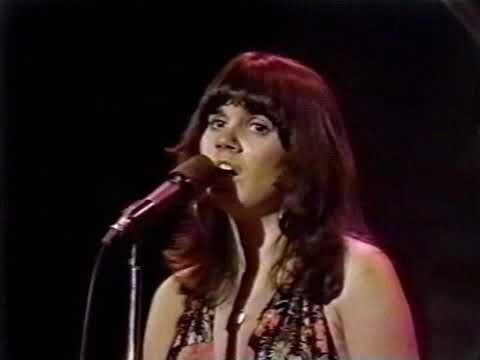
Before superstardom gave her voice a larger stage, Linda Ronstadt was already showing how a country standard could breathe in the open air of early country-rock.
On her 1972 self-titled solo album, Linda Ronstadt included I Fall to Pieces, a song already carrying one of the most recognizable shadows in country music. Written by Hank Cochran and Harlan Howard, the ballad had been made famous by Patsy Cline in 1961, when Cline’s poised, wounded performance helped turn it into a major country-pop crossover recording. By the time Ronstadt approached it more than a decade later, the song was not simply material; it was inheritance.
That is what makes Ronstadt’s early interpretation so revealing. This was not the Linda Ronstadt of Heart Like a Wheel yet, not the arena-commanding singer whose blend of country, rock, pop, and old standards would become a defining force of the 1970s. The Linda Ronstadt album arrived during a searching period, after her work with the Stone Poneys and before the full commercial breakthrough that would place her at the center of American popular music. She was already known for a voice of uncommon clarity and force, but she was still shaping the artistic identity that would later make her one of the great interpreters of other people’s songs.
Taking on I Fall to Pieces at that stage was a bold move precisely because Patsy Cline’s version seemed so complete. Cline sang the song with a kind of formal devastation: controlled, elegant, adult, each phrase balanced between restraint and collapse. The production surrounding her belonged to the Nashville Sound era, where country feeling was polished into something that could travel far beyond its original borders. Ronstadt, working from the early-1970s West Coast country-rock world, could not simply repeat that mood. Her task was not to outsing Cline or to decorate the standard with reverence. The more interesting choice was to let the song pass through her own musical weather.
On the 1972 album, Ronstadt’s country-rock interpretation places the song in a different emotional room. The heartbreak is still there, of course; it is built into the lyric’s repeated admission of losing control whenever the beloved appears. But Ronstadt’s reading feels younger, less ceremonially framed, more exposed to movement. There is a looseness in the atmosphere around her, a sense of California musicians translating country memory through folk directness and rock-era instinct. Instead of sounding sealed inside a ballroom of sorrow, the song seems to travel down a highway, carrying its ache in daylight.
What stands out is how carefully Ronstadt avoids imitation. She does not borrow Cline’s rounded phrasing or her grand sense of suspended heartbreak. Ronstadt’s voice moves with a different pressure. It has brightness even when the lyric is wounded, and that brightness changes the meaning of the performance. In her hands, I Fall to Pieces becomes less the confession of someone already resigned to emotional ruin and more the sound of someone discovering how fragile composure can be. She sings as if the feeling is happening in real time, as if the dignity of the line keeps being threatened by the force behind it.
That quality would become central to Ronstadt’s art. Again and again in the years that followed, she would take songs associated with other singers, other genres, and other eras, then make them feel newly personal without pretending to own them completely. She had a rare gift for standing inside a song’s history while still letting her own temperament be heard. The 1972 I Fall to Pieces is an early glimpse of that gift: respectful, but not timid; affectionate, but not frozen in admiration.
The album itself reflects that transitional moment. Linda Ronstadt drew from country, folk, R&B, and singer-songwriter material, suggesting an artist who was not interested in neat boundaries. She could move from a country standard to a contemporary song without treating either as a costume. In that sense, her reading of Patsy Cline was not nostalgia. It was part of a larger argument Ronstadt was making through performance: that American music was connected by feeling more than by category, and that a strong enough voice could reveal those connections without forcing them.
Heard now, the recording carries a special tenderness because it belongs to the before. Before the huge albums, before the radio dominance, before her interpretive range became widely understood, Ronstadt was already testing how much emotion a familiar song could hold when sung from a different angle. I Fall to Pieces did not need rescuing, and Ronstadt did not treat it as if it did. She treated it as a living song, one that could survive another room, another band, another young voice learning how to balance power with vulnerability.
That is the quiet importance of this 1972 performance. It does not erase Patsy Cline’s version, and it never tries to. Instead, it lets the standard cast a new shadow, one shaped by country-rock’s open spaces and by a singer on the edge of becoming herself. In the careful ache of Ronstadt’s vocal, you can hear not only a tribute to the past, but the first outlines of a future in which she would make interpretation feel like revelation.
