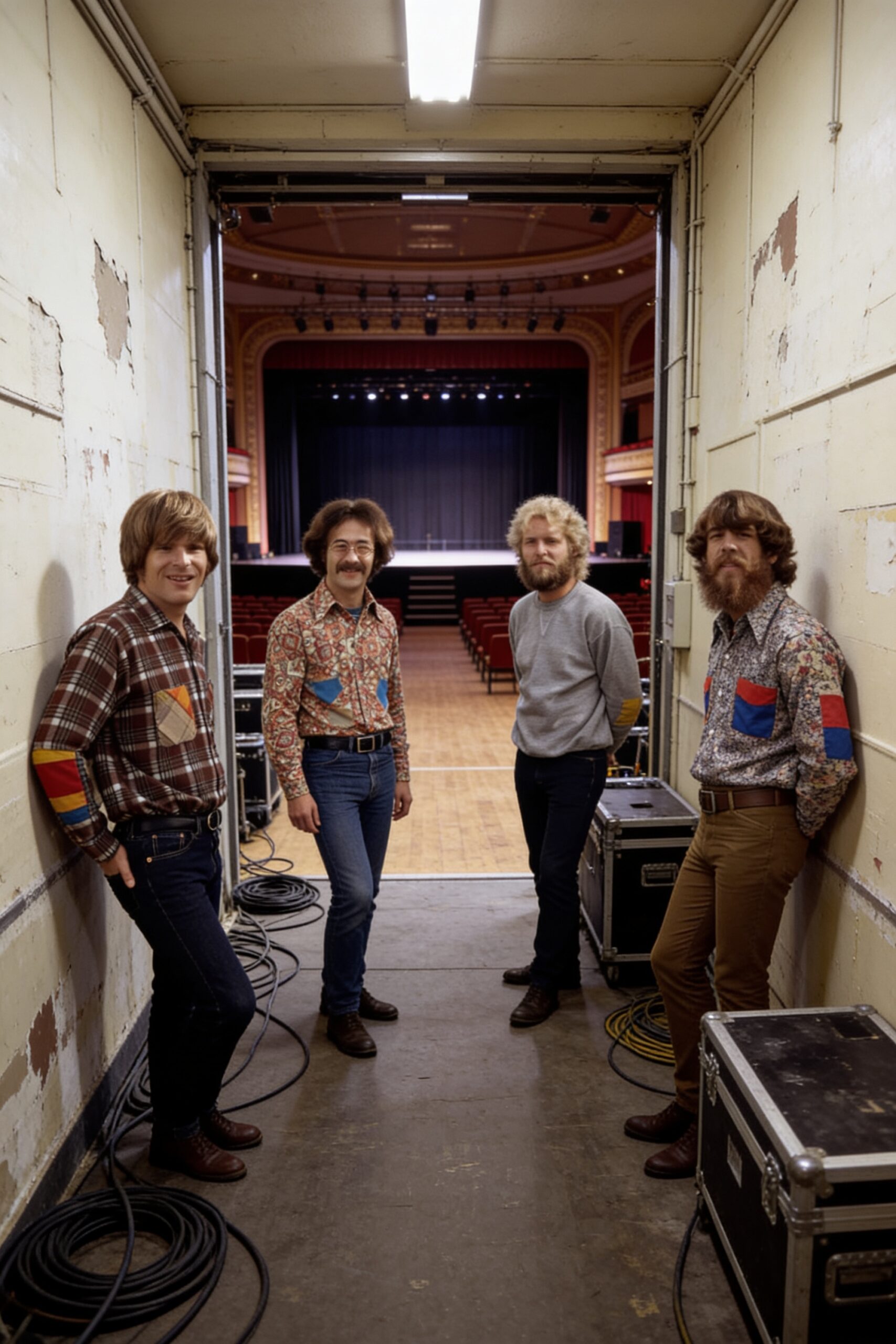
Before Creedence Clearwater Revival became shorthand for swamp-rock certainty, their Wilson Pickett cover showed a young band chasing total commitment, one hard groove at a time.
Creedence Clearwater Revival recorded “Ninety-Nine and a Half (Won’t Do)” for their self-titled 1968 debut album, turning a fierce Wilson Pickett soul statement into something leaner, rougher, and unmistakably their own. Written by Wilson Pickett, Steve Cropper, and Eddie Floyd, the song had already carried the snap and sanctified urgency of mid-1960s Southern soul. In CCR’s hands, it became part confession, part warning, part rehearsal-room challenge: not enough to feel something halfway, not enough to play it politely, not enough to coast on borrowed rhythm. The title itself demands all of the heart or nothing at all.
That demand suited the young band perfectly. Released in 1968 on Fantasy Records, Creedence Clearwater Revival arrived before the group’s astonishing run of hit singles fully took hold. It was the sound of a band still introducing its vocabulary: blues, R&B, rock and roll, country edges, gospel heat, and a California-born fascination with the imagined American South. The album also included their extended take on “Suzie Q” and a version of “I Put a Spell on You”, proof that CCR were not trying to enter the late-1960s rock conversation through ornament or abstraction. They were going straight to older sources, to riffs with dirt on them, to songs that felt as if they had already survived a few barrooms, church aisles, dance floors, and long highways.
What makes “Ninety-Nine and a Half (Won’t Do)” so revealing in the CCR catalog is not that it outshouts Pickett’s original. It does not need to. Pickett’s performance is built from soul authority, brass-driven insistence, and a singer who sounds as if he could push the room forward by force. CCR’s version comes from another corner of the same American map. The horns are gone, the structure is tightened into a guitar-band attack, and John Fogerty sings with the clipped, raspy pressure that would soon become one of rock’s most recognizable voices. He does not imitate Pickett so much as answer him from across a different floorboard: less preacher, more backwoods alarm bell, but still gripped by the same idea that half-hearted love, half-hearted faith, or half-hearted music simply will not stand.
The performance also shows how important groove was to CCR before fame hardened their image into radio shorthand. Doug Clifford and Stu Cook do not decorate the track; they hold it down with the kind of direct, muscular pulse that gave the band its authority. Tom Fogerty adds rhythm-guitar weight, helping make the arrangement feel spare but not thin. The song moves with economy, as if every extra gesture has been cut away so the central demand can keep hitting. That economy became one of Creedence’s great gifts. At a time when rock was stretching into long psychedelic forms, CCR often sounded radical by being concise, physical, and rooted.
Its later place in the band’s Woodstock story gives the cover another layer. Creedence Clearwater Revival performed at the festival in August 1969, during the long, sleep-bent stretch of the weekend when the event’s mythology was still being made in real time. By then the band had already broken through with songs like “Proud Mary”, “Bad Moon Rising”, and “Green River”. Yet in that famous setting, they still reached back to “Ninety-Nine and a Half (Won’t Do)”, a debut-album cover that connected their sudden rise to the R&B foundation underneath it.
That matters because Woodstock is often remembered through grand symbols: the crowd, the mud, the counterculture scale, the film that shaped public memory afterward. CCR’s own Woodstock set had a complicated afterlife, especially because it was not part of the original festival film and soundtrack in the way many other performances were. But hearing them bring “Ninety-Nine and a Half” into that field helps restore the band to its proper force. They were not merely a singles machine arriving with polished hits. They were a working rock and roll band with deep roots, carrying Wilson Pickett, Stax soul, blues discipline, and garage-band urgency into one of the largest gatherings American popular music had ever seen.
There is something fitting about that. A song built on the idea that ninety-nine and a half is not enough becomes, in CCR’s early story, a measure of artistic identity. The band did not sound as if it was looking for approval from fashion. It sounded as if it was testing whether old forms could still burn in a new decade. On the 1968 album, “Ninety-Nine and a Half (Won’t Do)” is a young group proving what it values. At Woodstock, it becomes a reminder that even in a field full of history, Creedence’s real power came from something plain and stubborn: four musicians driving a song until there was no room left for anything less than all of it.
