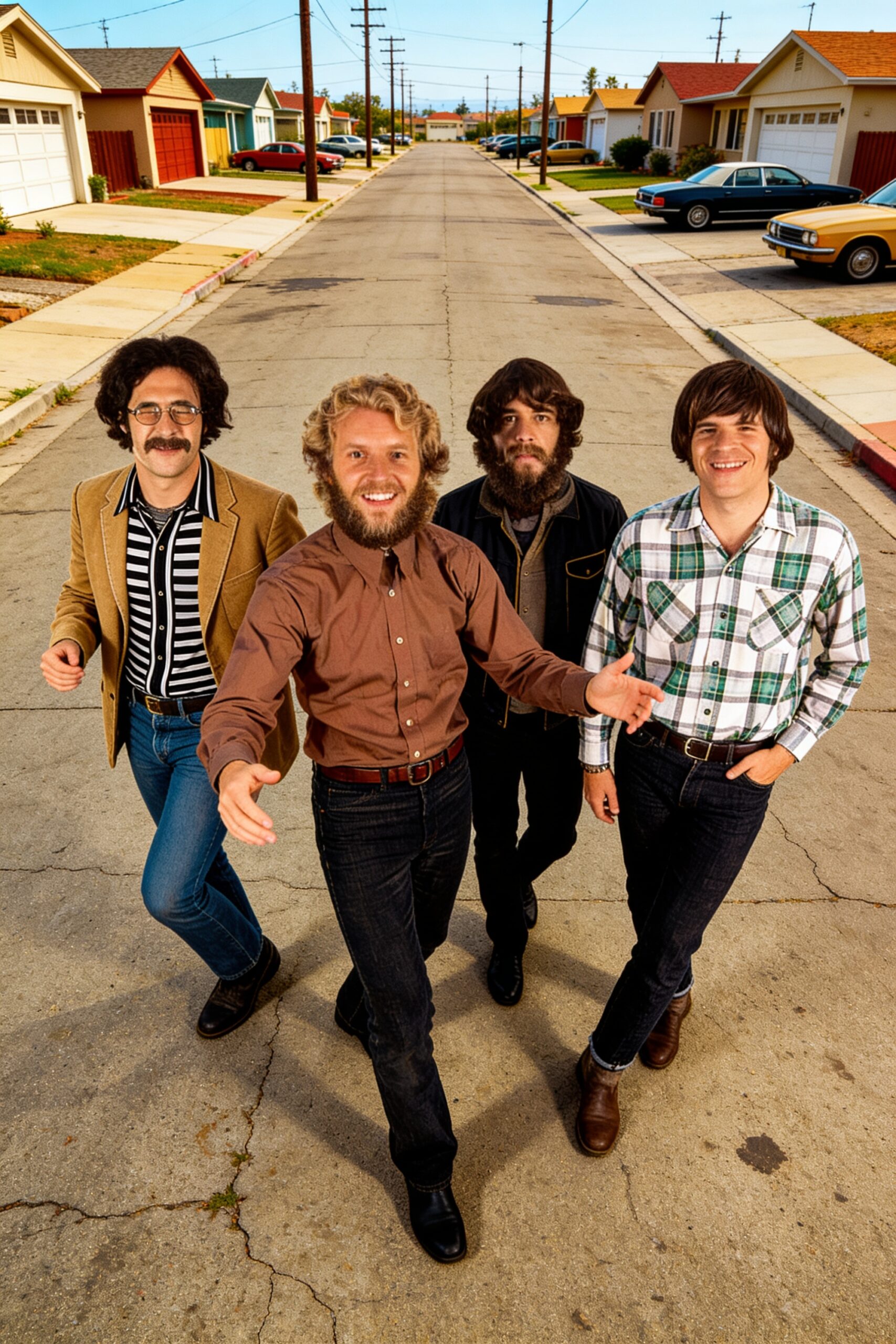
On Bayou Country, Creedence Clearwater Revival turned a Little Richard rocket into a swamp-rock test of nerve, with John Fogerty singing like the band had something to prove.
When Creedence Clearwater Revival placed their cover of Good Golly Miss Molly on the 1969 album Bayou Country, it did more than add a familiar early-rock title to the track list. It put the band in direct conversation with Little Richard, one of rock and roll’s most explosive architects, and it let John Fogerty test his lead vocal against a song already stamped with speed, swagger, and wild electricity. The album, released by Fantasy Records as CCR’s second LP, is usually remembered for Proud Mary, Born on the Bayou, and the long, rolling pull of Keep On Chooglin’. But this cover, opening the second side, catches something essential about the band at the moment their identity was hardening into shape.
Good Golly Miss Molly had arrived more than a decade earlier as part of Little Richard’s blazing run through the foundations of rock and roll. Written by Robert Blackwell and John Marascalco, and released by Little Richard in 1958, the song carried the kind of momentum that seemed to outrun the room it was recorded in. Little Richard’s voice did not merely sing the tune; it detonated it. His piano-driven version was frantic, joyous, and impossible to tidy up. For any later band, covering it meant facing a simple problem: how do you enter a song that already feels like it has reached the edge of human voltage?
CCR’s answer was not to compete with Little Richard on his own terms. Fogerty does not try to recreate the original’s gospel-fired abandon note for note. Instead, he tightens the song, darkens its edges, and drives it through the sturdy machinery of Creedence Clearwater Revival: Doug Clifford’s straight-ahead drumming, Stu Cook’s grounding bass, Tom Fogerty’s rhythm guitar support, and John Fogerty’s sharp, cutting guitar attack. The result is not polished reverence. It is a bar-band engine pushed hard enough to reveal the steel underneath. Where Little Richard’s version seems to leap upward, CCR’s version digs forward.
That difference matters because Bayou Country was the album where Creedence’s imaginary American landscape became unmistakable. The band came from the San Francisco Bay Area, not the Louisiana swamps, yet Fogerty was building a sound full of river images, humid grooves, working-class pressure, and a Southern vocabulary filtered through radio, records, and imagination. In that setting, Good Golly Miss Molly becomes more than a throwback. It becomes a reminder of what CCR owed to the first generation of rock and roll, even as they were shaping a leaner, earthier language of their own.
Fogerty’s lead vocal is the center of the performance. He sings with force, but the force is compressed. Little Richard turns the song into a shout of release; Fogerty turns it into a charge. There is less glitter, more gravel. He sounds less like a man throwing open the doors of a party and more like someone sprinting through a hot night with the band right behind him. That slight change in emotional temperature gives the cover its identity. It honors the original without pretending that CCR could, or should, become Little Richard for two and a half minutes.
The placement on Bayou Country also gives the cover a special kind of electricity. By the time a listener reaches it, the album has already established its deep, murky atmosphere with Born on the Bayou and Graveyard Train. Then suddenly, Good Golly Miss Molly breaks through with the directness of early rock and roll, almost like a flare shot into the swamp. It gives the record a jolt of ancestral memory. Before Creedence stretches out again, before Proud Mary rolls and Keep On Chooglin’ settles into its hypnotic endurance, this cover briefly pulls the band back toward the raw source.
That is why the track still feels revealing. It is not the most famous song on Bayou Country, and it was never meant to carry the album’s mythology by itself. But it shows Creedence Clearwater Revival in motion between tribute and transformation. They were not simply borrowing an old rock and roll standard; they were measuring themselves against it, finding the point where another artist’s fire could pass through their own wires and come out sounding unmistakably CCR. In Fogerty’s voice, Good Golly Miss Molly becomes a compact declaration: this band knew where the thunder came from, and they were ready to make it travel farther downriver.
