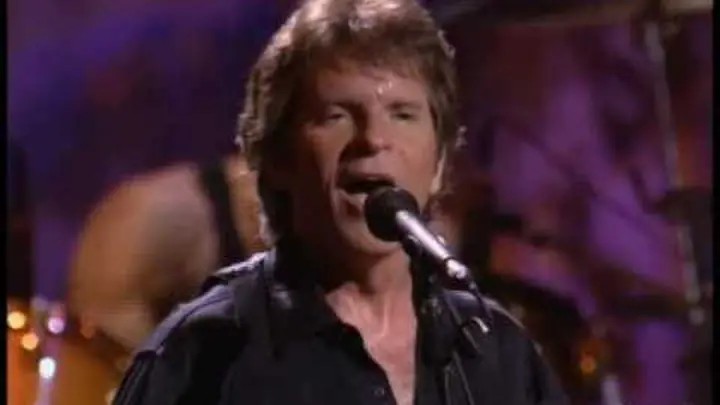
In John Fogerty’s 2018 standalone single, the search for treasure becomes a guitar conversation between two American roots-rock lifers.
Released in 2018 as a standalone single, “The Holy Grail” brought John Fogerty together with Billy F Gibbons of ZZ Top for a record that did not need an album around it to explain itself. The point was in the collision: Fogerty’s bayou-bred rock-and-roll urgency meeting Gibbons’ Texas-blues drawl, two voices and two guitars leaning into a swamp-boogie groove as if they had wandered into the same dusty room from different highways.
That pairing carries a certain natural logic. Fogerty’s sound has always had a strange geography of its own. In the late 1960s and early 1970s, with Creedence Clearwater Revival, he made California musicians sound as if they had been raised on river fog, roadhouse jukeboxes, gospel echoes, and backbeat radio. Gibbons, through ZZ Top, turned Texas blues into something dry, sharp, sly, and muscular, a sound that could be minimal on paper but enormous when it hit the speakers. Put them together on “The Holy Grail”, and the collaboration feels less like a novelty feature than a meeting of related dialects.
The song’s title points toward pursuit, appetite, and a kind of winking myth. A “holy grail” is supposed to be the object of a noble quest, something almost too pure to touch. But in Fogerty’s hands, especially with Gibbons at his side, the phrase becomes earthier. It is not wrapped in cathedral silence or grand ceremony. It is dragged into the world of riffs, grit, and rhythm. The record does not float; it shuffles, stomps, and grins. Its treasure is not polished gold but the stubborn pleasure of a groove that knows exactly where it wants to sit.
What makes the 2018 release interesting is how compact its statement is. Because “The Holy Grail” arrived as a standalone single, it feels like a flash of instinct rather than a carefully framed chapter in a larger album cycle. Fogerty was not introducing an entire new era with a long set of songs; he was sending out a concentrated burst of character. In that setting, Gibbons’ presence matters even more. His guitar and vocal texture are not decorative additions. They sharpen the record’s identity, giving Fogerty a second kind of gravel to push against.
Fogerty’s voice has always carried tension between command and impatience. He does not merely sing a line; he drives it forward, as though the band has to keep up with whatever is chasing him. On “The Holy Grail”, that familiar bite finds a rough companion in Gibbons’ lower, drier presence. The contrast is part of the pleasure. Fogerty cuts through the track with that clipped, urgent edge associated with swamp rock and American roots music; Gibbons answers with the cool burn of a bluesman who understands that a small phrase, placed correctly, can weigh more than a long speech.
The guitars speak in the same spirit. Neither musician needs to prove fluency. Fogerty’s playing has long been built around feel, concision, and rhythmic insistence, while Gibbons is famous for making tone itself feel like a personality. Their collaboration on this single is not about speed or excess. It is about texture: the scrape of strings, the pressure of the beat, the way a riff can suggest movement before the lyric has explained anything. That is where the swamp-boogie character of the track becomes more than a style label. It gives the song a body.
There is also a larger cultural echo in hearing these two together in 2018. Both men came from bands that helped define different corners of American rock radio, yet neither built a career on smoothness. Fogerty’s best-known work often sounds like folk memory thrown into a garage amplifier. Gibbons’ finest grooves often feel both relaxed and dangerous, full of space but never empty. “The Holy Grail” benefits from that shared belief in economy. It understands that older forms do not become stale when the players still know how to inhabit them.
In a music world often drawn toward spectacle, the single’s charm lies in its refusal to overcomplicate the meeting. It gives listeners the simple, durable thrill of two recognizable musical temperaments locking into a riff and letting the room fill with character. The song is playful, but not lightweight. It carries the confidence of musicians who do not have to shout for authority. They can lean on a groove, trade grit, and let the title’s grand promise come down to something wonderfully physical: a voice, a guitar, a pulse, and the old American art of making a small song feel like a weather system moving in.
That is why John Fogerty and Billy F Gibbons make such a satisfying pair on “The Holy Grail”. The record is not a reinvention of either man. It is a reminder that certain musical languages remain alive when spoken by people who helped shape them. The grail, in the end, may not be some distant prize at all. It may be the moment when two seasoned players meet inside a groove and make the familiar road sound newly traveled.
