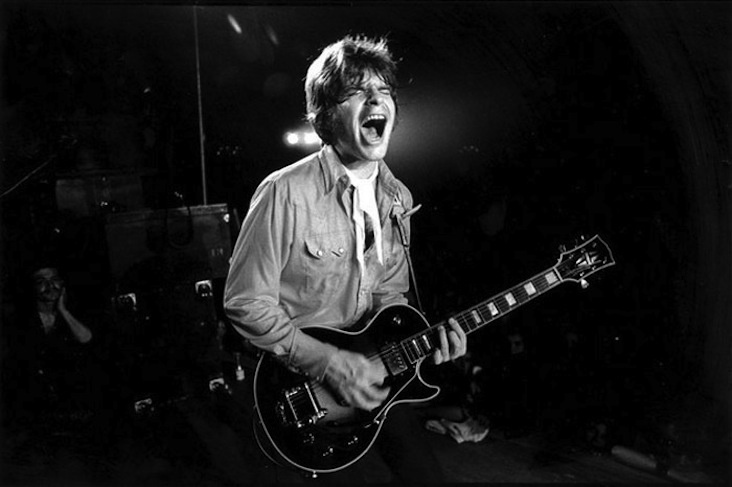
At the moment after Creedence, John Fogerty reached for an old country wound and made it sound like a man learning how to stand alone.
John Fogerty recorded his cover of “She Thinks I Still Care” for The Blue Ridge Rangers, his 1973 solo debut released after the collapse of Creedence Clearwater Revival. The album carried the name of a band, but the band was really Fogerty himself: singing the parts, playing the instruments, and building a roots-music world alone in the studio. That detail gives this country classic a special charge. It was not simply a famous rock singer borrowing a beloved song. It was Fogerty stepping into a new life by turning backward toward the music that had shaped him long before fame made everything louder.
The song itself already came with a heavy history. Written by Dickey Lee and Steve Duffy, “She Thinks I Still Care” had become one of George Jones’ defining recordings after his 1962 version rose to No. 1 on the country chart. Jones sang it like a man trying to talk his way out of an emotional truth that everyone else could hear. The narrator keeps insisting that his former love has misunderstood him. If he asks about her, if he says her name, if he appears in places where her memory lingers, she only “thinks” he still cares. The comedy of denial is there, but so is the ache. Every excuse confirms the very feeling he tries to deny.
For Fogerty to choose that song in 1973 was telling. He had just come out of one of American rock’s most recognizable bands, a group whose records sounded as if they had been cut from river mud, jukebox electricity, gospel memory, and back-porch discipline. With Creedence, he had been the voice, the principal songwriter, the producer, and the driving musical force behind songs that felt older than their calendar dates. Yet when it came time to introduce himself outside the group, he did not begin with a grand personal statement or a polished set of new confessions. He made The Blue Ridge Rangers, a record of country, gospel, and early American songs that sounded like a private map of influence.
That makes “She Thinks I Still Care” more than a cover. It sits at the center of a transition. Fogerty was not pretending to be George Jones, and he was not trying to turn the song into a Creedence Clearwater Revival number. His version carries the plainspoken directness that had always made his best singing feel close to the ground. There is less of the swamp-rock roar and more of a man standing in a room with the song, letting its old contradiction do its work. The arrangement does not need to dress up the wound. The power lies in the distance between the narrator’s casual tone and the emotional evidence scattered all around him.
Fogerty had always understood country music as more than decoration. Long before The Blue Ridge Rangers, Creedence records had carried the tug of Hank Williams, hillbilly radio, blues, gospel, rockabilly, and the regional imagination of the American South, even though Fogerty himself came from California. He knew how to make a song feel located somewhere deeper than geography. On this album, he removed the band identity that had made him famous and let the older songs speak with very little protection. It was an unusual move for a major rock figure at the time: not a bid for reinvention through modern sound, but a retreat into the roots beneath the floorboards.
There is something quietly revealing about hearing Fogerty sing a song built on denial just as he was moving away from a band that had defined him. The lyric is about a man insisting that his past no longer has power over him, while his behavior proves otherwise. In the context of 1973, that tension becomes impossible not to feel. Fogerty did not have to announce anything autobiographical for the song to gather extra meaning. The very act of choosing it, placing it among the songs of The Blue Ridge Rangers, and performing it by himself gives the record a private edge. He was honoring tradition, but he was also finding shelter inside it.
Unlike the original George Jones recording, which is inseparable from Jones’s genius for emotional collapse under restraint, Fogerty’s reading has the feel of a craftsman testing his balance. His voice does not plead in the same way. It presses forward, clipped and clear, with that familiar nasal bite softened by the country frame. The result is not imitation but translation. The song’s sad little joke remains intact, yet it begins to sound like a man trying to keep moving, even while a part of him keeps looking back.
That is why this cover still matters inside Fogerty’s story. The Blue Ridge Rangers was a debut, but it was also a pause between identities. It gave him room to acknowledge the music that had fed his imagination before he had to decide what John Fogerty, solo artist, would become. In “She Thinks I Still Care”, he found a perfect vessel for that uncertain space: a country standard about pretending not to care, sung by an artist who had every reason to prove he could go on, and every reason to know that the past still had a voice.
He did not need to make the song bigger. He only needed to step inside it. The old melody, the careful denial, the familiar ache, and the one-man-band setting all point to the same truth: sometimes a cover is not an escape from personal history, but a way of approaching it without saying too much. Fogerty’s “She Thinks I Still Care” remains a modest recording on the surface, yet it opens a revealing door into the lonely, disciplined, deeply musical passage from Creedence to whatever came next.
