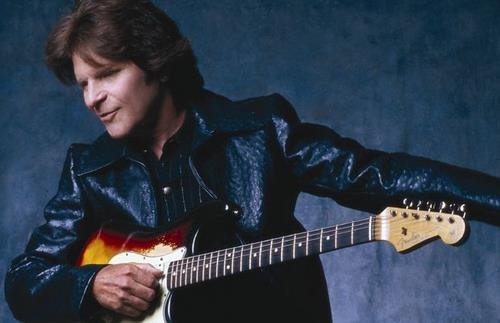
On a reflective 2004 solo album, John Fogerty suddenly kicked open a side door with a short, sharp burst of punk-rock nerve.
John Fogerty released Déjà Vu All Over Again in 2004, a solo album that arrived after the rootsy confidence of Blue Moon Swamp and long after his voice had become part of the permanent weather of American rock. Tucked inside that record was She’s Got Baggage, a song that still stands out because it refuses to behave like the kind of Fogerty track many listeners expected. It is brisk, lean, impatient, and edged with a punk-rock snap that makes it feel less like a formal experiment than a man throwing a lit match into his own familiar sound.
That surprise matters because Fogerty’s solo legacy is often heard through the long echo of Creedence Clearwater Revival: the swamp-rock pulse, the front-porch toughness, the concise storytelling, the guitars that sounded as if they had dust on their boots. Even his strongest solo work, from the comeback glow of Centerfield to the earthy authority of Blue Moon Swamp, carried some connection to that language. Fogerty never needed much ornament. He built his reputation on directness: a riff, a voice, a beat, a line that could hit like a headline and linger like a memory.
She’s Got Baggage uses that directness differently. Rather than stretching out into classic rock comfort, it tightens its fists. The rhythm pushes forward with little patience for scenery. The guitar tone has a clipped attack, the kind of sound that seems to favor friction over warmth. The title itself is comic and cutting at once, a compact phrase with enough attitude to feel like a warning sign. But the real point is not that Fogerty suddenly became a punk singer in the strict historical sense. The point is that he understood something punk always understood: speed can strip a song down to its argument.
By 2004, punk was no longer only the property of young clubs and torn amplifiers. It had become part of rock’s shared vocabulary, a way of signaling impatience, refusal, and the need to get to the point before the room has time to soften. Fogerty, however, did not approach it as a costume. His connection to that energy runs deeper than fashion. Long before punk had a name, early rock and roll, rockabilly, R&B, and garage-band music had already taught musicians the value of compression. Fogerty came from that older school of urgency. He knew how much could be done in two or three minutes if the band did not waste a motion.
That is what makes the track feel credible inside his catalog. She’s Got Baggage does not abandon the old Fogerty virtues; it pushes them into a more jagged frame. The vocal still has that unmistakable nasal bite, the sense of a singer leaning into a line as if it has to be delivered before it burns his tongue. The writing still favors blunt edges over polished confession. Yet the arrangement gives the song a different emotional weather. It is not swampy, not expansive, not especially nostalgic. It sounds like forward motion with no scenic route.
On Déjà Vu All Over Again, that matters. The album’s title track carried a pointed feeling of history circling back on itself, with Fogerty looking at public life through the eyes of someone who had already lived through one American era of division and noise. Against that reflective mood, She’s Got Baggage works like a jolt of private combustion. It does not carry the same public weight, but it adds texture to the album’s emotional range. It shows Fogerty not only as a guardian of a classic sound, but as an older rock and roll craftsman still willing to jab at the walls of expectation.
There is a temptation, when talking about artists with long histories, to treat every unexpected move as either a reinvention or a misstep. This one is more interesting than either label. She’s Got Baggage feels like a brief detour taken by someone who knows exactly where he comes from. It is not an attempt to erase the past. It is a reminder that the past itself contained plenty of roughness, speed, sarcasm, and impatience. Fogerty did not have to borrow punk’s spirit from another generation; he could recognize it as a younger cousin of the raw rock and roll energy he had always trusted.
That is why the song deserves more than a footnote in discussions of his solo years. It reveals a version of John Fogerty that is restless in a small but telling way. He was not simply polishing a legacy, nor was he chasing a trend. He was testing the pressure inside his own musical instincts, seeing what happened when the familiar snap of his writing was driven harder, faster, and with less room to breathe.
In the end, She’s Got Baggage lasts in memory because it feels a little unruly. It does not ask to be monumental. It simply kicks in, says its piece, and leaves behind the sensation of a veteran rocker refusing to let his sound become too well-mannered. Inside Fogerty’s solo legacy, that small refusal has its own kind of force.
