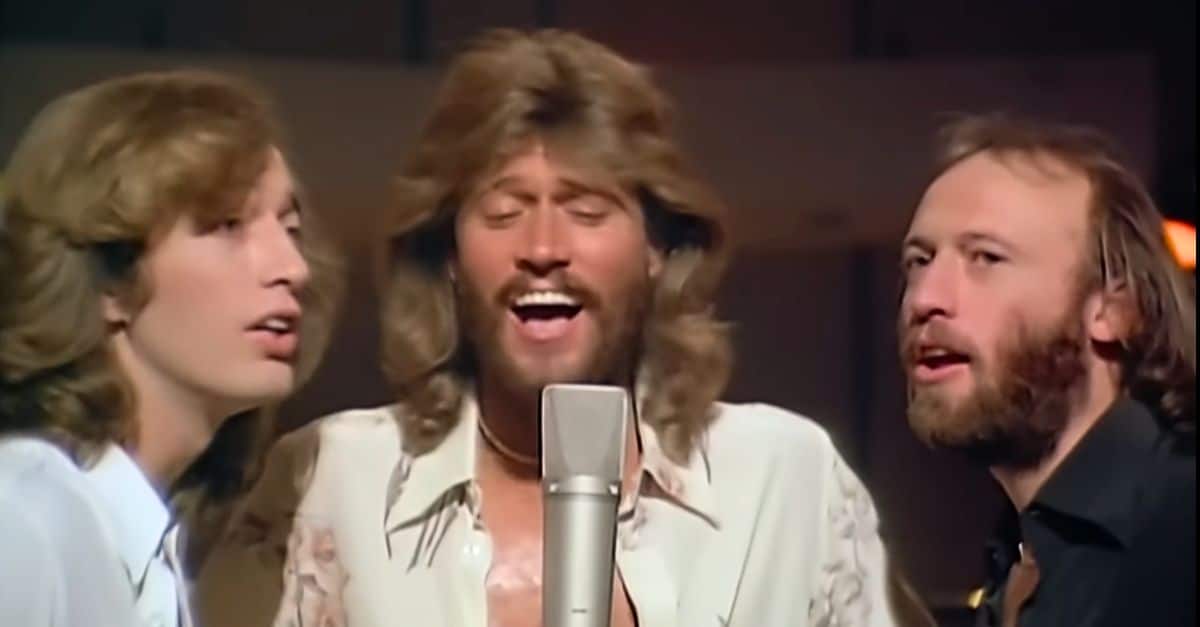
Before the Bee Gees became a sound of glittering dance floors, “Lion in Winter” caught Barry and Robin Gibb in a cooler, more reflective light, where harmony felt like memory and restraint carried its own drama.
“Lion in Winter” appears on the Bee Gees album Trafalgar, released in 1971, during a period when the group was still moving through the shadowed, orchestral, folk-rock-leaning territory that defined much of their late-sixties and early-seventies work. The album is often remembered first for “How Can You Mend a Broken Heart”, the Barry and Robin Gibb ballad that became the Bee Gees’ first No. 1 single in the United States. Yet tucked deeper into the record, “Lion in Winter” offers a different kind of reward: not the grand public arrival of a hit single, but the private glow of an album track that reveals how beautifully the brothers could shape tension with little more than melody, phrasing, and the strange closeness of voices that knew each other before they knew fame.
Credited to Barry Gibb and Robin Gibb, the song sits near the end of Trafalgar, where the album’s mood has grown more inward. By 1971, the Bee Gees had already lived through more musical turns than many bands manage in a lifetime. They had emerged from the ornate pop of the 1960s, weathered internal fractures, returned to one another, and were now recording with a seriousness that often sounded less like youth chasing fashion than young men trying to understand the cost of feeling too much. Trafalgar was produced by the group with Robert Stigwood, and its best moments carry that early-seventies sense of formal craft: careful arrangements, measured drama, and songs that seemed to look backward and forward at once.
What makes “Lion in Winter” especially compelling is the way it showcases the vocal relationship between Barry and Robin without turning it into a display. Barry’s voice, even before the world came to associate him with the high falsetto of the disco years, had a finely controlled warmth and a gift for soft insistence. Robin’s voice, with its tremulous edge and almost medieval ache, could make a phrase feel both wounded and dignified. Together, they did not simply harmonize in the usual sense. They created a third emotional presence, a shared tone that seemed to belong to the family itself.
The title alone suggests distance and age, even though the singers were still young men. A lion in winter is not merely powerful; it is power made reflective, strength surrounded by cold air. Whether heard as a character study, a romantic lament, or a symbolic piece in the broader atmosphere of the album, the song carries the feeling of someone standing at the edge of something already passing. That quality suited the Bee Gees of this era. Their music then was full of rooms, thresholds, recollections, and separations. Even when the arrangements swelled, the emotional center often remained quiet, as if the real story were happening behind the singer’s eyes.
Musically, “Lion in Winter” belongs to the Bee Gees’ pre-disco world, where folk-rock touches, chamber-pop instincts, and dramatic ballad writing could all meet inside the same song. The rhythm does not push for easy release. The performance seems to lean into atmosphere rather than spectacle. There is a sense of acoustic gravity in the writing, the kind of early-seventies texture that made space for introspection. In that setting, the Barry-and-Robin blend becomes the song’s emotional architecture. Their voices do not cancel each other out; they shade each other, one bringing steadiness, the other bringing ache.
Listening to it within Trafalgar also changes the way the song lands. The album’s title and cover art carry historical and maritime associations, and the music often feels grand without being triumphant. Songs such as “Don’t Wanna Live Inside Myself” and “Walking Back to Waterloo” share a fascination with inner retreat, memory, and loss of certainty. “Lion in Winter” fits that emotional weather. It is not the track that usually leads conversations about the album, but it helps explain the album’s character: dignified, melancholy, and finely made.
For listeners who know the Bee Gees mainly through the brilliance and velocity of their later reinvention, “Lion in Winter” can feel like opening a side door into another house entirely. There are no flashing lights here, no rhythmic command designed to take over a room. Instead, there is craft under restraint, melody shaped by sibling instinct, and a mood that asks to be entered slowly. The song reminds us that the Bee Gees were never a single story. They were ballad writers, harmony singers, dramatists, pop craftsmen, and restless survivors of changing taste.
That is why this album track still deserves attention. It does not ask to be remembered through chart statistics or public triumph. It survives through tone. It is there in the way Barry and Robin seem to approach the same emotion from different sides, in the way the melody carries itself without hurry, in the way the song makes winter feel less like an ending than a condition of reflection. “Lion in Winter” may be a quiet corner of Trafalgar, but in that quietness, the Bee Gees reveal one of their deepest gifts: the ability to make a small song feel inhabited by years.
