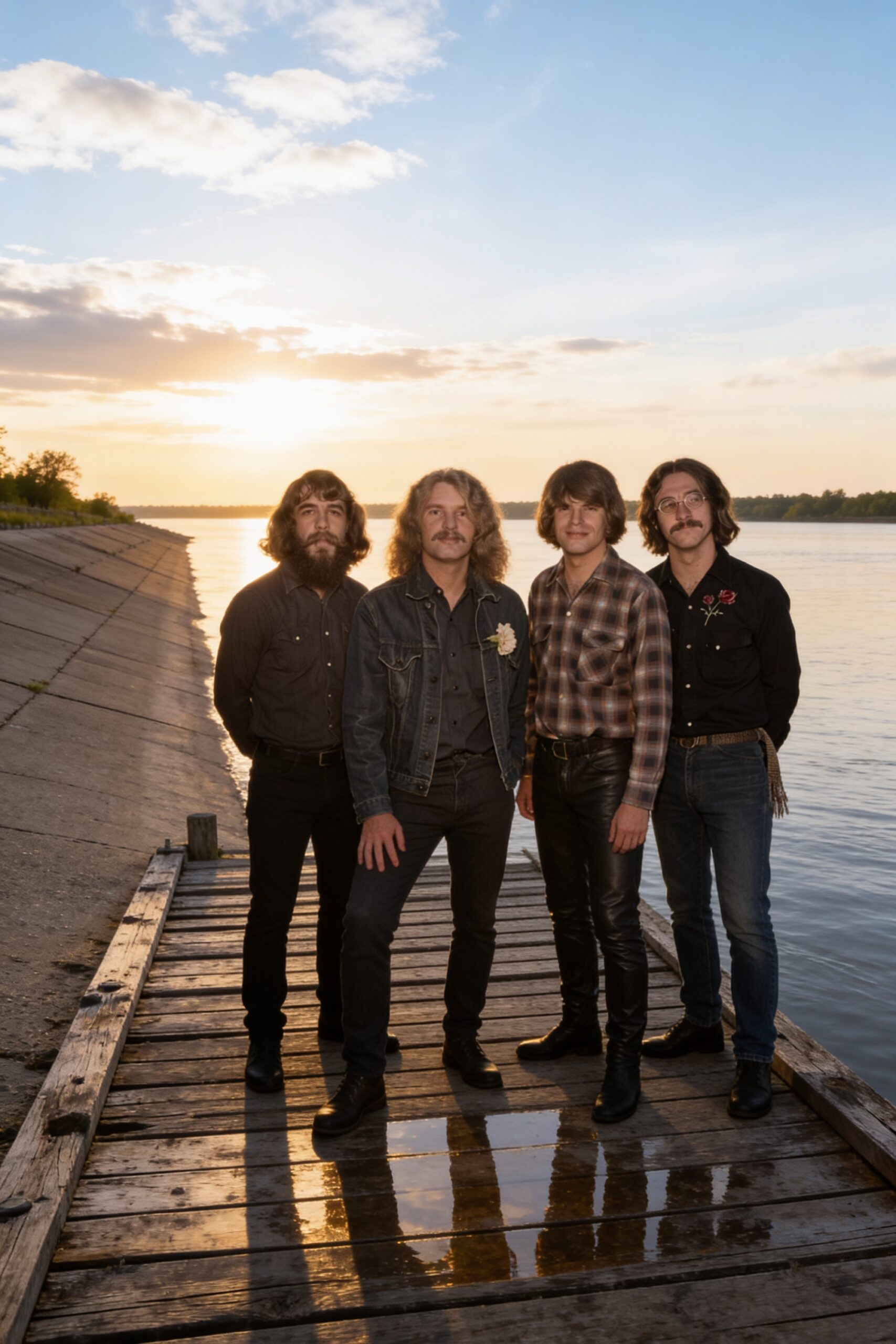
On a record crowded with sharp stories and workingman warnings, “Side o’ the Road” pauses the talk and lets John Fogerty’s guitar speak in plain, stubborn heat.
Released in 1969 on Creedence Clearwater Revival’s fourth studio album, Willy and the Poor Boys, “Side o’ the Road” occupies a curious and rewarding corner of the band’s catalog. It is not one of the album’s famous radio landmarks like “Down on the Corner” or “Fortunate Son.” It does not carry the moral stare of “Don’t Look Now” or the long-shadowed unease of “Effigy.” It has no lyric at all. Instead, it stands as a lean instrumental deep cut, a short burst of groove and guitar attitude that reminds listeners how much of Creedence’s identity lived not only in Fogerty’s voice, but in the way his guitar could bark, bend, answer, and prowl.
That matters because Willy and the Poor Boys is often remembered as one of Creedence’s most pointed albums. Arriving during an astonishingly productive year for the band, it followed Bayou Country and Green River, both also released in 1969, and it found the group sharpening its version of American roots music into something both old-fashioned and urgently current. The album’s cover and loose street-corner-band concept suggested a rough democratic music made close to the ground: jug-band echoes, blues feeling, country memory, rock-and-roll economy. Yet beneath that approachable surface were some of Fogerty’s clearest observations about class, war, labor, and power. In that setting, “Side o’ the Road” works almost like a breather, but not a throwaway. It is the sound of the band stepping aside from the message for a moment and proving that its instrumental engine was just as tough as its songwriting.
Creedence was never a band that needed excess to make its point. The classic lineup of John Fogerty, Tom Fogerty, Stu Cook, and Doug Clifford was built around compression, drive, and discipline. They made records that sounded direct even when the ingredients were drawn from many places: blues, rockabilly, gospel, country, R&B, and the imagined bayou world that Fogerty, a California songwriter, shaped with remarkable conviction. “Side o’ the Road” fits that philosophy. It does not wander into a long psychedelic showcase, even though 1969 was full of bands stretching songs into open-ended jams. Creedence keeps the piece tight. The thrill comes from its compactness: a riff pushed forward, a rhythm section holding the road steady, and Fogerty’s lead guitar cutting through with a tone that feels dry, bright, and slightly dangerous.
What makes the track stand out is the way it reveals a different kind of John Fogerty. The world knows him first as a singer with one of rock’s most unmistakable voices, a songwriter who could make a three-minute record feel like a front-porch argument, a newspaper headline, and a Saturday-night dance all at once. But “Side o’ the Road” removes the vocal center and leaves the listener with his hands. The guitar lines are not ornamental; they carry the personality of the piece. They snarl where a lyric might accuse, lean back where a singer might pause, and return to the groove with the confidence of a band that understands exactly how little it needs.
There is also a subtle humor in its placement. On an album where Creedence could sound like traveling players setting up on a corner, “Side o’ the Road” feels like the part of the evening when nobody announces the next number. Someone simply starts playing. The song’s title even suggests a casual geography: not a grand stage, not a polished ballroom, but a patch of earth just off the main route, a place where the band can kick up dust without explaining itself. That image suits Creedence beautifully. Their greatest recordings often feel as if they are coming from the edge of town, close enough to the crowd to be communal, far enough from respectability to stay free.
As an album deep cut, “Side o’ the Road” also helps correct a narrow view of Creedence Clearwater Revival. Because the band produced so many durable singles in such a short span, it is easy to hear them only as a hit-making machine. But the albums tell a broader story. They show a working band thinking about sequence, mood, contrast, and texture. Willy and the Poor Boys is not just a container for famous songs; it is a record with movement. The instrumentals and roots-minded pieces help create the atmosphere that allows the sharper political numbers to land with more force. Without those side roads, the main road would feel less lived-in.
Heard today, “Side o’ the Road” still has the appeal of something unpolished in the best sense: concise, physical, and unpretentious. It does not ask to be decoded. It asks to be felt in the shoulders, in the foot, in the little spark of recognition that comes when a band locks into a groove and trusts it. For a group so closely associated with the sound of Fogerty’s voice, this instrumental reminds us that Creedence had another voice running through the amplifiers. It was a guitar voice, wiry and restless, carrying the same grit as the songs but speaking in bends, attacks, and spaces. On “Side o’ the Road,” the band does not need a chorus to leave a mark. It just pulls over, plugs in, and lets the road dust rise.
