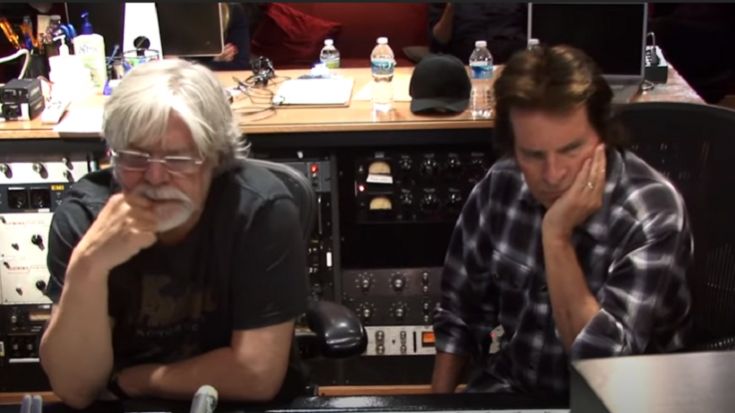
On “Nobody’s Here Anymore”, John Fogerty turns absence into atmosphere, and Mark Knopfler’s guest guitar gives that emptiness a second, deeply human voice.
When John Fogerty released Déjà Vu All Over Again in 2004, one detail on the album carried a special kind of quiet intrigue: “Nobody’s Here Anymore” features a guest guitar performance by Mark Knopfler. For listeners who grew up with both men, that is the sort of pairing that immediately sparks curiosity. These are two players whose sound can be recognized in a few notes, yet they come from different kinds of musical pressure. Fogerty has always had that direct, grainy force, the feeling of a singer and guitarist who believes a song should get to the point and leave a mark. Knopfler, by contrast, often works through nuance, contour, and understatement. Bringing those two sensibilities together on a song about absence was not an obvious stunt. It was something better: a meeting built on restraint.
Déjà Vu All Over Again arrived as Fogerty’s first studio album of new material since Blue Moon Swamp in 1997. By then, he had long since moved beyond the need to prove his place in rock history. His work with Creedence Clearwater Revival had already secured that. What made the 2004 album interesting was its mood: part public witness, part private reckoning. The title track looked outward at war and repetition in American life, but elsewhere the record often felt more personal, more interior. “Nobody’s Here Anymore” belongs to that inward side of the album. It is not the record’s most confrontational moment, and that is exactly why it lingers.
Written by Fogerty, the song suggests a room after the conversation has ended, a place where memory is still present even when the people are not. The title itself carries a plainspoken ache. There is nothing ornate about it, nothing dressed up for effect. That plainness has always been one of Fogerty’s gifts. He can make simple language feel lived in, as if the line was not manufactured for a record but found in the air after something important has already happened. On “Nobody’s Here Anymore”, that quality matters. The song does not push toward grand declaration. It lets space do part of the work, and that makes every musical decision count a little more.
This is where Mark Knopfler becomes more than a notable credit in the liner notes. His guest guitar performance does not turn the track into a summit meeting or a show of virtuosity. It deepens the emotional architecture. By 2004, Knopfler had already spent decades defining a guitar language that could feel conversational rather than demonstrative, first with Dire Straits and then in his solo work, where folk, blues, country, and narrative songwriting often sat close together. On a Fogerty song, that touch is especially revealing. Instead of trying to match Fogerty’s toughness blow for blow, Knopfler brings patience. He shades the edges. He gives the song a sense of distance and afterthought, which is exactly what a piece about emptiness needs.
What makes the collaboration so satisfying is that neither artist has to become less himself in order for the song to work. Fogerty still sounds like Fogerty: grounded, weathered, unadorned, with that unmistakable ability to make even reflective material feel sturdy. Knopfler still sounds like Knopfler: measured, melodic, and subtle in a way that can alter the emotional temperature of a track without calling attention to itself. The result is not fusion for its own sake. It is contrast serving the song. One musician brings the weight of the statement; the other brings the afterglow around it.
That kind of maturity is easy to overlook because it does not arrive with fireworks. In a younger artist, a collaboration like this might have been framed as an event, sold on novelty alone. But “Nobody’s Here Anymore” feels almost anti-spectacle. It asks the listener to lean in. It trusts that experience can be heard in small decisions: when not to crowd a phrase, when to leave air in the arrangement, when a guitar line should answer a vocal instead of compete with it. That is one of the quiet pleasures of late-career records made by artists who no longer need to chase volume or fashion. They can let craft and instinct carry the meaning.
There is also something fitting about these two musicians meeting on this particular ground. Fogerty’s songwriting has always drawn power from American roots forms, even when filtered through the hard efficiency of rock and roll. Knopfler, though shaped by a different scene and a different accent, has long been drawn to many of the same traditions: country textures, blues feeling, storytelling detail, the dignity of understatement. On “Nobody’s Here Anymore”, those affinities are not announced; they are simply lived out in the music. The collaboration works because it sounds less like a crossover and more like a recognition.
That may be why the song continues to reward close listening. It is not built to dominate a room. It lives in subtler territory, where tone, timing, and emotional discipline matter as much as melody. Fogerty gives the song its plainspoken center. Knopfler adds a ghostly kind of companionship around that center, the feeling that even solitude can have echoes. Together, they make “Nobody’s Here Anymore” feel richer than its title first suggests. It becomes not just a song about someone missing, but a study in what seasoned musicians can do when they trust quietness, trust each other, and let the unsaid remain part of the performance.
In the end, that is the real strength of this collaboration. It does not ask to be admired from a distance as a piece of rock-star trivia. It asks to be heard as a conversation. And in that conversation, John Fogerty and Mark Knopfler find common ground not in volume, but in precision, patience, and the kind of musical empathy that only sounds effortless because both men know exactly how much to leave behind.
