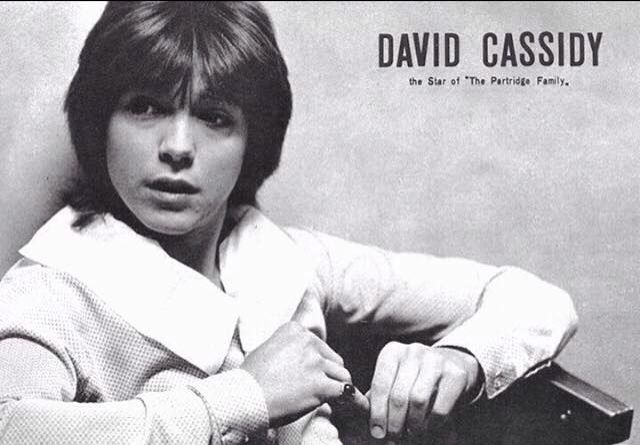
Cruise to Harlem catches David Cassidy in motion, leaving the safe frame of teen stardom for a wider, more complicated American sound in 1976.
In 1976, on the album Gettin’ It in the Street, David Cassidy recorded Cruise to Harlem, a track that still feels quietly surprising before it even begins. The credits tell part of the story: Cassidy wrote it with Brian Wilson of the Beach Boys and Gerry Beckley of America. That alone places the song in a fascinating corner of the decade. Here was one of the most famous faces of early-1970s television pop reaching beyond the image that made him a sensation, linking himself to two songwriters associated with California sophistication, melodic craft, and a more adult kind of radio listening. Cruise to Harlem may not be the first title most people remember when Cassidy’s name comes up, but it reveals something essential about where he was trying to go.
That matters because Gettin’ It in the Street belongs to the phase of Cassidy’s career when simple nostalgia no longer served him. The frenzy of The Partridge Family and the scream-driven celebrity surrounding his early fame had fixed him in the public imagination as a youthful idol. By the mid-1970s, that image was both an asset and a trap. Records like this one show him trying to step out of the poster and back into the wider musical world as a working adult artist. He was not the only star of the era forced into that transition, but few examples are as revealing as an album track like Cruise to Harlem, where the ambition is audible in the choice of collaborators, in the title, and in the atmosphere the song tries to create.
Seeing Brian Wilson and Gerry Beckley on the same writing line is more than a trivia note. It is a small map of 1970s American pop. Wilson brought with him the restless melodic intelligence and emotional complexity that had already made his name stand for something larger than ordinary hitmaking. Beckley, through America, represented a different but equally recognizable strand of the decade: polished songwriting, open-road ease, and a soft-rock surface that could still carry real craft beneath it. Add David Cassidy to that mix and the song begins to look like a crossroads. It joins television fame, West Coast studio imagination, and a hunger for reinvention in a single three-name collaboration. Even before one talks about the music itself, the song already feels like a document of artists crossing lanes.
The title is part of the reason the track invites a cultural reading. Harlem is not just a place-name tossed into a lyric for flavor. In American music, it carries decades of history: jazz rooms, church harmonies, soul authority, literary memory, style, political language, and the sense of a neighborhood standing at the center of so much Black cultural life. When a mid-1970s pop artist like Cassidy records a song called Cruise to Harlem, the record enters a larger conversation about how mainstream pop borrowed, admired, stylized, and sometimes simplified the meanings attached to real places. The song does not have to be heard as a street-level portrait to be interesting. In some ways, it is more revealing as an example of how the era imagined urban energy and musical seriousness through destination, motion, and atmosphere.
That sense of motion fits the wider climate of 1976. American pop was no longer organized around one dominant center. Disco was rising fast, singer-songwriters were refining confessional polish, soul and funk remained foundational, and FM rock was encouraging artists to think in terms of albums, texture, and mood rather than only singles. In that environment, a performer like Cassidy could no longer survive on familiarity alone. He had to find a setting that sounded contemporary without pretending to be someone else entirely. Gettin’ It in the Street suggests exactly that effort, and Cruise to Harlem sits near the heart of it. Even the language feels right for its moment: getting in the street, cruising, heading toward somewhere charged with significance. It is the vocabulary of movement, and movement is what Cassidy needed most.
What makes the track resonate now is not that it solves the question of who David Cassidy was after teen-idol fame. It is that it lets us hear the question being asked in real time. In a song like this, he is no longer protected by the clean, sealed frame of his earliest image. The material asks for a more grounded presence, something less ornamental and more self-possessed. Heard in the context of the album, Cruise to Harlem belongs to a more mature, groove-conscious, city-facing version of Cassidy than the one mass culture first embraced. The appeal is not perfection. The appeal is transition. Songs like this preserve the moment when an artist is still testing how much weight his voice can carry once youth is no longer the entire story.
That is also why overlooked songs often outlast bigger narratives. The major hits become shorthand; they arrive preloaded with memory, image, and public agreement. A track like Cruise to Harlem keeps more of its mystery. It has room for listeners to notice details that a giant single can no longer hide: the taste level behind the collaboration, the cultural reach of the title, the way an artist uses an album track to announce a change that radio may never fully reward. It becomes easier, with time, to hear not what the marketplace decided, but what the musician was reaching for.
So Cruise to Harlem endures as more than a curious credit or a footnote to Gettin’ It in the Street. It captures a very specific American moment, when geography, genre, celebrity, and aspiration were all being remixed at once. A former television phenomenon tried to sound like a man in motion. A Beach Boys visionary and a writer from America helped shape the route. And the result, decades later, still carries the restless feeling of a culture changing lanes. That is often where the most revealing music lives: not in the fully settled image, but in the stretch of road between one identity and the next.
